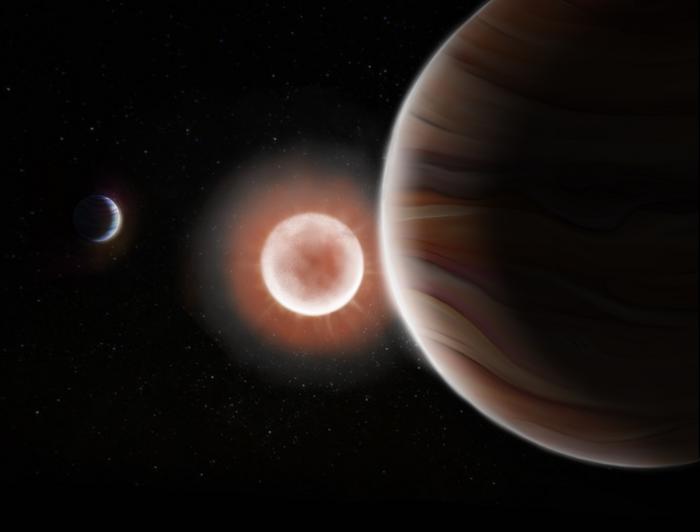
Scientists from The University of New Mexico (UNM), and Massachusetts Institute of Technology (MIT) have detected and validated two of the longest-period exoplanets found by TESS to date. These long period large exoplanets orbit a K dwarf star and belong to a class of planets known as warm Jupiters, which have orbital periods of 10-200 days and are at least six times Earth’s radius. This recent discovery offers exciting research opportunities for the future of finding long-period planets that resemble those in our own solar system.

The research titled, TOI-4600 b and c: Two long-period giant planets orbiting an early K dwarf will be published in a future issue of The Astrophysical Journal Letters. The exoplanets, TOI-4600 b and c, were detected using photometric data from the Transiting Exoplanet Survey Satellite (TESS) and followed up with observations using the telescopes on the ground since they provide better resolution.

The observing strategy adopted by NASA’s TESS, which divides each hemisphere into 13 sectors that are surveyed for roughly 28 days, is producing the most comprehensive all-sky search for transiting planets. This approach has already proven its capability to detect both large and small planets around different kinds of stars. In the case of TOI-4600, the star is a K dwarf star, also known as an orange dwarf, which are stars slightly smaller and cooler than the Sun.


For the ornithologically inclined or the nerd who loves owlish humor, this T-shirt knows whoooo makes science fun! The comfy premium tee is ideal for hitting the books or the lab, going on nature walks to birdwatch, or just making your fellow owl and science fans smile. Hoot hoot – time to fly to the top of the class armed with curiosity and wordplay!

Exoplanets must transit their host stars at least twice within TESS ‘s observing span to be detected with the correct period by the Science Processing Operations Center (SPOC) pipeline and the Quick Look Pipeline (QLP), which search the 2-minute and 30-minute cadence TESS data, respectively. Because 74 percent of TESS’ total sky coverage is only observed for 28 days, the majority of TESS exoplanets detected have periods less than 40 days. Therefore, TOI-4600 bโ€™s 82.69-day, or nearly 3-month, and TOIโ€“4600 cโ€™s 482.82-day, or 16-month, periods make their discoveries even more valuable.

The University of New Mexicoโ€™s Ismael Mireles, the lead author of the paper, along with collaborators including Diana Dragomir, an assistant professor in UNMโ€™s Department of Physics and Astronomy, and collaborators from Massachusetts Institute of Technology and University of Bern, analyzed the data in order to measure the periods and sizes of these planets.

After initially detecting the transits, Mireles and team had to confirm that these were actual planets and to determine which signal the star was coming from. The diagnostic tools with TESS indicated that the signals coming from the target site were indeed on point. With help from TESS-Follow-up Observing Program (TFOP) Subgroup 1 (SG1), a global network of professional and amateur astronomers with access to telescopes small and large, they observed and watched a transit happen thus confirming for the researchers that this planet is indeed on target.  Another factor that Mireles and his team had to consider were the masses and sizes of the planets. In order to achieve this they substituted the velocity measurements to observe how much the host star wobbles because the host star will pull on the planet.

โ€œWhen we got the measurements, we were seeing very little movement in the target star. So when you start, you could be responsible for what we were seeing. Those two things together pretty much ruled it out. At that point we were sure that we had two planets,โ€ Mireles stated.

The researchers found these two planets and the inner planet TOI-4600 b is 82.69 days with a radius that is around just under seven times Earthโ€™s radius. It is between the size of Neptune and Saturn. This planet, TOI-4600 b,has an estimated temperature of about 170 degrees Fahrenheit, which is hot, but colder than a lot of the planets that astronomers have found. The second planet found, TOI-4600 c, is about nine and a half times Earthโ€™s radius, meaning it is roughly Saturn sized. It initially transited only once the first time TESS observed the star before transiting a second time almost three years later.

โ€œOnce you have two transits, you have an idea of what the periods can be. It could be the 965 days separating them, half of that, a third, a quarter, etc. The shorter periods could be ruled out because TESS had observed the star for a long time, so it only left two periods: 965 days or half of that,โ€ explained Mireles. The researchers used a model developed by collaborator Hugh Osborn at the University of Bern to compare the possible orbital periods and determine which one was most likely, and found that half of 965, or 482.82 days to be precise, was more likely. TOI-4600 cโ€™s 482.82 day period makes it the longest-period planet found by TESS to date and with a temperature of around -110 degrees Fahrenheit, it is one of the coldest planets found by TESS.

Katharine Hesse, TOI & Vetting Lead at MIT, collaborated with Mireles and team on the data analysis from TESS. Hesse helped process and analyze the large amount of data and placed the system into the context of other multiple-planet systems that have been found by missions including TESS. The comparison of the TOI-4600 system with other discovered exoplanet systems helps explore features like the formation time and processes and helped the researchers begin to place this system in the broader context of exoplanet systems.

โ€œThe main thing is trying to uncover more about planet formation because based on what we know about the exoplanets we found, so far, nothing really looks like the solar system. The interesting thing is that we want to learn about this planet formation. We have over 5,000 exoplanets now, but none of these systems really look like the solar system. And so we want to find out how these different types of systems formed and migrated,โ€ Mireles said. 

Mireles and researchers are interested in these findings because of the discovery of two long period giant planets, which is a configuration that astronomers donโ€™t often see, even though the solar system found had four giant long distances or a long period one. This prompts further research discussions and questions as Mireles points out, โ€œWe want to find out how these are formed? Are there other planets in this system? Does that tell us anything about how these giant planets affect smaller planets that might be in there or might not be in there and why they’re not there? There’s still things that we want to find out and that will tell us a lot about planet formation.โ€

In closing, Mireles promotes a call to action for citizen scientists, and hobbyists in astronomy, to participate and get involved in this research discovery. On Monday, Oct. 16, there will be another possible transit opportunity coming up for those who are interested and want to observe it to further confirm that the period of the outer planet is indeed 482 days. People with even smaller telescopes could participate if they have the right tools. โ€œThere are definitely people that are citizen scientists or amateur astronomers that have their own telescopes and help us with all these observations. There is a group of people with access to telescopes that are essentially confirming that a transit event is occurring on the star of interest,โ€ said Mireles.

โ€œPeople, who are either retired or have a different day job but who are also amateur astronomers, are contributing very useful data to help verify these planets. The results that they are producing are of professional quality. The efforts of these committed citizen scientists are critical to the process of confirming these planetsโ€ Dragomir, assistant professor in UNMโ€™s Department of Physics and Astronomy stated.

IMAGE CREDIT: Tedi Vick


Sign up for the Daily Dose Newsletter and get the morning’s best science news from around the web delivered straight to your inbox? It’s easy like Sunday morning.

Processingโ€ฆ
Success! You're on the list.

As Semaglutide Use Soared, So Did Calls to Poison Control โ€” and a UTSA Undergrad Helped Prove the Link
A student-led analysis found GLP-1-related poison control calls rose several-fold after the …
Local Population Declines May Serve as an Early Warning System for Global Extinction Risk, Study Finds
Analysis of more than 60,000 wildlife populations links shrinking local presence to …
Trapped in the Ice: Antarctic Microbes Reveal a Hidden Engine of Climate Cooling
A winter expedition to the Southern Ocean finds sea ice harboring up …
Scientists just found something weird inside moss
Researchers discovered fungi inside desert mosses, potentially reshaping our understanding of moss …

One response to “Scientists detect and validate the longest-period exoplanet found with TESS.”

  1. […] Cientรญficos de la Universidad de Nuevo Mรฉxico (UNM) y del Instituto Tecnolรณgico de Massachusetts (MIT) han detectado y validado dos de los exoplanetas de perรญodo mรกs amplio hallados por TESS hasta ahora. Estos exoplanetas grandes de amplio perรญodo orbitan una sino enana K y pertenecen a una clase de planetas conocidos como Jรบpiters cรกlidos, que tienen perรญodos orbitales de 10 a 200 dรญas y tienen al menos seis veces el radiodifusiรณn de la Tierra. Este flamante descubrimiento ofrece interesantes oportunidades de investigaciรณn para el futuro de encontrar planetas de amplio perรญodo que se asemeje a los de nuestro propio sistema solar. La investigaciรณn titulada TOI-4600 byc: dos planetas gigantes de amplio perรญodo que orbitan una enana K temprana se publicarรก en un nรบmero futuro de The Astrophysical Journal Letters. Los exoplanetas, TOI-4600 byc, se detectaron mediante datos fotomรฉtricos del Transiting Exoplanet Survey Satellite (TESS) y se siguieron con observaciones utilizando los telescopios en el suelo, ya que proporcionan una mejor resoluciรณn. La tรกctica de observaciรณn adoptada por el TESS de la NASA, que divide cada hemisferio en 13 sectores que se estudian durante aproximadamente 28 dรญas, estรก produciendo la bรบsqueda mรกs completa de planetas en trรกnsito en todo el Paraรญso. Este enfoque ya ha demostrado su capacidad para detectar planetas grandes y pequeรฑos en torno a diferentes tipos de estrellas. En el caso de TOI-4600, la sino es una sino enana K, incluso conocida como enana naranja, que son estrellas tenuemente mรกs pequeรฑas y mรกs frรญas que el Sol. Para los inclinados a la ornitolรณgica o los nerds que ama el humor del bรบho, ยกesta camiseta sabe whoooo hace que la ciencia sea divertida! La cรณmoda camiseta premium es ideal para ir a los libros o al laboratorio, dar paseos por la naturaleza a observar pรกjaros o simplemente hacer sonreรญr a sus compaรฑeros de bรบho y aficionados a la ciencia. Hoot hoot: es hora de huir al frente de la clase armado con curiosidad y maniobra de palabras! Los exoplanetas deben transitar sus estrellas anfitrionas al menos dos veces en el interior del perรญodo de observaciรณn de TESS para ser detectados con el perรญodo correcto por el pipeline del Centro de operaciones de procesamiento verificado (SPOC) y el Quick Look Pipeline (QLP), que buscan la cadencia de 2 minutos y 30 minutos. Datos TESS, respectivamente. Cubo que el 74 por ciento de la cobertura total del Paraรญso de TESS sรณlo se observa durante 28 dรญas, la mayorรญa de los exoplanetas TESS detectados tienen perรญodos inferiores a 40 dรญas. Luego, los perรญodos de 82,69 dรญas o casi 3 meses del TOI-4600 by los perรญodos de 482,82 dรญas o 16 meses del TOI-4600 c hacen que sus descubrimientos sean aรบn mรกs valiosos. Ismael Mireles de la Universidad de Nuevo Mรฉxico, el autor principal del documento, unido con colaboradores como Diana Dragomir, profesora asistente del Secciรณn de Fรญsica y Astronomรญa de la UNM, y colaboradores del Instituto Tecnolรณgico de Massachusetts y la Universidad de Berna, analizaron los datos con el fin de cronometrar los perรญodos y tamaรฑos de estos planetas. Tras detectar inicialmente los trรกficos, Mireles y el equipo tuvieron que confirmar que se trataba de planetas reales y determinar de quรฉ seรฑal venรญa la sino. Las herramientas de dictamen con TESS indicaron que las seรฑales procedentes del oficio objetivo estaban efectivamente en su punto. Con la ayuda del Subgrupo 1 (SG1) del Software de Seguimiento de Observaciรณn TESS (TFOP), una red integral de astrรณnomos profesionales y aficionados con camino a telescopios pequeรฑos y grandes, observaron y observaron un trรกfico, confirmando asรญ a los investigadores que este planeta estรก efectivamente en el objetivo. Otro delegado que Mireles y su equipo tuvieron que tener en cuenta fueron las masas y tamaรฑos de los planetas. Para ello, sustituyeron las medidas de velocidad para observar hasta quรฉ punto la sino huรฉsped oscila porque la sino huรฉsped tirarรก del planeta. ยซCuando obtuvimos las medidas, estรกbamos viendo muy poco movimiento a la sino objetivo. Asรญ que cuando empieces, puedes ser responsable de lo que estรกbamos viendo. Estas dos cosas juntas lo descartaban prรกcticamente. En ese momento estรกbamos seguros de que tenรญamos dos planetasยป, afirmรณ Mireles. Los investigadores encontraron estos dos planetas y el planeta interior TOI-4600 b tiene 82,69 dรญas con un radiodifusiรณn de poco menos de siete veces el radiodifusiรณn de la Tierra. Estรก entre el tamaรฑo de Neptuno y Saturno. Este planeta, TOI-4600 b, tiene una temperatura estimada de unos 170 grados Fahrenheit, que es caliente pero mรกs frรญa que muchos de los planetas que han incompatible los astrรณnomos. El segundo planeta hallado, TOI-4600 c, tiene unas nueve veces y media el radiodifusiรณn de la Tierra, es afirmar, es aproximadamente el tamaรฑo de Saturno. Inicialmente transitรณ sรณlo una vez la primera vez que TESS observรณ a la sino ayer de transitar una segunda vez casi tres abriles luego. ยซUna vez tienes dos trรกficos, tienes una idea de cuรกles pueden ser los perรญodos. Podrรญan ser los 965 dรญas que los separan, la centro, un tercio, un cuarto, etc. Los perรญodos mรกs cortos se podrรญan descartar porque TESS habรญa observado el sino durante mucho tiempo, por lo que sรณlo dejรณ dos perรญodos: 965 dรญas o la centroยป, ha explicado Mireles. Los investigadores utilizaron un maniquรญ desarrollado por el colaborador Hugh Osborn en la Universidad de Berna para comparar los posibles perรญodos orbitales y determinar cuรกl era lo mรกs probable, y encontraron que la centro de 965, o 482,82 dรญas para ser precisos, era mรกs probable. El perรญodo de 482,82 dรญas de TOI-4600 c lo convierte en el planeta de perรญodo mรกs amplio incompatible por TESS hasta ahora y con una temperatura de unos -110 grados Fahrenheit, es uno de los planetas mรกs frรญos encontrados por TESS. Katharine Hesse, TOI & Vetting Lead en el MIT, colaborรณ โ€‹โ€‹con Mireles y el equipo en el investigaciรณn de datos de TESS. Hesse ayudรณ a procesar y analizar la gran cantidad de datos y colocรณ el sistema en el contexto de otros sistemas de mรบltiples planetas encontrados por misiones, como TESS. La comparaciรณn del sistema TOI-4600 con otros sistemas de exoplanetas descubiertos ayuda a explorar caracterรญsticas como el tiempo y los procesos de formaciรณn y ayudรณ a los investigadores a emprender a situar este sistema en el contexto mรกs amplio de los sistemas de exoplanetas. ยซLo mรกs importante es intentar descubrir mรกs cosas sobre la formaciรณn de los planetas porque, segรบn lo que sabemos sobre los exoplanetas que hemos incompatible, hasta ahora, cero se parece efectivamente al sistema solar. Lo interesante es que queremos conocer la formaciรณn de ยซeste planeta. Ahora tenemos mรกs de 5.000 exoplanetas, pero ningรบn de estos sistemas se parece efectivamente al sistema solar. Y por consiguiente queremos investigar cรณmo se formaron y migraron estos diferentes tipos de sistemasยป, dijo Mireles. Mireles y los investigadores estรกn interesados โ€‹โ€‹en estos hallazgos adecuado al descubrimiento de dos planetas gigantes de amplio perรญodo, que es una configuraciรณn que los astrรณnomos no ven a menudo, aunque el sistema solar incompatible tenรญa cuatro distancias largas gigantes o una de amplio perรญodo. Esto provoca mรกs discusiones y preguntas de investigaciรณn, tal y como seรฑala Mireles: ยซยฟQueremos investigar cรณmo se forman? ยฟHay otros planetas en este sistema? ยฟEsto nos dice poco sobre cรณmo estos planetas gigantes afectan a los planetas mรกs pequeรฑos que podrรญan estar ahรญ en el interior o ยฟno estรกn y por quรฉ no estรกn? Todavรญa hay cosas que queremos investigar y que nos dirรก mucho sobre la formaciรณn del planetaยป. Para cerrar, Mireles promueve un llamada a la argumento para que los cientรญficos ciudadanos, y los aficionados a la astronomรญa, participen y se impliquen en este descubrimiento de investigaciรณn. El lunes, octubre. El 16, habrรก otra oportunidad de trรกfico posible para aquellos que estรฉn interesados โ€‹โ€‹y quieran observarla para confirmar aรบn mรกs que el perรญodo del planeta extranjero es efectivamente de 482 dรญas. Las personas con telescopios aรบn mรกs pequeรฑos podrรญan participar si dispusieran de las herramientas adecuadas. ยซSin duda, hay personas que son cientรญficos ciudadanos o astrรณnomos aficionados que tienen sus propios telescopios y nos ayudan con todas estas observaciones. Hay un corro de personas con camino a los telescopios que bรกsicamente estรกn confirmando que se estรก produciendo un evento de trรกfico a la sino de interรฉsยป, dijo Mireles. ยซLas personas, que estรกn jubiladas o tienen un trabajo diferente, pero incluso astrรณnomos aficionados, estรกn aportando datos muy enseres para ayudar a compulsar estos planetas. Los resultados que estรกn produciendo son de calidad profesional. Los esfuerzos de estos cientรญficos ciudadanos comprometidos son crรญticos para el proceso de confirmaciรณn de estos planetasยป, afirmรณ Dragomir, profesor ayudante del Secciรณn de Fรญsica y Astronomรญa de la UNM. CRร‰DITO DE LA IMAGEN: Tedi Vick ยกInscrรญbete en el boletรญn Daily Dose y recibirรกs las mejores noticiero de ciencia de la maรฑana de toda la web directamente en tu bandeja de entrada? Es comprensible como el domingo por la maรฑana. รšnete a la directorio de correo electrรณnico de SCIENTIFIC INQUIRER u003cemu003eAl hacer clic en destinar, aceptas compartir tu direcciรณn de correo electrรณnico con el propietario del sitio y Mailchimp para tomar marketing, actualizaciones y otros correos electrรณnicos del propietario del sitio. Utilice el enlace de rescisiรณn de la suscripciรณn de estos correos electrรณnicos para desactivarse en cualquier momento.u003c/emu003e Procesamiento… ยกร‰xito! Estรกs en la directorio. ยกVaya! Se ha producido un error y no hemos podido procesar su suscripciรณn. Vuelva a cargar la pรกgina y vuelva a intentarlo. Asรญ: Me gusta cargando… Source link […]

Leave a Reply

Trending

Discover more from Scientific Inquirer

Subscribe now to keep reading and get access to the full archive.

Continue reading