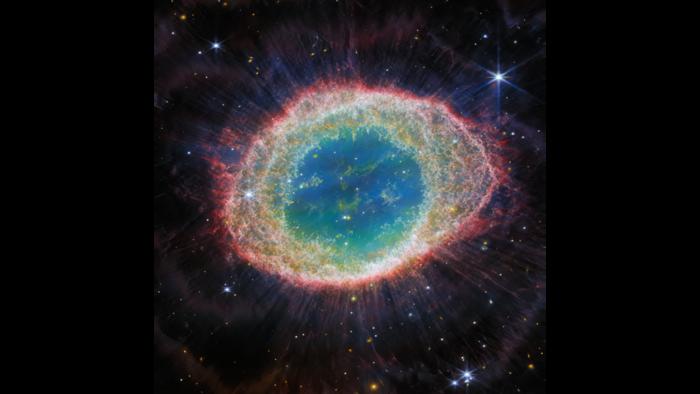
NASA’s James Webb Space Telescope obtained images of the Ring Nebula, one of the best-known examples of a planetary nebula. Much like the Southern Ring Nebula, one of Webb’s first images, the Ring Nebula displays intricate structures of the final stages of a dying star. Roger Wesson from Cardiff University tells us more about this phase of a Sun-like star’s stellar lifecycle and how Webb observations have given him and his colleagues valuable insights into the formation and evolution of these objects, hinting at a key role for binary companions.
“Planetary nebulae were once thought to be simple, round objects with a single dying star at the center. They were named for their fuzzy, planet-like appearance through small telescopes. Only a few thousand years ago, that star was still a red giant that was shedding most of its mass. As a last farewell, the hot core now ionizes, or heats up, this expelled gas, and the nebula responds with colorful emission of light. Modern observations, though, show that most planetary nebulae display breathtaking complexity. It begs the question: how does a spherical star create such intricate and delicate non-spherical structures?
“The Ring Nebula is an ideal target to unravel some of the mysteries of planetary nebulae. It is nearby, approximately 2,200 light-years away, and bright – visible with binoculars on a clear summer evening from the northern hemisphere and much of the southern. Our team, named the ESSENcE (Evolved StarS and their Nebulae in the JWST Era) team, is an international group of experts on planetary nebulae and related objects. We realized that Webb observations would provide us with invaluable insights, since the Ring Nebula fits nicely in the field of view of Webb’s NIRCam (Near-Infrared Camera) and MIRI (Mid-Infrared Instrument) instruments, allowing us to study it in unprecedented spatial detail. Our proposal to observe it was accepted (General Observers program 1558), and Webb captured images of the Ring Nebula just a few weeks after science operations started on July 12, 2022.

“When we first saw the images, we were stunned by the amount of detail in them. The bright ring that gives the nebula its name is composed of about 20,000 individual clumps of dense molecular hydrogen gas, each of them about as massive as the Earth. Within the ring, there is a narrow band of emission from polycyclic aromatic hydrocarbons, or PAHs – complex carbon-bearing molecules that we would not expect to form in the Ring Nebula. Outside the bright ring, we see curious “spikes” pointing directly away from the central star, which are prominent in the infrared but were only very faintly visible in Hubble Space Telescope images. We think these could be due to molecules that can form in the shadows of the densest parts of the ring, where they are shielded from the direct, intense radiation from the hot central star.
“Our MIRI images provided us with the sharpest and clearest view yet of the faint molecular halo outside the bright ring. A surprising revelation was the presence of up to ten regularly-spaced, concentric features within this faint halo. These arcs must have formed about every 280 years as the central star was shedding its outer layers. When a single star evolves into a planetary nebula, there is no process that we know of that has that kind of time period. Instead, these rings suggest that there must be a companion star in the system, orbiting about as far away from the central star as Pluto does from our Sun. As the dying star was throwing off its atmosphere, the companion star shaped the outflow and sculpted it. No previous telescope had the sensitivity and the spatial resolution to uncover this subtle effect.
“So how did a spherical star form such a structured and complicated nebulae as the Ring Nebula? A little help from a binary companion may well be part of the answer.”
The James Webb Space Telescope is the world’s largest, most powerful, and most complex space science telescope ever built. Webb will solve mysteries in our solar system, look beyond to distant worlds around other stars, and probe the mysterious structures and origins of our universe and our place in it. Webb is an international program led by NASA with its partners, ESA (European Space Agency) and the Canadian Space Agency.
IMAGE CREDIT: ESA/Webb, NASA, CSA, M. Barlow (University College London), N. Cox (ACRI-ST), R. Wesson (Cardiff University).
Sign up for the Daily Dose Newsletter and get the morning’s best science news from around the web delivered straight to your inbox? It’s easy like Sunday morning.

Leave a Reply