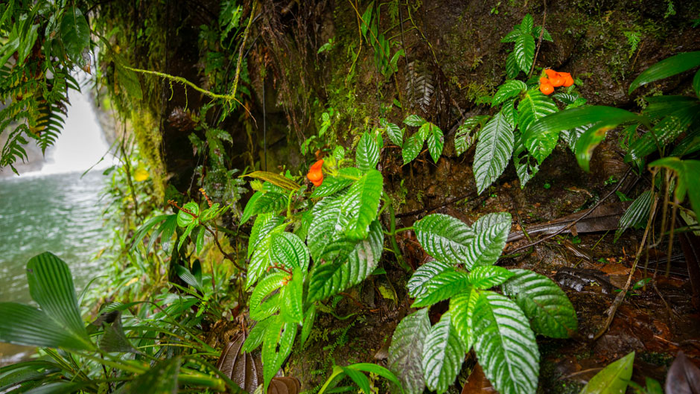
Two University of Miami researchers were part of a team that rediscovered a tropical plant species believed to be extinct for almost 40 years.

At the encouragement of his advisor, biology associate professor Kenneth Feeley, graduate student Riley Fortier joined a small expedition in November to the Centinela Ridge in western Ecuador, a place well known to biologists for its many rare species. The team was searching for a low-lying South American wildflower named Gasteranthus extinctus, which was discovered in the 1980s. The species was given its unique moniker in 2000 because scientists expected the plant to be extinct, since many of the Ecuadorian forests where it was first located had since become teak, cacao, or banana plantations.
To uncover the truth about whether G. extinctus was really extinct or not, botanists Nigel Pitman and Dawson White from Chicago’s Field Museum assembled an international team of plant scientists, including Fortier and several Ecuadorean botanists. As soon as they arrived in Centinela, the team split up into three groups and scouted out the few remaining forest patches they had previously mapped using satellite images.
“Almost immediately, two of the teams found the plant growing along streams,” said Fortier. “We were definitely excited to see it, and because of how bright the flowers are, once we knew what to look for, it was easy to find.”
Pitman tweeted out his thrill with a photo, writing: “And suddenly there it was. Not gone. Not at all extinct. Still alive and well and capable of catching your eye from halfway across the forest.”
The group also found the distinctive plant growing outside of the Centinela Ridge, signaling that it is not limited to that small area. Their findings were published last week in PhytoKeys, a leading plant science journal.
“This is a call for optimism—it shows that some of these species that we thought were extinct are not, and that these little patches of forest that are left behind can help save the diversity of plants and animals in this area,” said Feeley, the University’s Smathers Chair of Tropical Tree Biology and a co-author of the article. “Some of these species have been able to hang on for a long time, but that area is still losing forest as they continue to clear it for agricultural land, so we need to save what we have now to prevent any actual extinctions.”
Ecuador is one of the most biodiverse nations in the world, with 17 percent of the world’s bird species and 16,000 species of plants, according to the World Land Trust. Located in northwestern Ecuador, the Centinela Ridge lies just west of the Andes, in between the mountain range and the Pacific Coast. Perhaps because of this remoteness, it is home to hundreds of endemic tropical species. The area even sparked the interest of renowned biologist E.O. Wilson, who coined the term “Centinelan extinction,” to refer to the loss of rare species before they are even discovered.
The rediscovery of Gasteranthus extinctus came as part of an ongoing collaboration between Feeley and Pitman, who are working to understand the extinction risk of many tropical plant species. Feeley said he hopes that this expedition will spark others to explore the remaining forests and discover what other tropical species may or may not be extinct today.
“This highlights a problem of the tropics, which is that we have so little information; until you send a team of top botanists to a location, you’ll never know what is really there,” said Feeley, who studies the effects of climate change on tropical plant and tree communities. “The fact that we can’t even be confident about if a species is either alive or extinct just highlights that we need more people out there looking for these species.”
They hope to form future expeditions to the Centinela Ridge to learn more. Meanwhile, the team of botanists is working with local organizations to protect the two remaining patches of forest that exist today in the area. Fortier said that these two spots represent just 100 hectares of land—about 247 acres—but contain a host of rare plant species, such as Gasteranthus extinctus, as well as many insects, birds, and mammals. While there, Fortier was glad to see howler monkeys inhabiting the trees.
“Right now, these forests could be cut down any day, so we want to push to protect them,” Fortier said.
As part of the solution, conservation groups or the Ecuadorian government must buy the land in between these forests and connect them through restoration efforts, Feeley added. Additional funds and resources are also needed, so that scientists can survey the many tropical species in this region and help protect them from extinction.
“When botanists first collected plants there, they noted the immense biodiversity of the region, but before they could do anything about it, they returned and were completely alarmed by the deforestation,” Feeley said. “Unfortunately, deforestation can happen quicker than science can.”
Both Feeley and Fortier stressed the importance of conserving this diversity to help counter the effects of climate change.
“Preserving biodiversity, especially local biodiversity, is more than just plants and animals. It’s also preserving the water cycle, our food, and much more,” Fortier said. “We are ensuring an easier life for humankind in the long run.”
IMAGE CREDIT: Riley Fortier



Leave a Reply