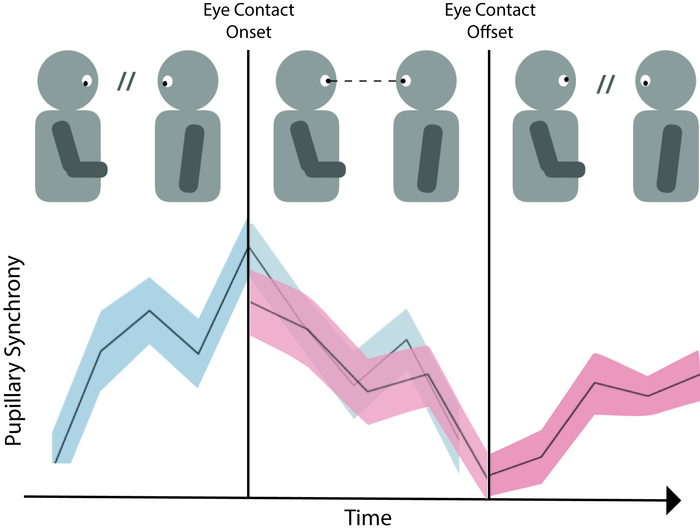
Making eye contact repeatedly when you’re talking to someone is common, but why do we do it? When two people are having a conversation, eye contact occurs during moments of “shared attention” when both people are engaged, with their pupils dilating in synchrony as a result, according to a Dartmouth study published in the Proceedings of the National Academy of Sciences.
“Eye contact is really immersive and powerful,” says lead author Sophie Wohltjen, a graduate student in psychological and brain sciences at Dartmouth. “When two people are having a conversation, eye contact signals that shared attention is high —that they are in peak synchrony with one another. As eye contact persists, that synchrony then decreases. We think this is also good because too much synchrony can make a conversation stale. An engaging conversation requires at times being on the same page and at times saying something new. Eye contact seems to be one way we create a shared space while also allowing space for new ideas.”
“In the past, it has been assumed that eye contact creates synchrony, but our findings suggest that it’s not that simple,” says senior author Thalia Wheatley, a professor of psychological and brain sciences at Dartmouth, and principal investigator of the Dartmouth Social Systems Laboratory. “We make eye contact when we are already in sync, and, if anything, eye contact seems to then help break that synchrony. Eye contact may usefully disrupt synchrony momentarily in order to allow for a new thought or idea.”
To examine the relationship between eye contact and pupillary synchrony in a natural conversation, pairs of Dartmouth students were brought into the lab. Wearing eye-tracking glasses and sitting across from each other, each pair was asked to have a conversation for 10 minutes, which was audio and video recorded. Participants could talk about whatever they wanted. After the conversation was over, the two participants were separated into different rooms and were asked to watch the conversation that they just had and to continuously rate how engaged they were.
The research team looked at how pupillary synchrony increases and decreases around instances of eye contact. The results showed that people make eye contact as pupillary synchrony is at its peak. Pupillary synchrony then immediately decreases, only recovering again once eye contact is broken. The data also demonstrated a correlation between instances of eye contact and higher levels of engagement during the conversation.
“Conversation is a creative act in which people build a shared story from independent voices.” Wheatley adds, “Moments of eye contact seem to signal when we have achieved shared understanding and need to contribute our independent voice.”
The team’s results are consistent with other work, which has illustrated how periodically breaking synchrony can allow for creativity and individual exploration.
IMAGE CREDIT: Sophie Wohltjen




Leave a Reply