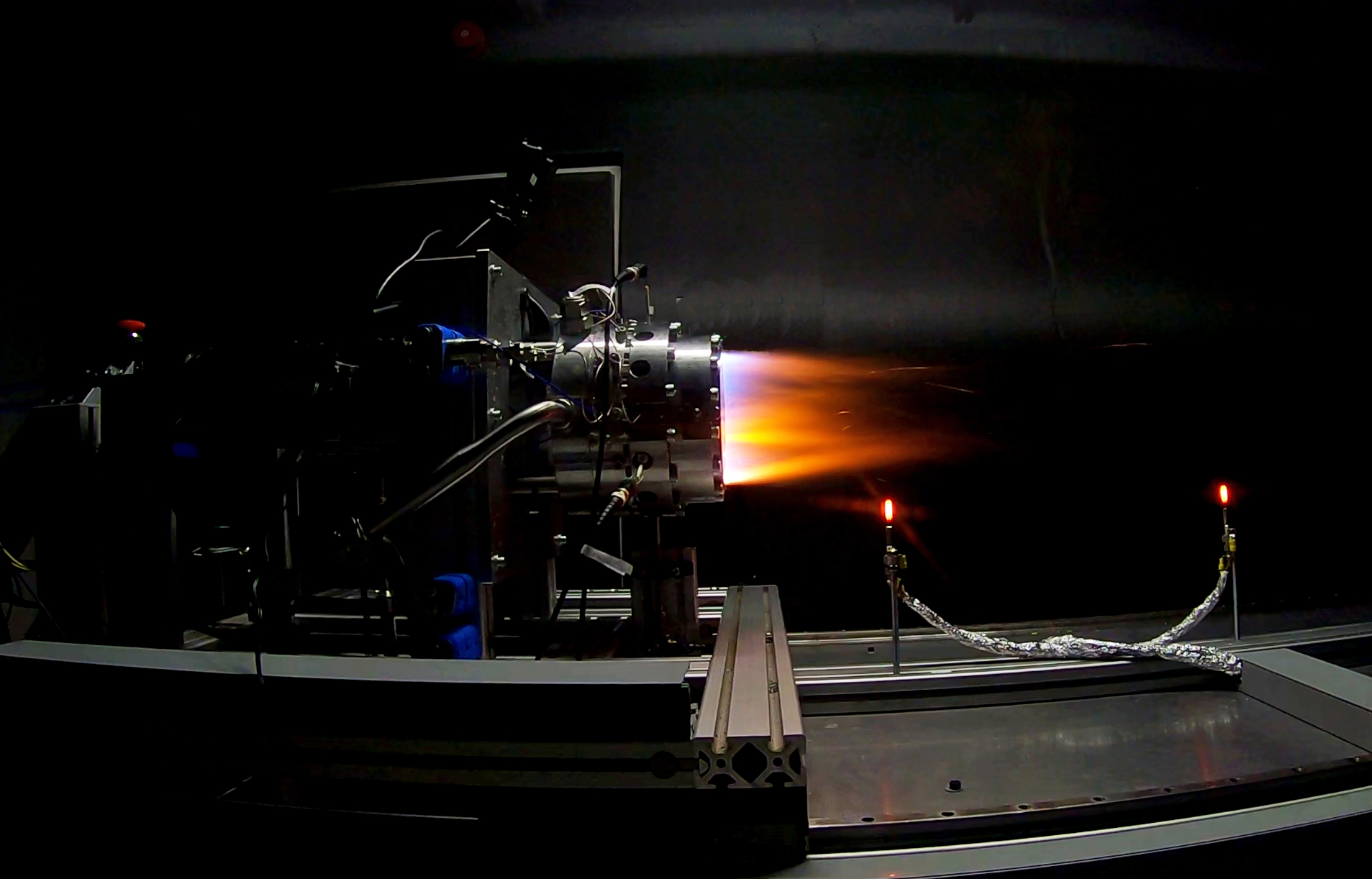
An Australian research consortium has successfully tested a next generation propulsion system that could enable high-speed flight and space launch services.
The team’s rotating detonation engine, or RDE, is a major technical achievement and an Australian first.
It was designed by RMIT University engineers and is being developed by a consortium led by DefendTex, with researchers from RMIT, University of Sydney and Universität der Bundeswehr in Germany.
How it works
While conventional rocket engines operate by burning fuel at constant pressure, RDEs produce thrust by rapidly detonating their propellant in a ring-shaped combustor. Once started, the engine is in a self-sustaining cycle of detonation waves that travel around the combustor at supersonic speeds greater than 2.5km a second.
Using this type of combustion has the potential to significantly increase engine efficiency and performance, with applications in rocket propulsion and high-speed airbreathing engines – similar to ramjets.
Benefits over existing engines include better fuel efficiency, simpler flight systems and a more compact engine, allowing for larger payloads and reduced launch costs.
Major research advances
Project technical lead and RMIT University aerospace engineer, Dr Adrian Pudsey, said successful ground demonstrations at the engine test cell, which was custom designed and operated by RMIT with support from DefendTex, had triggered enormous excitement.
“To succeed in such an exceptionally challenging project means a lot to everyone involved,” he said. “Through strong collaboration over the past two years we now have a truly unique capability and have demonstrated the know-how and science required to push the boundaries of this technology even further.”
Pudsey said a major challenge to overcome was keeping the engine from overheating, while the next step of the project involved looking at a fully 3D-printed, actively cooled version of the successful prototype.
Other challenges, including advanced modelling of the engine’s behaviour and integration of the engine into a functioning flight vehicle, remain to be overcome before proceeding to test flights.
The University of Sydney’s Deputy Head of School of Aerospace, Mechanical and Mechatronic Engineering, Associate Professor Matthew Cleary, said computational fluid dynamics simulations, a mathematical method which models the movement of liquids and gases, will be an important element to the improved design of the engine and its testing.
“The rotating detonation engine combustor is an extreme environment that cannot easily be tested. Experimental measurements cannot provide all the information we need to optimise these engines,” Cleary said.
“Not only did the simulations complement the experiments, but at the same time, the new models that we are developing will be validated from the experimental data and then used for future design work.”
Meanwhile, Universität der Bundeswehr’s Professor Christian Mundt has brought significant expertise in perfecting ratios of fuel and oxidizer in the propellant and its precision injection into the combustor.
“I am glad and proud to be the international partner on this important programme,” he said.
Supporting Australia’s space industry
Although this technology is in its early stages, further development could support satellite launches from Australian soil and commercial opportunities for Australia’s space industry, while indirectly supporting telecommunications, agriculture, transport, logistics and other industries.
DefendTex Chief Executive Travis Reddy said he was proud of the researchers for achieving an ‘Australian first’, while joining an elite list of countries who’d successfully demonstrated this technology.
“A few years ago, little funding and support was available for early-stage research in space technology, and through the Cooperative Research Centre Program the opportunity for collaborative engagement between academia, industry and defence has been made possible,” Reddy said.
“This is allowing Australia to rapidly strengthen capability and expertise in this field to achieve game changing breakthroughs, future-proofing our economy and capturing a greater share of the space launch market.”
This project would not have been possible without Cooperative Research Centre project funding.
IMAGE CREDIT: DefendTex/RMIT.




Leave a Reply