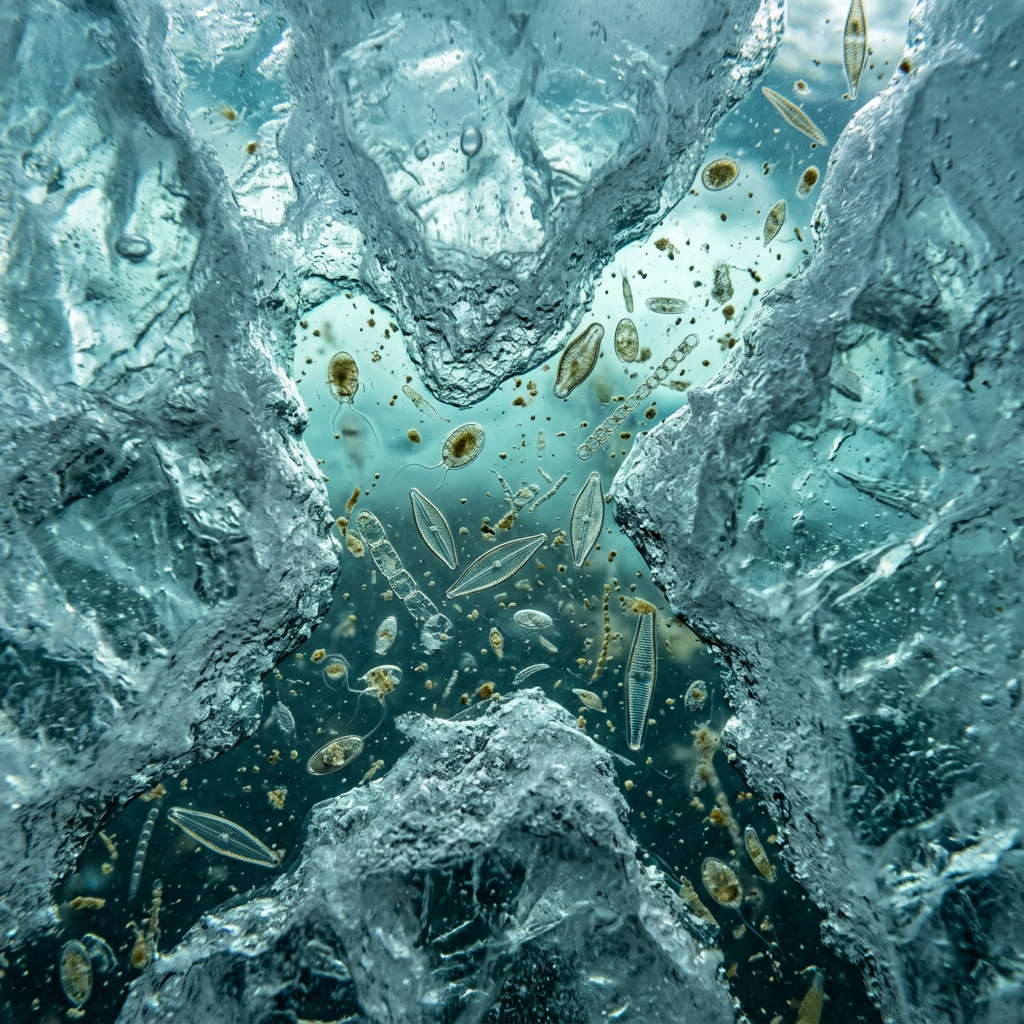
For much of the year, the frozen ring encircling Antarctica is dismissed as a frontier too hostile to matter ecologically — a place where ice-bound temperatures can plunge to minus 20 degrees Celsius and some of the planet’s fiercest winds make it nearly impossible to reach by ship. But a new study led by scientists at Stellenbosch University in South Africa finds that this seemingly barren expanse hosts a hidden reservoir of microbial life — and a chemical process with consequences that ripple far beyond the ice itself.
The compound at the center of the discovery is dimethylsulfoniopropionate, or DMSP, one of the most abundant organic sulfur compounds in the ocean. DMSP does double duty in the marine world: it protects algae and bacteria from environmental stress, and when it breaks down, it produces dimethylsulfide and methanethiol — gases known to play a role in cooling the planet’s climate.2 Researchers found DMSP concentrations in Southern Ocean sea ice up to 38 times higher than in the surrounding seawater during the depths of austral winter, a season researchers rarely sample because access to the ice is so difficult. The finding matters at scale: at its peak extent in September, Antarctic sea ice spans roughly 20 million square kilometers, forming a ring 400 to 1,900 kilometers wide around the continent.
That scale is part of why the discovery reframes how scientists think about sea ice’s role in the planet’s chemistry. “Together with these high concentrations of DMSP, we also found an abundance of algal marker genes which are encoding for DMSP production, as well as diverse and previously unidentified bacterial producers,” says Mayi Buthelezi, a marine microbiologist at Stellenbosch University and the study’s first author. “These processes are central to sustaining the ecological and physiological adaptions of microorganism in these extreme environments.”
Sea ice, in other words, isn’t simply where marine life survives the winter — it’s where a quietly significant chunk of the ocean’s sulfur cycling appears to happen.
Buthelezi and his colleagues collected their samples during the Southern Ocean Seasonal Experiment, known as SCALE, aboard the polar research vessel SA Agulhas II between July 11 and July 22, 2022. The original goal, he says, was simpler: characterize which microorganisms live in the ice and in what abundance during winter.
“Although DMSP production is exclusive to some microbial groups, the process is not metabolically expensive,” Buthelezi explains. “Under stressful conditions, when organisms cannot afford to spend excessive energy for growth, they express metabolic pathways for either intercellular synthesis or extracellular import of DMSP as a buffering mechanism to survive.” At the same time, he notes, DMSP serves as a vital source of carbon and sulfur for the microbes trapped within the ice — a dual role that helps explain why the compound shows up in such striking concentrations.
The genetic evidence backs this up. Sea ice samples showed an enrichment of genes for DMSP synthesis, consistent with organisms producing the compound as a defense against the cold, salty conditions inside the ice. Seawater samples, by contrast, showed more genes for breaking DMSP down than for making it — suggesting that in the comparatively less stressful open water, microbes are using DMSP primarily as fuel rather than as armor.
For Thulani Makhalanyane, who holds the South African research chair in African Microbiome Innovation at Stellenbosch and is the study’s senior author, the findings speak to a gap in how scientists currently model the Southern Ocean’s role in climate regulation. “The specific contributions of microbial communities to Earth systems remain underappreciated,” he says. “Until now we have just basically tried to describe what types of microorganisms are in the Southern Ocean, and how they differ from those that are found in other marine ecosystems that are not limited in trace elements such as iron and manganese. With this study we show how microbial communities are contributing to the recycling of important sulfur-related compounds with important contributions in climate cooling. Now we need to find ways to add these microbial communities as components to Earth system models to aid in predictions.”
The idea that ocean sulfur chemistry might influence climate isn’t new — researchers have debated a version of this link since the 1980s, when atmospheric scientists first proposed that DMS emissions seed cloud-forming particles over the ocean, an idea later dubbed the CLAW hypothesis.3 What the Stellenbosch-led team adds is evidence that polar sea ice, long treated as a footnote in that story, may be acting as a concentrated transformation hub rather than a passive bystander.
The study also drew on international collaboration. Stéphane Pesant, a senior marine data curator at the European Bioinformatics Institute in the United Kingdom and a co-author, says the results contribute to AtlantECO, a research initiative tracking ecosystems across the Atlantic and polar oceans involving scientists in South Africa, Brazil and Europe.
“With the recent expansion of data infrastructures, bioinformatics skills and artificial intelligence, we are starting to exploit a treasure trove of historical data, and to identify important gaps in the geographic coverage of those observations,” Pesant says. “This study contributes to fill those gaps.”
Microbial communities in the Southern Ocean are already known to be disproportionately important to the planet’s carbon budget, contributing to nearly half of global atmospheric carbon uptake through their role in ocean productivity.4 The new findings suggest their reach extends into sulfur cycling as well — and that winter, not just the more easily studied summer months, may be when some of that chemistry is most active. The next step, Makhalanyane and his colleagues say, is building that seasonal picture into the climate models that currently treat the polar sulfur cycle as a static, summer-only process. For a region defined by how hard it is to study, that is a meaningful gap to close — and one that may reshape how much credit sea ice deserves for the planet’s climate-cooling chemistry.
Notes
1. Buthelezi, M. et al. “Dimethylsulfoniopropionate metabolism shapes microbial ecology and physiological adaptation during the austral winter in Southern Ocean sea ice and seawater.” Nature Communications, June 18, 2026. DOI: 10.1038/s41467-026-73596-x.
2. Background on DMSP’s dual role as a stress-protectant and precursor to the climate-active gases dimethylsulfide and methanethiol is detailed in the study above and in prior reviews of the marine sulfur cycle, including Jackson, R. & Gabric, A. “Climate Change Impacts on the Marine Cycling of Biogenic Sulfur: A Review.” Microorganisms, 2022.
3. The proposed link between oceanic DMS emissions and cloud formation, known as the CLAW hypothesis, was first articulated by Charlson, R.J., Lovelock, J.E., Andreae, M.O. & Warren, S.G. in “Oceanic phytoplankton, atmospheric sulphur, cloud albedo and climate,” Nature, 1987. Its scope and certainty remain debated; see Jackson & Gabric (2022) for an overview.
4. Stellenbosch University, news release distributed via EurekAlert!, “New study led by South African scientists reveals how sea-ice microbes survive the Southern Ocean’s harsh winter, with implications for climate change,” June 18, 2026.


Leave a Reply