Record-breaking dinosaur tracksite rewrites Bolivia’s Cretaceous coastline
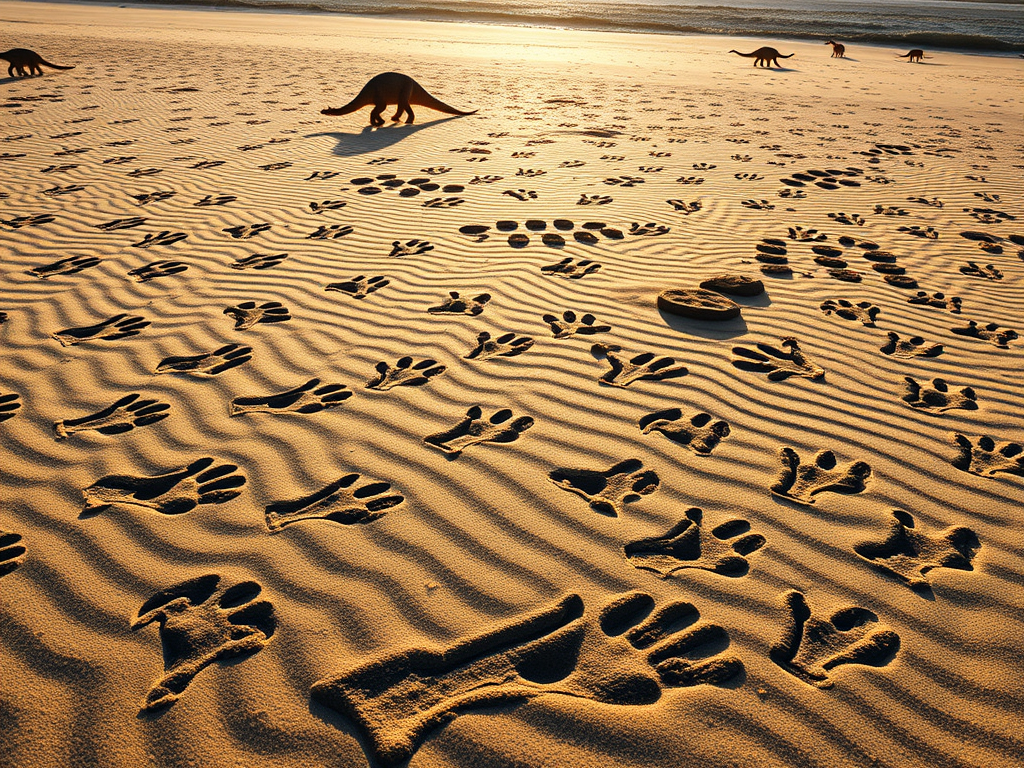
Researchers have mapped roughly 16,600 dinosaur footprints and 1,378 swim tracks at the Carreras Pampa site in central Bolivia, now the most extensive dinosaur tracksite known. The prints, preserved along an ancient shoreline, capture theropods, birds, and other dinosaurs moving across ripple-marked sediments near the end of the Cretaceous. High densities of overlapping tracks and swimming claw marks record a mix of behaviors, from walking and running to paddling through shallow water. The study, published in PLOS ONE, turns the site into a behavioral archive rather than a simple fossil list, helping paleontologists reconstruct how different dinosaur groups used coastal habitats just before the end-Cretaceous extinction. (Live Science)
Nanotyrannus confirmed as a distinct predator, not a teenage T. rex
A long-running debate over whether Nanotyrannus lancensis is just a juvenile Tyrannosaurus rex may finally be settled. A new analysis of skull and limb material concludes that Nanotyrannus represents a separate tyrannosaurid species coexisting with T. rex in Late Cretaceous North America. Researchers examined growth patterns, bone microstructure, and proportions, arguing that the fossils lack the expected features of a rapidly growing adolescent tyrannosaur. Instead, they show traits consistent with a lightly built, fast-moving predator specialized for different prey. If accepted, the result adds another apex hunter to an already crowded Late Cretaceous ecosystem and complicates the picture of niche partitioning among large theropods near the end of the dinosaur era. (Sci.News)
New giant duck-billed dinosaur expands the hadrosaur family tree
Paleontologists have described a massive new hadrosaur, or duck-billed dinosaur, from Late Cretaceous rocks in North America. The species, identified from skull and postcranial remains, shows distinctive crest and jaw features that set it apart from known hadrosaurs, suggesting a previously unrecognized lineage. Modeling of its skeleton indicates a multi-ton, bulk-feeding herbivore that likely browsed in herds across coastal lowlands. Its anatomy hints at differences in how it chewed and processed vegetation compared with relatives, refining ideas about hadrosaur feeding diversity. The find also helps fill geographic and evolutionary gaps in the group’s history, underscoring how fragmentary bones can still yield big surprises in well-studied formations. (Phys.org)
“Medusa” the dinosaur mummy arrives in Minnesota for a closer look
An exceptionally preserved hadrosaur nicknamed “Medusa” has been transported to Winona State University, where scientists will use modern imaging to study what may be a true dinosaur “mummy.” The specimen, likely an Edmontosaurus, preserves large areas of skin impression and possibly soft tissues beneath a thick, rocklike shell. Researchers plan CT scans and 3D modeling to map internal structures without damaging the fossil. The work will probe how such extensive soft-tissue preservation occurred and test whether Medusa retains original biomolecular traces. For students, the project offers rare hands-on access to a world-class specimen; for paleontology, it may refine models of dinosaur skin, musculature, and taphonomy in Late Cretaceous ecosystems. (Phys.org)
Fossils show anacondas have been giants for over 12 million years
New vertebrae fossils from Venezuela reveal that giant anacondas reached massive sizes—comparable to today’s largest individuals—more than 12 million years ago. By comparing bone dimensions to living snakes, researchers estimate lengths exceeding 7 meters, demonstrating that gigantism in these constrictors evolved early and persisted through major environmental changes. The study, based on material from Miocene-age deposits, also refines the evolutionary timeline for Neotropical snake faunas and their riverine habitats. Rather than steadily increasing in size, anacondas appear to have hit an optimal body plan and then maintained it. That long-term success raises questions about how such specialized mega-predators might respond to today’s rapid climate and habitat shifts. (Sci.News)

Tiny dinosaur choked on stones, preserving a 120-million-year death scene
A palm-sized early bird from China, Chromeornis funkyi, offers an extraordinarily intimate look at how one dinosaur died. CT scans of the fossil reveal more than 800 tiny stones jammed high in its throat, far beyond the number and position of normal gizzard stones. Researchers conclude the animal likely choked while trying to regurgitate the mass, leaving a frozen snapshot of its final moments. Anatomical quirks in its skull and beak teeth also mark Chromeornis as a new longipterygid species, adding to the diversity of Cretaceous birds. The work, published in Palaeontologia Electronica, shows how individual tragedies can illuminate broader questions about avian evolution and extinction vulnerability. (Discover)
Half-billion-year-old larva fossil preserves a miniature brain and guts
Scientists have described an incredibly rare 520-million-year-old fossil larva, Youti yuanshi, with its internal organs preserved in three dimensions. Discovered in Cambrian rocks in Yunnan, China, the poppy-seed-sized creature retains brain regions, digestive glands, a primitive circulatory system, and traces of nerves feeding its tiny legs and eyes. Using advanced scanning, researchers showed that Youti sits near the base of the arthropod family tree, clarifying how today’s insects, spiders, and crustaceans evolved from wormlike ancestors. Larval forms almost never fossilize, making this specimen a developmental Rosetta stone for early arthropod evolution. The work, published in Nature, demonstrates just how early complex organ systems appeared in Earth’s oceans. (People)
“Free-range” dinosaur parenting linked to richer ancient ecosystems
A new study suggests that dinosaur nesting strategies may have shaped the diversity of entire ecosystems. Researchers reexamined fossil nests, eggshell fragments, and juvenile remains from multiple sites and inferred that some species used widely dispersed, low-density nesting rather than tight colonies. Modeling those patterns, they found that “free-range” parenting created mosaics of disturbed ground, vegetation, and nutrient patches, opening ecological space for plants, invertebrates, and other vertebrates. The result: regions with these nesting styles supported more species overall. The work reframes dinosaur reproduction as an ecosystem-engineering force comparable to modern elephants or seabird colonies, linking parenting behavior to large-scale patterns of biodiversity before the end-Cretaceous extinction. (Maryland Today)
Devonian “dunk” relatives push soft-tissue fossilization back 100 million years
A PLOS ONE study demolishes assumptions about how old soft-tissue preservation can be. Paleontologists demineralized bones from Bothriolepis and other Late Devonian fishes—relatives of the armored placoderm “sea monsters”—to test whether any original microstructures survived. Under the microscope, they found osteocyte-like cells, blood vessel fragments, and fibrous bone matrix with elemental signatures consistent with partially organic material. These fossils predate previous reports of similar preservation by nearly 100 million years, showing that geologic age alone is a poor predictor of cellular survival. The authors argue that soft-tissue fossilization pathways likely began as soon as vertebrates evolved vascularized cellular bone, dramatically expanding the search window for ancient biomolecules. (PLOS)
Qatar’s fossil sea cows reveal a new species and long-term seagrass engineering
Excavations in Qatar have uncovered a rich assemblage of fossil sea cows—sirenians—that includes a newly named species, Salwasiren qatarensis, dating to about 21 million years ago. The bones, recovered from ancient seafloor deposits, show adaptations for intensive seagrass grazing, such as downturned snouts and robust ribs for ballast. By mapping fossil distributions, researchers conclude that herds of these mammals repeatedly cropped seagrass meadows, much like modern dugongs and manatees, reshaping coastal ecosystems over millions of years. The discovery plugs a geographic and temporal gap in sirenian evolution and highlights how long large marine herbivores have been “gardeners” of shallow seas in the Arabian Gulf region. (Smithsonian Magazine)


Leave a Reply