NOBEL PRIZE IN PHYSICS 2025 HONORS PIONEERS OF QUANTUM SUPERCONDUCTING CIRCUITS
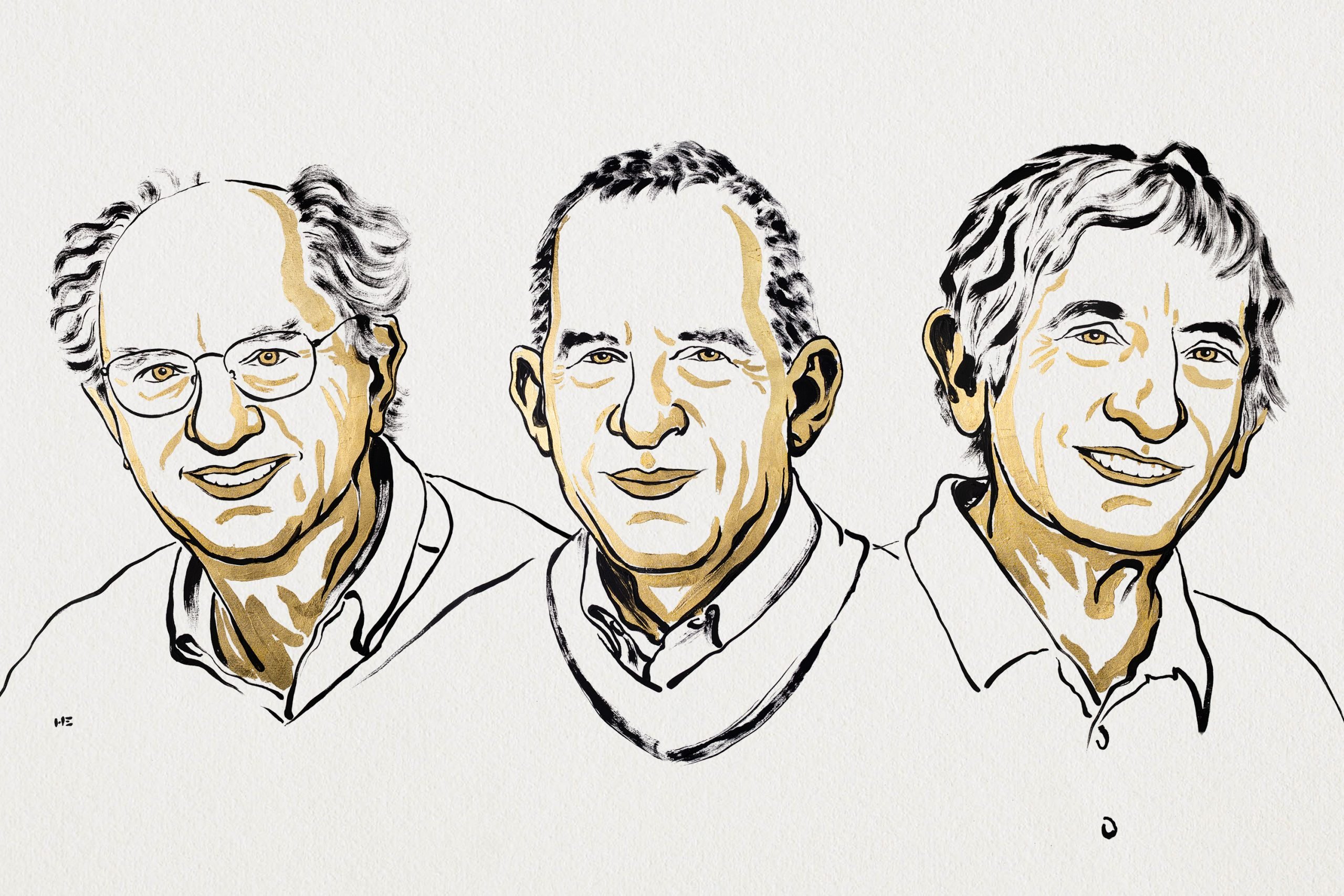
The 2025 Nobel Prize in Physics was awarded to John Clarke (UC Berkeley), Michel Devoret (Yale), and John Martinis (UC Santa Barbara) for pioneering experiments that revealed quantum behavior in superconducting circuits at everyday scales. By engineering systems that could tunnel between distinct energy states—like a ball seemingly passing through a wall—the trio showed that the ‘weirdness’ of quantum mechanics can produce measurable effects in macroscopic devices. Their breakthroughs laid foundations for quantum technologies, including quantum computing, cryptography, and precision sensors, and helped transform speculative physics into practical engineering. Announced by the Royal Swedish Academy of Sciences, the prize totals 11 million Swedish kronor. Clarke called the news “the surprise of my life,” underscoring how decades of advances culminated in today’s quantum technology ecosystem. (theguardian.com)
A NEWLY DISCOVERED “EINSTEIN’S CROSS” MAPS A GIANT DARK-MATTER HALO
ALMA and other observatories spotted five lensed images of a dusty starburst galaxy, HerS-3, arranged in a cross by four massive galaxies 7.8 billion light-years away. Modeling shows the visible matter can’t reproduce the lens geometry; a hefty, unseen dark-matter halo—likely trillions of solar masses—does. The extreme magnification lets astronomers probe HerS-3’s rotating disk and powerful outflows in exquisite detail, while the lens offers a rare laboratory for mapping dark matter at earlier cosmic times. Together, the system tightens constraints on how mass is distributed in galaxy groups and how dark matter sculpts their evolution. It also showcases how multi-facility data can decode complex gravitational lenses. (Wired)
ROGUE PLANET CAUGHT GORGING LIKE A BABY STAR
Astronomers observed the free-floating object Cha 1107-7626, five to ten Jupiter masses and ~1–2 million years old, undergoing a violent accretion burst: roughly six billion tons of gas and dust per second streaming from its surrounding disk. The event—spotted with ESO’s Very Large Telescope and supported by space-based data—looks more like star formation than planet growth, suggesting some planetary-mass bodies can grow “star-style” from collapsing clouds. The burst also revealed changes in disk chemistry, including water vapor signatures, offering a rare, time-resolved look at how isolated worlds assemble. It’s the strongest accretion episode ever recorded for a planetary-mass object and blurs the line between planets and stars. (phys.org)
“BABY” PLANET PHOTOGRAPHED IN A DISK GAP FOR THE FIRST TIME
Researchers directly imaged a young protoplanet, WISPIT 2b, embedded in a ring-shaped gap of its star’s protoplanetary disk ~437 light-years away. The gas giant—about five Jupiter masses and only ~5 million years old—sits precisely where theorists expect nascent planets to carve out material, offering vivid confirmation that forming planets can sculpt disk rings. Beyond the milestone image, the discovery helps calibrate models of early planet growth, migration, and gap-opening physics, with implications for interpreting the concentric rings commonly seen by ALMA. Follow-up spectroscopy could probe atmospheric composition and accretion shocks, while continued imaging will test how quickly such giants gather mass and alter their natal environment. (Space Daily)
HOW AMERICA FELL BEHIND CHINA IN THE LUNAR RACE—AND WHAT’S NEXT
A detailed analysis outlines how the U.S. ceded momentum to China’s rapidly advancing lunar program and sketches paths to recover: faster lander development, commercial partnerships, and clearer, sustained policy. With China preparing large surface missions and infrastructure precursors, the piece argues the U.S. must streamline Artemis, reduce cost and schedule risk, and lean on new lunar delivery services to maintain scientific and strategic leadership. It also highlights looming technology and workforce bottlenecks, plus opportunities—like tele-robotics and ISRU—to regain an edge. The upshot: the contest is accelerating, and choices made in the next 12–24 months will shape lunar science and industry for a decade. (Ars Technica)
MARS’ POLAR NIGHT HARBORS A MYSTERIOUS OZONE SURGE
New observations reveal extreme winter conditions inside Mars’s north polar vortex: temperatures plunge far below surroundings and darkness allows ozone to accumulate dramatically. The chemistry suggests sunlight usually destroys ozone faster than it forms, but in polar night, production dominates—revealing a sensitive balance between photolysis, transport, and heterogeneous reactions on icy aerosols. The data refine general circulation models and help explain seasonal variability seen by orbiters. Beyond basic science, understanding polar-vortex chemistry matters for interpreting past methane claims and planning future atmospheric probes. It underscores Mars as a dynamic world where subtle seasonal processes drastically reshape the air we’ll one day fly through and sample. (SciTech Daily)
SUPERMOON + METEOR SHOWERS: OCTOBER’S SKY CALENDAR
October opens with a bright supermoon—larger and brighter thanks to lunar perigee—followed by the short-lived Draconids and the longer-lasting Orionids later in the month. Observers can also enjoy prime evening views of Jupiter and Saturn. The guide offers practical observing windows, finder tips, and educational tie-ins for outreach events, including printable maps for International Observe the Moon Night. For classrooms and clubs, it’s a one-stop plan for aligning activities with predictable celestial milestones. Even veteran stargazers will appreciate the consolidated dates and context around each event’s origin, brightness expectations, and observing conditions. (NASA)
INTERSTELLAR COMET 3I/ATLAS: ITS COMA MAY TEST COMET FORMATION IDEAS
Fresh analyses of interstellar visitor 3I/ATLAS examine how its coma—the diffuse envelope of gas and dust—evolves as it approaches the inner solar system. By comparing activity to solar-system comets, researchers are probing whether familiar sublimation and dust-release physics apply to bodies born around other stars. Early results hint at composition and grain-size differences that could challenge standard formation scenarios. Because 3I/ATLAS is on a one-time, hyperbolic pass, coordinated observations across wavelengths are crucial. The campaign aims to pin down nucleus properties, outgassing rates, and whether interstellar comets share a common origin story—or represent a diverse diaspora of planetary leftovers. (phys.org)
JUPITER’S “WEATHER”: NEW MODEL TRACKS WATER CYCLE ON A GIANT
Caltech scientists present a comprehensive simulation of Jupiter’s hydrological cycle, showing how water vapor condenses into clouds, falls as rain, and redistributes with the planet’s ferocious winds and rapid rotation. The model suggests water is unevenly distributed, offering a roadmap for where missions like Juno (and future probes) should look to quantify abundances. Because Jupiter’s water inventory constrains how and where the planet formed—and by extension how water reached Earth—the result connects meteorology to planetary origins. The framework could generalize to exoplanet giants, helping interpret spectra from JWST and upcoming observatories by linking cloud physics, circulation, and chemistry. (Space Daily)
OCTOBER NIGHT SKY: SUPERMOON + TWIN SHOWERS (DRACONIDS & ORIONIDS)
A second observing guide highlights October’s headliners: the early-month supermoon followed by twin meteor showers. The Draconids can flare unexpectedly but often sputter; the Orionids are steadier, delivering ~20 meteors per hour under dark skies as Earth plows through Halley’s debris. Practical tips cover when to look, where to face, and how to boost your chances (dark sites, no telescopes needed, patience). The post also flags planet viewing and provides handy graphics useful for social sharing or classroom slides. It’s a simple, timely rundown to engage casual observers and newcomers while giving amateurs clear planning cues. (SciTech Daily)
A FUSION “DONUT” JUST BROKE A RECORD—WHY IT MATTERS
A stellarator (a twisty cousin of the tokamak) set a world record for sustained plasma runtime, signaling renewed momentum for an alternative fusion pathway. Unlike tokamaks, stellarators can confine plasma without large pulsed currents, potentially offering steadier operations and fewer disruptions—advantages for future power plants. The piece explains why this record matters: longer runtime improves prospects for continuous operation, materials testing, and integrating advanced heating/control systems. It also frames the rivalry with tokamaks and where each approach shines. While not astronomy, it’s a major tech story with space-relevant implications for high-power missions and deep-space infrastructure. (Popular Mechanics)



Leave a Reply