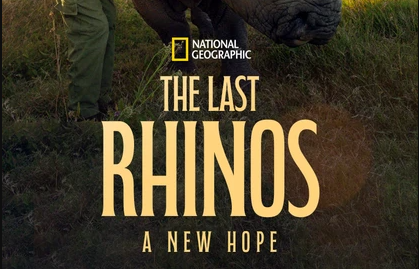
On the open savannas of Kenya, two elderly females stand as the last of their kind—the northern white rhino, once a great giant of Central Africa, now reduced to a fragile flicker of existence. Their survival no longer rests in the rhythms of nature but in the precision of science, where needles, helicopters, and embryology replace the age-old rituals of mating and birth. At the heart of this improbable rescue is BioRescue, an international consortium of scientists and conservationists fighting against extinction with the tools of modern medicine. In The Last Rhinos: A New Hope, National Geographic captures this extraordinary effort. Here, Jan Stejskal, Director of BioRescue, reflects on the mission, the challenges, and the hope that one day rhinos might again roam the lands that once defined them.

Can you give some background on BioRescue and its mission?
BioRescue has been active since 2019. It’s a large consortium, though the efforts to save the northern white rhino go back years, even decades, earlier. BioRescue represents the latest phase in those efforts.
The leading institution is the Leibniz-IZW in Berlin, and I represent Safari Park Dvůr Králové in the Czech Republic, the coordinating institution. This is where the last two northern white rhinos were born before they were moved to Kenya. Alongside us, the Max Delbrück Center in Berlin produces stem cells; the University of Padua in Italy carries out the ethical evaluations of our work; Osaka University in Japan works on turning stem cells into primordial germ cells and ultimately gametes; and Avantea, a company based in Cremona, Italy, is the only laboratory in the world capable of producing rhino embryos. In Kenya, we work with Ol Pejeta Conservancy, where the rhinos live and where the procedures are performed, as well as the Kenya Wildlife Service and the Wildlife Research and Training Institute, which are the governmental bodies responsible for wildlife.
It’s complicated, but that’s BioRescue.
Why the northern white rhino? Why should it be preserved, and what’s its ecological or cultural importance?
Together with elephants and possibly hippos, the northern white rhino was one of the largest animals roaming Central Africa in recent times. It diverged from the southern white rhino hundreds of years ago and is genetically distinct. Whether it’s classified as a separate species or not, it represents a population that was isolated for a long time.
The main reason it should be saved is that its near-extinction wasn’t the result of natural evolution, but of human greed. Rhinos were slaughtered for their horns. Now that we have techniques—originally developed for human medicine—that can be adapted to save them, I believe it’s worth the effort to preserve this charismatic species.
Beyond ecology, the northern white rhino has cultural importance. Communities in the regions where they lived—like South Sudan—still incorporate rhinos into folklore and even state symbols. If we can reestablish a population in its native range, it would carry deep cultural meaning for those communities.
How does the IVF process work with rhinos? Is it similar to humans or other animals?
In principle, yes—it’s comparable to human IVF. But rhinos are extremely large, so we need specialized tools and protocols.
We collect oocytes (eggs) from rhinos in Kenya. These are transported overnight to Italy, where they’re matured in the lab and fertilized with northern white rhino sperm. If they develop to the blastocyst stage, they can be frozen, shipped back to Kenya, thawed, and implanted into a surrogate mother. The surrogate would be a southern white rhino, but the calf would be genetically northern white.
What’s particularly challenging is accessing the ovaries. Rhinos have a cervix that’s extremely difficult to penetrate, so our lead scientist, Thomas Hildebrandt, developed a technique to reach the ovaries via the rectum using a specialized ultrasound probe and needle. It’s technically demanding—you’re working 1.5 to 2 meters inside the body.
What have been the biggest technical or biological challenges so far?
The most delicate step is embryo transfer. Oocyte collection is demanding but more routine—we’ve done it many times, and usually collect multiple eggs at once.
Embryo transfer, however, is much more complex. We often only have one or two embryos, so there’s no room for error. Timing is crucial—you need to synchronize thawing the embryo with the surrogate’s reproductive cycle. Hormonal stimulation is unreliable in rhinos, so we rely on a sterilized male to mate with the female, which signals ovulation is near.
The logistics are immense: you need a helicopter, a skilled pilot, trackers who know the animals well, and perfect timing between embryo thawing and sedation. If the surrogate is sedated too long, she risks bloating; if the embryo is thawed too long, it may rupture. All these moving parts make embryo transfer the most complicated stage.

Looking ahead—say, a decade from now—if there are 50 or 100 rhinos, is genetic diversity still a concern?
Yes, but I’m optimistic. Right now, our embryos come from one female and two males—three animals in total. That’s not enough to sustain the species.
This is why we’re also developing stem cell techniques. These could allow us to bring at least 12 individuals into reproduction. It’s not a huge number, but it’s comparable to other historical bottlenecks. For instance, southern white rhinos themselves went through a bottleneck about 100 years ago with perhaps only 15–30 breeding individuals, yet recovered.
With advanced techniques, we can carefully choose which individuals contribute genetically, maximizing diversity.
We’re also exploring whether viable cells might still exist in storage somewhere in Africa. And another intriguing idea: sequencing DNA from museum skulls collected during hunting expeditions a century ago. If we find genes missing from today’s genetic pool, we might one day restore them through gene editing. This won’t happen overnight, but it’s technically possible.
How important is storytelling, like in The Last Rhinos: A New Hope, for generating awareness and support?
It’s absolutely vital. We try to be as transparent as possible and keep the public informed. This story has global importance because it demonstrates that new approaches to conservation can work—and may be needed for other species, like the Sumatran or Javan rhino.
Financial support is, of course, critical. With more resources, we could accelerate progress, particularly in developing lab-produced gametes. But public engagement also matters—if people feel connected to the story, they advocate for it, and that helps counter critics who argue we should just let the species die out.
I believe that if we have the technology to save them, we have a responsibility to try.
What would you like audiences to take away from this film?
First, that rhinos truly are on the brink of extinction. But also that, even when a situation looks desperate, if people commit to a cause, there’s still hope.
Finally, I’m glad this is being told by a global platform like National Geographic. It’s a story of worldwide importance, and I hope people everywhere understand the urgency and the possibilities of what we’re trying to achieve.


Leave a Reply