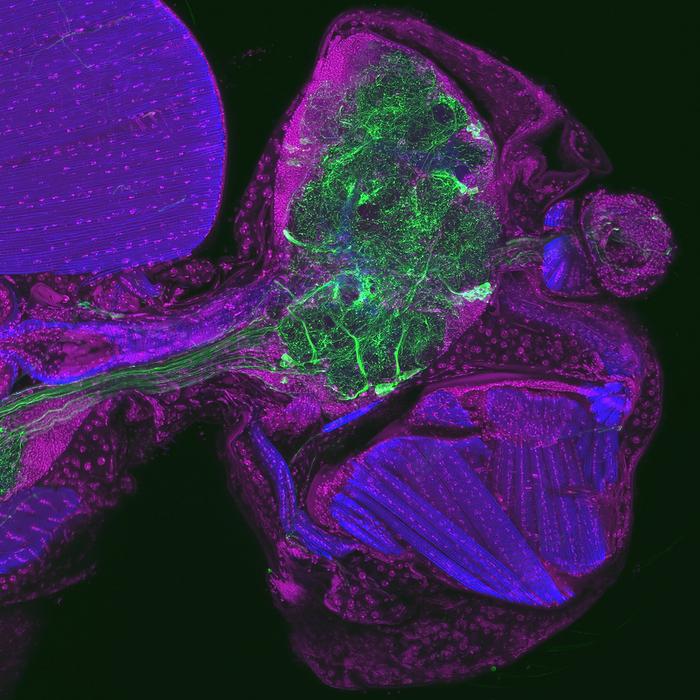
If humans or animals eat something that causes them to feel unwell, they subsequently avoid this food source. Until now, it has been unclear precisely how this avoidance learning takes place. A new study shows that communication between the brain cells and fat cells could play a crucial role here. The participants from the Universities of Bonn and Tohoku (Japan) and University Hospital Bonn have revealed the previously unknown mechanism in the fruit fly Drosophila. It may also exist in a similar form in mammals and even in humans. The results have now been published in the journal Neuron.
Anyone who’s ever had an upset stomach after eating a bad meatball knows just how much this experience can put you off them. Within research, this is also known as “conditioned taste aversion”: The brain registers the immune response to the bacteria and their toxins and concludes from this that the food source should be avoided in the future.
It is not yet known how the immune system’s discovery of the pathogens leads to a change in behavior. “As this learned food avoidance can be found in all species, we investigated this question in a model organism – the fruit fly Drosophila,” explains Prof. Dr. Ilona Grunwald Kadow. “Within this model, we can clarify how the brain and body interact with each other to trigger an avoidance reaction that is vital for survival.”

Grunwald Kadow heads the Institute for Physiology II at the University of Bonn and University Hospital Bonn. In the current study, her working group is collaborating with researchers from Japan’s Tohoku University. The participants had their test animals choose between two food sources. One of them was contaminated with the pathogenic bacterium Pseudomonas entomophila. The other contained a harmless Pseudomonas strain. The two food sources were otherwise completely identical.
Flies that have not yet had any bad experiences with the pathogen prefer the harmful food because they find its odor attractive. “As this is life-threatening for the animals, we wondered how animals that have consumed these bacteria with their food behave,” explains the scientist. The pathogens did not remain undiscovered among the flies for long: The animals’ innate immune system has sensors that raise the alarm in cases such as this. “In our experiment, receptors were activated in them that respond to components of the bacterial cell wall,” explains Grunwald Kadow’s colleague, Yujie Wang. She conducted a large proportion of the experiments as part of her doctoral thesis.
Bacteria sensors lead to behavioral change
These sensors mainly respond to the harmful Pseudomonas strain, but hardly respond at all to the harmless strain. Many of them sit on the surface of special neurons located near the fly’s throat. Via their branches, these neurons are connected not only to the fly’s brain but also to a fat store in the fly’s head. If the receptors raise the alarm in the presence of harmful microorganisms, this leads to the release of the neurotransmitter octopamine in the neurons, which is closely related to adrenaline. This travels through the neuronal branches to the fat store.
“The octopamine then triggers the formation of another neurotransmitter, dopamine, in the fat cells,” says Grunwald Kadow. “The dopamine, in turn, is transported into the fly’s brain, where it causes the continuous, increased activation of neuronal networks that are important for learning and trigger an avoidance response.” The animals then tend to be deterred by the odor of pathogenic bacteria. “We were able to show that the flies chose the food source with the harmless germs following their experience with the spoiled food,” explains the scientist.
Are starving flies less choosy?
The adipose tissue is significantly involved in this learned behavioral change. But why is that so? “We still do not have a definitive answer,” says Grunwald Kadow, who is also a member of the Transdisciplinary Research Area (TRA) “Life & Health” at the University of Bonn. “However, the flies’ decision may be linked to their nutritional status.”
When the animals are starving, they have fewer fat cells. These would then produce correspondingly less dopamine when they discover that pathogenic bacteria has been consumed with the food. Perhaps starving animals are thus more willing to resort to contaminated food sources. “This is a hypothesis that we are currently investigating in further experiments,” explains the scientist.
The results may be relevant to humans as well, as the adipose tissue in our species also produces neurotransmitters that can act on our brain and influence our appetite. Researchers currently assume that the interaction between the brain, organs, and fat does not function correctly in eating disorders such as anorexia or obesity. The fruit fly Drosophila makes it possible to investigate hypotheses such as this in a simple model organism and understand the underlying mechanisms. This understanding could help influence the complex interaction between the metabolism, immune system, and brain in the context of illness.
IMAGE CREDIT: Mareike Selcho/Leipzig University.



Leave a Reply