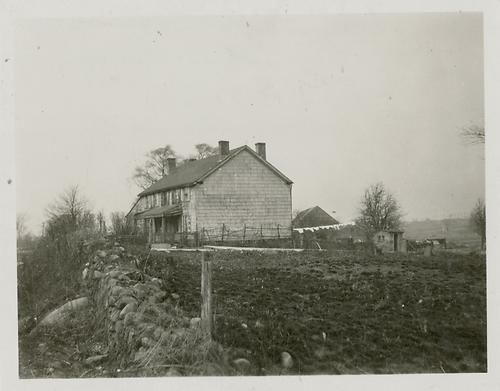
For centuries, the fields of Newtown—present-day Elmhurst and its surrounding neighborhoods in Queens—were renowned for their agricultural bounty. Farmers here cultivated vegetables, grains, and fruit, including the celebrated Newtown Pippin apple, which became an export crop sought far beyond Long Island’s shores. That reputation for productivity was not a happy accident. It was the result of deep geological forces that shaped the very ground beneath farmers’ feet thousands of years before the first furrows were plowed.

The Glacial Legacy
Roughly 21,000 years ago, during the last ice age, the Wisconsin glaciation reached its maximum extent across what is now the northeastern United States. Massive ice sheets—hundreds of feet thick—crept southward, grinding down rock, scooping valleys, and depositing enormous amounts of sediment as they advanced and retreated.
As Nikolaou (2004) notes, “During the more recent Pleistocene… the landscape was modified due to glaciation and the work of glacial meltwaters. Continental ice flowed slowly from the north, picking up on the way loose rock material. During the melting of ice, clay, sand, gravel and boulders were transported from north. This mixture, known as the terminal moraine, forms the spine of Long Island.”
Long Island is itself a geological monument to that era, formed almost entirely from glacial deposits. Its spine is marked by a series of moraines, which are ridges of unsorted sediment dropped at the edges of the ice sheet. The Harbor Hill Moraine runs through the northern part of the island, while the Ronkonkoma Moraine arcs through its center. South of these ridges lies the broad outwash plain, where meltwater streams from the glaciers fanned out, leaving layers of sand and gravel.
Newtown sits in a transitional zone between the moraine’s rolling hills and the flatter outwash plain. This location gave it a combination of soil types—both the coarser, well-drained sands of the outwash and the richer, more varied soils of moraine slopes. This mix created a natural balance: good drainage to prevent waterlogging, but enough fine particles to hold moisture during dry spells.

The Quality of Glacial Till
The foundation of this fertility was glacial till—a heterogeneous blend of clay, silt, sand, gravel, and occasional boulders deposited directly by ice. Unlike layered sediments left by rivers or lakes, till is unsorted, containing materials of many sizes packed together. In Newtown and much of western Long Island, the till tended to be loamy, meaning it had a nearly ideal balance between sand (for drainage), silt (for moisture retention), and clay (for nutrient holding capacity).
As Shah et al. (2006) point out, these deposits “comprise boulders, gravels, sand, silt, clays and compressible soils,” and their variability is a key part of the local geology. The moraine ridge “is composed of this glacial till deposit” and its composition is the starting point for understanding both past agricultural success and present-day engineering challenges.
This balance mattered for crops. Sandy soils drain too quickly, leaving plants thirsty; heavy clay holds water but can drown roots. Loam offers the “Goldilocks” middle ground—moist but not saturated, airy enough for root growth, and rich enough to support successive plantings without rapid depletion. Early farmers, both Indigenous peoples and European settlers, recognized this advantage intuitively.
The soils were also mineral-rich, thanks to the glaciers’ grinding of diverse bedrock from far to the north. Nikolaou (2004) notes that the outwash plain south of the moraine overlies “a thick series of dense Cretaceous clays and sands reaching bedrock at depths exceeding 300 meters.” These deeper formations contributed to the slow-release nutrient base that made the land so productive.

Early Agricultural Abundance
Long before Europeans arrived, Indigenous Algonquin-speaking peoples farmed patches of this land, supplementing hunting and fishing with the cultivation of corn, beans, and squash. The soils’ natural fertility and moderate climate allowed repeated cropping without artificial fertilizers, especially when paired with traditional practices such as intercropping and fallowing.
When Dutch and English settlers took up farming here in the 17th century, they found the ground responsive and forgiving. Wheat, rye, oats, and barley grew well in rotation with hay and pasture. Orchards thrived, especially apples, which benefited from the soils’ drainage and mineral content. By the 18th century, Newtown’s reputation as a producer of high-quality food was well established.
One key factor was the ease of soil management. Glacial till, while containing stones, was not so rock-bound as to be prohibitive to plowing. Farmers could work the land with animal-drawn implements, remove larger stones for building walls, and still have a friable, plant-friendly surface. Seasonal flooding from nearby creeks and the deposition of organic-rich sediments in low areas further enhanced fertility in certain fields.

The Moraine-Outwash Advantage
Newtown’s geological position between moraine and outwash plain also meant that different crops could be matched to specific microzones. Slightly higher moraine slopes were ideal for orchards and grains that preferred well-drained conditions. Lower-lying outwash soils, where groundwater was more accessible, favored vegetables that needed steady moisture. This variety allowed farmers to diversify their production, which was an economic hedge and a means of maintaining soil health.
The proximity to Newtown Creek and other tidal inlets added another advantage: marsh hay. Cut from nearby salt meadows, this resource could be carted to farms as animal bedding and then returned to fields as manure—an early nutrient recycling system that kept soils productive for generations.
Shah et al. (2006) emphasize that the same water systems that benefitted agriculture also complicate construction today: “The complex nature of ground water flow through soil and the rocks make the dewatering plan more challenging during… complex deep foundations where water tables are shallow.”
Enduring but Not Eternal
The geological legacy that made Newtown’s soils so desirable persisted well into the 19th century, even as market gardening intensified to meet the demands of a growing New York City. Fertility could be sustained with crop rotations, manuring, and the importation of additional organic matter from the city’s stables.
But while the underlying soil structure—that glacially gifted loam—remained a constant, human use patterns would eventually push the land toward exhaustion. By the late 19th and early 20th centuries, relentless cultivation, reduced fallow periods, and creeping urbanization began to erode the soils’ natural advantages.
Nikolaou (2004) makes a point relevant to this decline: areas of deep, soft subsoils, such as those created by glacial lake deposits or reclaimed wetlands, “may create large seismic amplifications” in engineering contexts. In agriculture, the same kinds of deposits could be double-edged—rich and moist in their natural state, but vulnerable to compaction, drainage disruption, and eventual nutrient depletion under intensive cultivation.
A Dark Legacy Beneath Our Feet
The story of Newtown’s agricultural success and the entrenched reliance on slavery that accompanied it cannot be told without understanding the glaciers that shaped Long Island. From the moraines that define the island’s backbone to the outwash plains that fan toward the Atlantic, these ice age remnants created soils that, for centuries, supported one of the most productive farming districts in the region and one of the most slavery indebted communities in New York.
Even today, beneath layers of asphalt and concrete, the same geological framework lies dormant. Shah et al. (2006) conclude that NYC’s “complicated geological setting… has imposed extreme variability in the geotechnical parameters,” but for much of its history, that variability worked in Newtown’s favor. Where glacial till and outwash sands met in just the right proportions, the land yielded abundantly.
Though the legion of faces and farms have vanished, replaced by streets, homes, and factories, the loamy glacial till still lies beneath, a reminder that the borough’s history is written not only in buildings and deeds, but also in the ancient sediments underfoot. As Nikolaou (2004) underscores, “Large surface motions can be generated due to strong site amplification effects that far exceed those derived from Western experience”—a technical observation about seismic waves, but equally apt as a metaphor for the way Newtown’s deep geological past still resonates in its cultural memory.




Leave a Reply