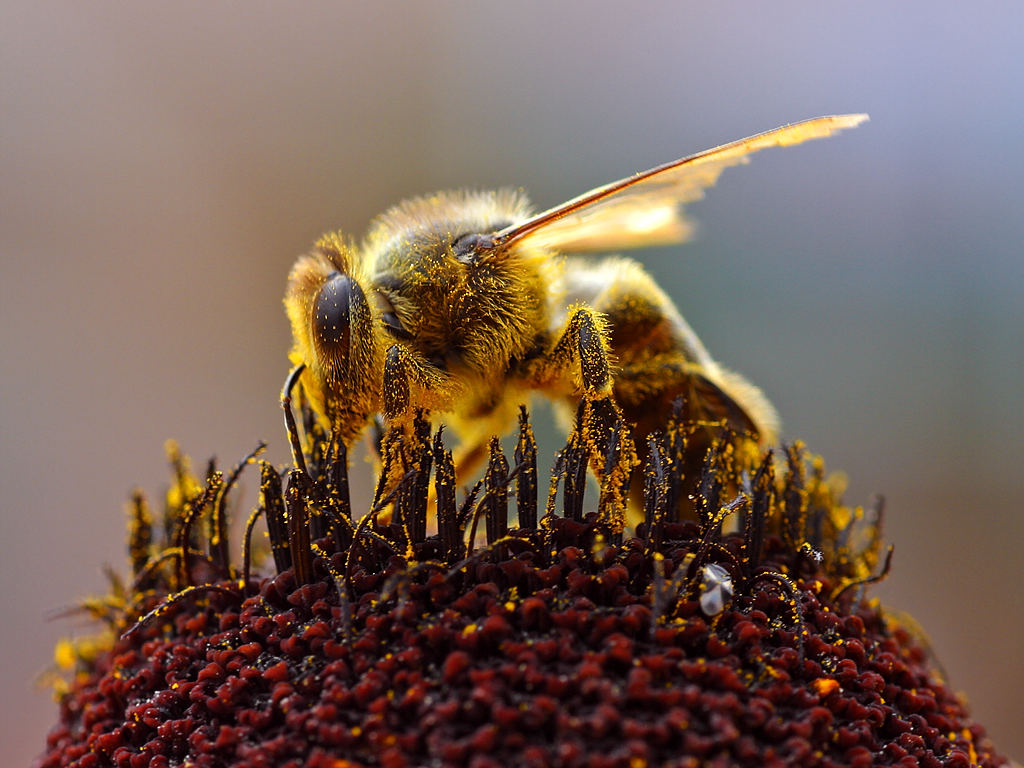

At first glance, the image shows a simple act: a honeybee nestled in the heart of a flower, dusted with golden pollen. But within this snapshot lies a symphony of biology, chemistry, and environmental interaction—one of the most vital relationships in nature.
Bees, particularly Apis mellifera, are among the most efficient pollinators on Earth. The scene captured here is not just a moment of feeding, but a key function in the continuation of flowering plants and global food webs. As the bee forages for nectar—a sugary energy source—it inadvertently collects pollen on the branched hairs of its body. These hairs, called scopae, are electrostatically charged due to the bee’s flight, helping pollen grains stick like iron filings to a magnet.
Pollen isn’t just a side effect. Female bees actively groom themselves and pack pollen into specialized structures called corbiculae, or “pollen baskets,” on their hind legs. This gathered pollen becomes a primary protein source for developing larvae back at the hive, while the accidental spillage across floral landscapes facilitates cross-pollination—a process critical to genetic diversity and crop yields.
The flower, for its part, has evolved in tandem with bees. Petal colors, UV patterns invisible to the human eye, and even scent compounds serve as nectar guides, directing pollinators precisely where to land and feed. These co-evolutionary traits maximize reproductive success on both sides. The flower’s reproductive organs—the stamen (male) and stigma (female)—are positioned so a bee’s contact ensures effective pollen transfer.
Zoom in further, and the image reveals another layer of complexity: the pollen grains themselves. Each microscopic sphere carries a distinct molecular signature, and some even contain species-specific allergens or bioactive compounds. Scientists use pollen morphology in palynology to reconstruct ancient ecosystems, track climate change, and even solve forensic cases.
Bees navigate to flowers using a sophisticated internal compass. They can detect polarized light, assess distance through optic flow, and communicate resource locations via the waggle dance—a behavior that encodes direction and distance relative to the sun. Their vision, although different from ours, is attuned to motion and ultraviolet patterns, making a flower’s bullseye target vividly clear.
Yet, this intimate connection is under threat. Pesticides, habitat loss, climate shifts, and diseases like colony collapse disorder have decimated bee populations. The consequences ripple across ecosystems and economies. One-third of all food consumed by humans depends on pollination, and bees contribute billions annually to global agriculture.
This photograph is more than an aesthetic marvel—it’s a visual thesis on ecological interdependence. It captures the precision of evolution, the elegance of mutualism, and the fragile thread connecting a single insect to the stability of life on Earth.
In the pollen-dusted fur of a honeybee, we see not just gold, but value beyond measure.

Leave a Reply