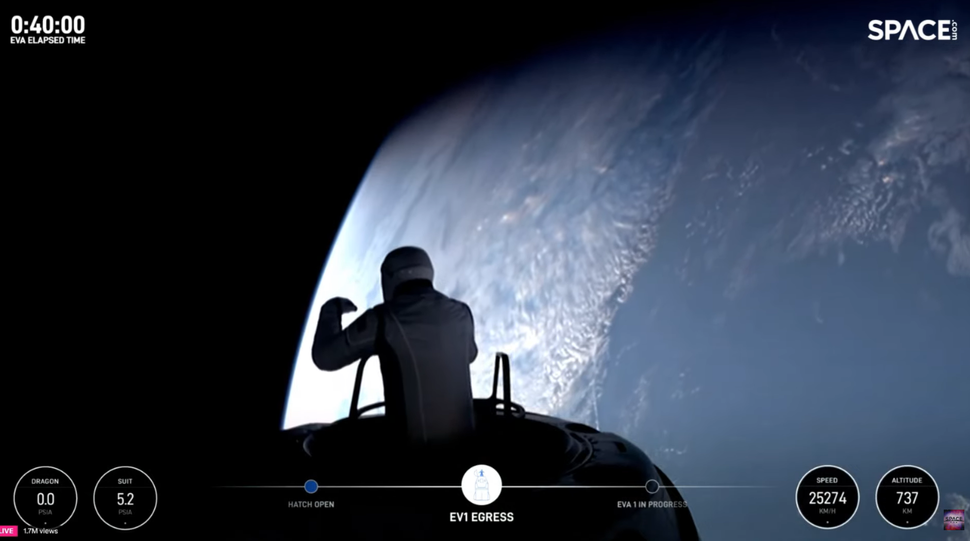
POLARIS DAWN ACHIEVES HISTORIC FIRST COMMERCIAL SPACEWALK
Polaris Dawn has achieved a historic milestone by conducting the world’s first commercial spacewalk. Launched on September 10 from NASA’s historic Launch Complex-39A aboard a Falcon 9 rocket, the SpaceX mission carried four astronauts: billionaire Jared Isaacman (commander), pilot Scott “Kidd” Poteet, and mission specialists Sarah Gillis and Anna Menon. On September 12, during the mission’s third day, the crew reached an altitude of 870 miles, surpassing the Apollo-era record. They then descended to 458 miles, where Isaacman and Gillis performed a spacewalk lasting 1 hour and 46 minutes using new SpaceX-designed EVA suits. The mission utilized a modified Crew Dragon Resilience with a specialized “Skywalker” hatch and tested laser communications with Starlink satellites. Additionally, the crew conducted 36 scientific experiments from 31 institutions to support future space exploration, including missions to the Moon and Mars. Polaris Dawn, the second SpaceX mission funded by Isaacman, is set to return to Earth on its sixth day, concluding a groundbreaking commercial spaceflight. (space.com)
WHAT DOES POLARIS DAWN SPACEWALK MEAN FOR SCIENCE?
Polaris Dawn, SpaceX’s private mission launched on September 10, has already set multiple records, reaching an unprecedented altitude of 1,400 kilometers—the highest orbit by a crewed spacecraft since Apollo. On September 12, astronauts Jared Isaacman and Sarah Gillis completed the first-ever commercial spacewalk at over 700 kilometers, showcasing SpaceX’s advanced EVA suits designed for future missions, including Mars. The mission, led by Isaacman, aims to advance private spaceflight and support SpaceX’s broader ambitions, including the upcoming Starship missions for NASA’s Artemis program. Polaris Dawn is conducting 36 experiments from 31 institutions, focusing on astronaut health in microgravity, bone density, vision changes (SANS), and radiation effects. These studies benefit from the frequent private flights, accelerating research compared to traditional government missions. Additionally, the mission demonstrated the feasibility of private companies performing complex space operations, potentially enabling future tasks like repairing scientific equipment in orbit. Polaris Dawn is set to return to Earth soon, delivering valuable scientific data to enhance human space exploration. (Nature)
OPENAI LAUNCHES O1 MODEL WITH ENHANCED LOGICAL REASONING
OpenAI has introduced a groundbreaking AI model, OpenAI o1, marking a shift from simply increasing model size to enhancing logical reasoning abilities. Unlike traditional large language models like GPT-4o, which generate answers in a single step, o1 reasons through problems step-by-step, significantly outperforming its predecessor on complex tasks. For example, on the American Invitational Mathematics Examination, o1 achieved an 83% success rate compared to GPT-4o’s 12%. Internally named Strawberry, o1 employs reinforcement learning to improve its reasoning strategies and is designed to complement GPT-4o rather than replace it. Although o1 is slower and lacks web search and multimodal capabilities, it excels in areas such as coding, math, and scientific problem-solving. OpenAI plans to integrate this reasoning approach into its upcoming GPT-5 model. Experts acknowledge the advancement but note challenges like transparency and factual accuracy. OpenAI asserts that o1’s enhanced reasoning improves safety and aligns outputs with desired behaviors, aiming for more intelligent and cost-effective AI solutions. (Wired)
US CONSIDERS BOOSTER DOSES AMID MPX OUTBREAK
As a deadly mpox outbreak spreads in Africa and globally, the U.S. contemplates booster doses of the Jynneos vaccine for vulnerable populations. The World Health Organization declared the outbreak in the Democratic Republic of Congo a public health emergency, involving the severe clade Ib strain. The 2022 clade IIb outbreak in the U.S. infected over 30,000 people, controlled by the two-dose Jynneos regimen. However, emerging data indicate antibody levels may wane within a year, sparking debates on booster necessity. Dr. Ashish Jha suggests boosters might be needed if clade Ib spreads rapidly, but current CDC guidelines do not recommend more than two doses for the general public. Vaccination rates among at-risk groups remain low, with only about 25% fully vaccinated. A new study highlights declining immunity, yet vaccines still reduce severe illness. Efforts continue to increase vaccine availability and enhance U.S. public health readiness to prevent widespread outbreaks. (CNN)

ASTEROID 2024 PT5 BECOMES EARTH’S TEMPORARY MINI-MOON
Asteroid 2024 PT5 is set to become Earth’s temporary mini-moon, orbiting the planet from September 29 to November 25 before escaping back into space. Measuring approximately 33 feet long, 2024 PT5 was discovered on August 7 by NASA’s Asteroid Terrestrial-impact Last Alert System (ATLAS). Unlike most asteroids that either miss or collide with Earth, this space rock will loop around our planet in a horseshoe-shaped orbit, though it won’t complete a full revolution to qualify as a true mini-moon. Researchers believe it may be a fragment from a past lunar impact, adding intrigue to its origin. Observing 2024 PT5 will enhance understanding of near-Earth objects and their behaviors. Additionally, such asteroids are of interest for potential mining of precious metals and for planetary defense, highlighting the importance of tracking and studying these transient celestial visitors to protect and benefit humanity. (New York Times)
SPACE INDUSTRY MAKES SIGNIFICANT PROGRESS WITH REUSABLE ROCKETS
Edition 7.11 of the Rocket Report highlights significant advancements and developments in the global reusable rocket industry. China’s private sector is making strides with Landspace successfully completing a 10 km vertical takeoff and landing test of its Zhuque-3 rocket, aiming for reusable boosters by 2026. Deep Blue Aerospace and other Chinese firms are also progressing in reusable technology. Germany’s Isar Aerospace cautiously approaches its Spectrum rocket’s first flight, setting low expectations for success. The FAA is advancing new orbital debris regulations to mitigate space junk from upper stages. South Korea’s Korea Aerospace Administration plans ambitious reusable rockets targeting low-cost payload delivery by the mid-2030s. bluShift Aerospace in Maine achieved a significant engine test, moving towards commercial suborbital launches. Additionally, SpaceX’s Polaris Dawn mission set records with a private spacewalk, while NASA’s Europa Clipper prepares for its Falcon Heavy launch. Upcoming launches include missions from Falcon 9, Electron, and New Glenn rockets, showcasing a dynamic and evolving space industry. (Ars Technica)
Thanks for reading. Let’s be careful out there.
WORDS: The Biology Guy.
IMAGE CREDIT: SpaceX.



Leave a Reply