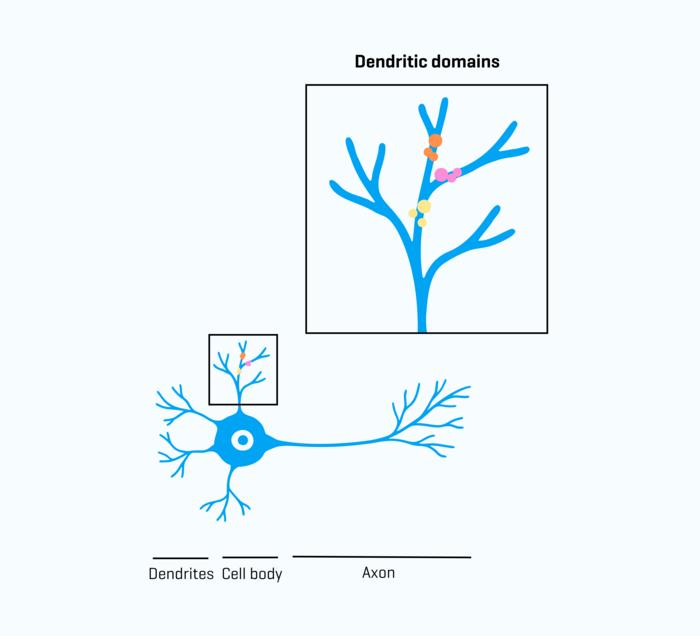
A new mouse study from the Netherlands Institute for Neuroscience (NIN) reveals that neurons establish “mini-computers” very early in life to make the brain computationally powerful.
Building a functional brain requires neuronal circuits to be wired up with high specificity. Key players in this system are branched extensions from neurons called dendrites, which process and integrate the information they receive from other neurons. Previously, computational neuroscientists proposed that dendrites can compute information locally in many individual segments within one cell. Such “computational subunits” or “mini-computers” would increase a neuron’s computational power dramatically. However, how neurons wire up these mini-computers inside the living brain during development is still unknown.
But what if we could observe the development of these subunits in real life? In a new study from the group of Christian Lohmann, researchers looked into the computational subunits in the intact developing brain of young mice. They indeed discovered that the communication points in the dendrites, or synapses, are clustered according to the information they are transmitting. In other words, neighboring synapses that transmit similar information are clustered together in dendritic domains.

Christian Lohmann: ‘We made this discovery by recording time-lapse videos from dendrites of individual neurons in the cortex of living mice. Interestingly, this sorting already happens before the mice open their eyes, so before they receive visual information. Here, we demonstrate that neighboring synapses are frequently coactive. When synapses are further away from each other, they are less coactive. It seems that this spontaneous activity (the activity the brain generates before eye opening) is sufficient for sorting synapses into domains and thus probably for establishing the computational subunits.
But why is this important? This work could potentially explain why certain errors in development can cause neurodevelopmental disorders. “To investigate this further, we would like to look into mouse models of neurodevelopmental disorders, to see whether the sorting of synapses is absent or altered. This would support the idea that successful sorting of synapses along dendrites is required for the development of a healthy brain.”
Answers to this question will help us understand better how our brains develop and how errors in development can compromise the brain’s computational power. They could also potentially give new ideas for designing biologically inspired artificial neuronal networks for high-level information processing as for example AI. Lohmann concludes: “To me the most fascinating thing is how specifically neurons are connected and how early this is possible without even knowing anything about the outside world. It is amazing how the brain can do this.”
IMAGE CREDIT: Netherlands Institute for Neuroscience




Leave a Reply