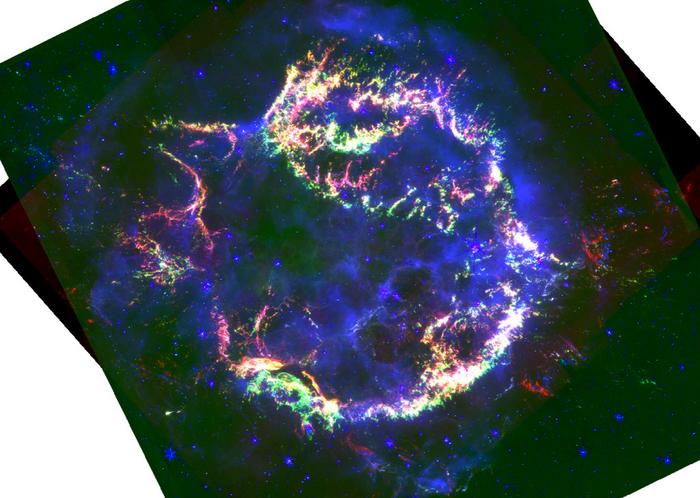
The SETI Institute announced the latest findings from the James Webb Space Telescope (JWST) of the supernova remnant, Cassiopeia A (Cas A). These observations of the youngest known core collapse supernova in the Milky Way provide insights into the conditions that lead to the formation and destruction of molecules and dust within supernova ejecta.
The study’s findings change our understanding of dust formation in the early universe in the galaxies detected by JWST 300 million years after the Big Bang. Researchers consider supernovae, such as those that formed Cas A, vital sources of the dust seen in distant, high-redshift galaxies. These new insights challenge beliefs that dust primarily originated from intermediate-mass stars on the asymptotic giant branch (AGB) in present-day galaxies.
“It is remarkable to see how bright the carbon monoxide emission detected in JWST NIR imaging and spectroscopy, showing a few tens of sinusoidal patterns of CO fundamental rovibrational lines,” said Dr. Jeohghee Rho, research scientist at the SETI Institute who led this research. “The patterns look like they were artificially generated.”

Key findings include:
- Supernovae such as Cas A, located 11,000 light years away, are explosions that occur when a high mass star comes to the end of its life about 350 years ago. Called a core collapse supernova, the star’s interior collapses inwards due to gravity once the nuclear fuel that powered the star is depleted. The rebound of this collapse blows the star’s outer shell into space in an explosion that can outshine an entire galaxy.
- Molecular CO Formation: The data shows more CO gas in the outer layers than argon gas, which means CO molecules are forming again after the reverse shock. This data is important for understanding how cooling and dust formation happen after a supernova explosion. The images indicate CO molecules are reformed behind the shock and may have protected the dust in the ejecta.
- Detailed Spectroscopy: The NIRSpec-IFU spectra of two significant areas in Cas A show differences in how elements were formed. Both regions have strong CO gas signals and show various ionized elements like argon, silicon, calcium, and magnesium. The fundamental CO lines are a few tens of sinusoidal patterns of CO fundamental rovibrational lines with a continuum-like underneath due to the high velocity of the CO molecules.
- emperature Insights: The research shows that the temperature is about 1080 K, based on the CO gas emissions. This helps us understand how dust, molecules, and highly ionized gas interact in supernovae. However, the authors also find vibrational lines in high rotational (J=90) lines, which features appear between 4.3-4.4 microns. These lines indicate the presence of hotter (4800 K) temperature component, implying CO formation and reformation at the same time. CO from such high rotational levels is first seen in Cas A with the new JWST spectroscopy.
Sign up for the Daily Dose Newsletter and get every morning’s best science news from around the web delivered straight to your inbox? It’s easy like Sunday morning.
“To see such hot CO in a young supernova remnant is truly remarkable and indicates that CO formation is still happening thousands of years after the explosion,” said Chris Ashall, Assistant Professor at Virginia Tech. “Combining such impressive data sets with earlier JWST observations of supernovae will allow us to understand the pathway to molecules and dust formation in a way not previously possible.”
Groundbreaking Images and Spectroscopy
The observations utilized JWST’s Near Infrared Camera Instrument (NIRCam) and the Mid Infrared Instrument (MIRI), along with detailed Near-Infrared Spectrograph (NIRSpec)-Integral Field Units (IFU) spectroscopy. The team mapped the intricate structures of synchrotron radiation (light emitted when charged particles, like electrons, are sped up into high speeds in strong magnetic fields), argon-rich ejecta, and carbon monoxide (CO) molecules within Cas A. The images show very detailed and intricate patterns of shells, holes and filaments, highlighting how powerful JWST is.
Seong Hyun Park, a graduate student at Seoul National University in South Korea, performed modeling of the CO properties together with Rho.
The new observations highlight supernova remnants’ complex and competing molecular formation and destruction processes. While not directly leading to dust formation, CO molecules are critical indicators of the cooling and chemical processes that eventually lead to dust condensation.
While this study offers new perspectives, the debate continues regarding the extent to which supernovae contribute to dust formation in the early universe. Researchers will continue exploring these phenomena with future observations and research to unravel the mysteries of cosmic dust and molecular formation.
IMAGE CREDIT: SETI Institute
If you enjoy the content we create and would like to support us, please consider becoming a patron on Patreon! By joining our community, you’ll gain access to exclusive perks such as early access to our latest content, behind-the-scenes updates, and the ability to submit questions and suggest topics for us to cover. Your support will enable us to continue creating high-quality content and reach a wider audience.
Join us on Patreon today and let’s work together to create more amazing content! https://www.patreon.com/ScientificInquirer



Leave a Reply