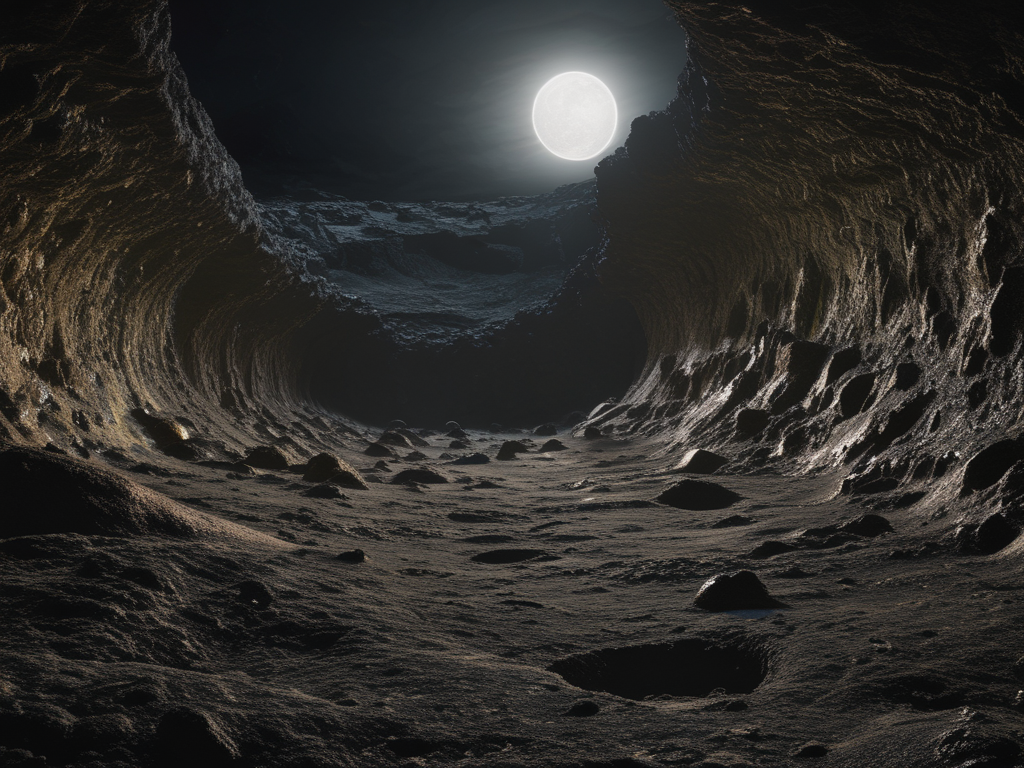
A team of international scientists, under the lead of the University of Trento, Italy, has published a research study that has made a milestone discovery on the Moon knowledge.
For the first time, scientists have demonstrated the existence of a tunnel in the lunar subsurface. It seems to be an empty lava tube. The research study was published by Nature Astronomy and is the result of an international collaboration.
“These caves have been theorized for over 50 years, but it is the first time ever that we have demonstrated their existence,” explains Lorenzo Bruzzone, professor at the University of Trento.

How was this demonstration achieved? Bruzzone explains: “In 2010, as part of the ongoing LRO NASA mission, the Miniature Radio-Frequency (Mini-RF) instrument acquired data that included a pit in Mare Tranquilitatis. Years later we have reanalysed these data with complex signal processing techniques we have recently developed, and have discovered radar reflections from the area of the pit that are best explained by an underground cave conduit. This discovery provides the first direct evidence of an accessible lava tube under the surface of the Moon.”
“Thanks to the analysis of the data we were able to create a model of a portion of the conduit,” continues Leonardo Carrer, researcher at University of Trento. “The most likely explanation for our observations is an empty lava tube.”
The Mini-RF principal investigator, Wes Patterson, from the Johns Hopkins Applied Physics Laboratory adds “This research demonstrates both how radar data of the Moon can be used in novel ways to address fundamental questions for science and exploration and how crucial it is to continue collecting remotely sensed data of the Moon. This includes the current LRO mission and, hopefully, future orbiter missions.”
The study, partially funded by the Italian Space Agency, involved also researchers of the University of Padua and La Venta Geographic Explorations APS who contributed to the geological analyses and the modelling of the identified conduit.
The study has scientific importance and implications for the development of missions to the Moon, where the environment is hostile to human life. Surface temperatures on the illuminated side of the Moon can reach 127°C, while temperatures on the unilluminated side can drop to -173°C. Cosmic and solar radiation can be as much as 150 times more powerful on the lunar surface than we experience on Earth and there is a constant threat of meteorite impact. These conditions drive a need to find safe sites for the construction of infrastructure that can support sustained exploration. Caves such as this one offer a solution to that problem.




Leave a Reply