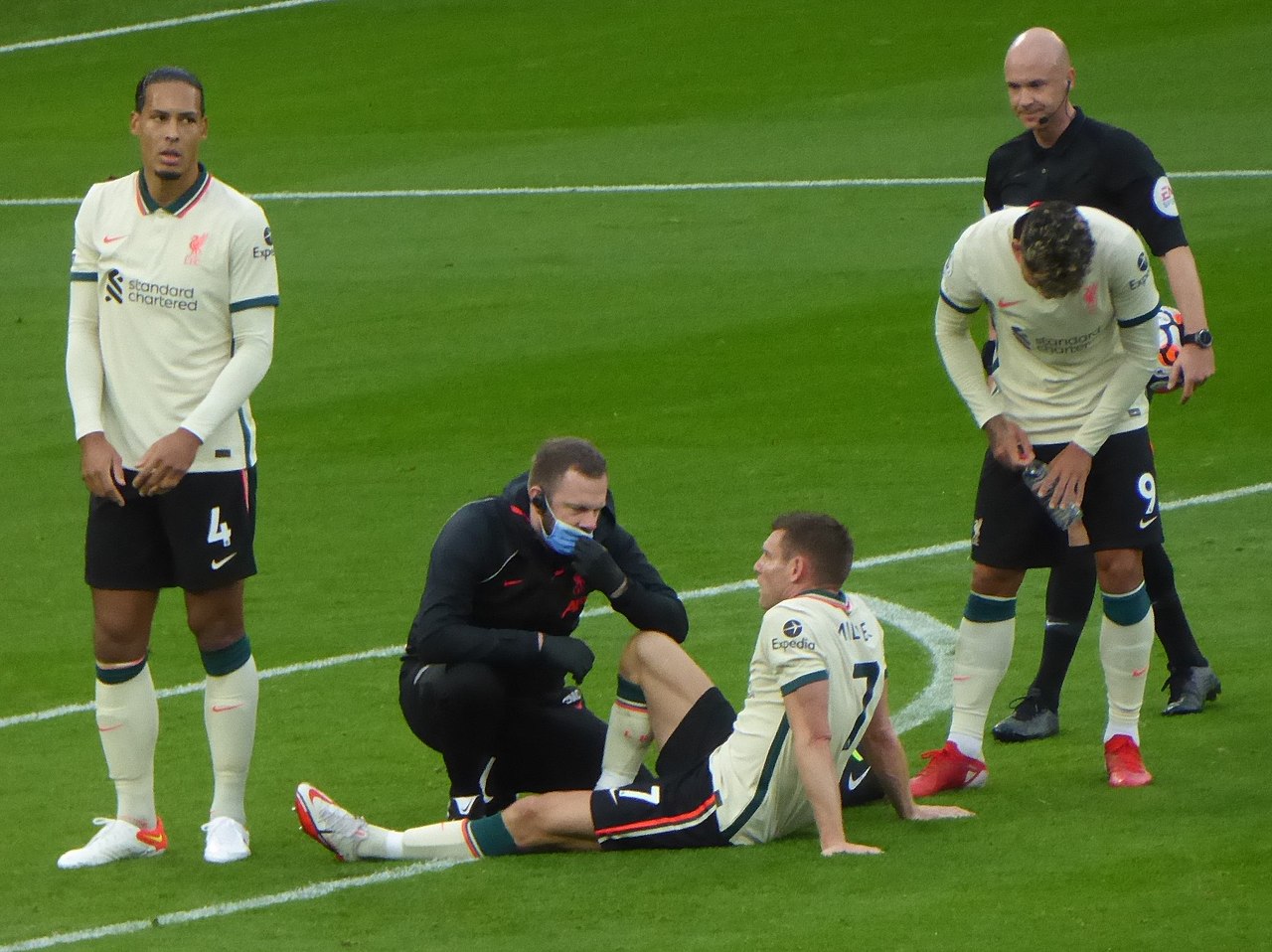
The physiological impact of Video Assistant Referees (VAR) checks is having a damaging effect on players in the English Premier League and other European football leagues. Of course, not all injuries can be attributed to VAR, it is one factor of many. But unlike other contributors to injuries, this one is preventable.
First implemented in 2019, VAR is exceptionally hard for fitness coaches and physios to prepare for. Given the lack of communication from VAR officials to those in the stadium, there is no way of knowing whether a check will take five seconds or five minutes. If there was consistency, it would be easier for these staff members to prepare and create a plan to keep players warm during this period. But the complete unpredictability makes this an almost impossible factor.
It’s important to consider the temperatures that players are playing in. Temperatures in England throughout winter can reach close to freezing, and often the temperature is cold for around half the year. In 2023, the average UK temperature was below 10 degrees Celsius from November to April. These cold temperatures, given the lengthy VAR breaks, are extremely dangerous to the wellbeing high performance athletes.
There are already complaints about how full the English football calendar is. In the Premier League, teams only have a brief winter break that allows for a couple of weeks of recovery. Beyond that, there is very little opportunity to rest from the time the season starts in August to when it ends in May. If a team is competing on multiple fronts, such as in Europe or the FA Cup, the number of games increases too.
VAR, then, exacerbates the problem.
According to a 2020 BBC article about the spike in injuries (see table below), the season had been significantly impacted by a surge in player injuries, attributed largely to a compressed schedule and insufficient recovery time. Jurgen Klopp, Liverpool’s manager, had been vocal about the detrimental effects of the dense fixture list, which he believes is contributing to the injuries. Data from Premier Injuries highlighted a 23% increase in muscle injuries compared to the previous season, with 133 incidents reported in just the first nine matchdays. Notable players sidelined included Liverpool’s Virgil van Dijk and Joe Gomez, Manchester City’s Sergio Aguero, and Chelsea’s Christian Pulisic.
The discussion around the number of substitutes allowed per match was reignited, with managers like Klopp and Pep Guardiola advocating for a return to five substitutes to mitigate injury risks. This suggestion, however, was met with resistance, with the Premier League opting to maintain the limit of three substitutes, despite other major leagues and UEFA competitions allowing five. This decision has sparked debate among managers and experts about player welfare and the fairness of the rule.

Two years later, the problem worsened. According to a 2022 BBC article, injuries surged in Europe’s top five football leagues (Premier League, La Liga, Bundesliga, Ligue 1, Serie A) during the first half of their seasons, accounting for nearly 60% of last season’s total despite a decrease in soft-tissue injuries.
During the 2022-23 Premier League season, there were a total of 196 injuries in just over three months at the start of the top-flight season. This represented a 15% increase compared to the past four campaigns. The impact of the 2022 winter World Cup may also have contributed to player strain. The first half of the 2022-23 Premier League season was condensed to accommodate more games before the tournament, leading to a higher injury toll
In November 2023, Tottenham Hotspur faced Chelsea in a Premier League game of huge importance to both teams, especially given the local rivalry. The game was particularly feisty, and led to a number of VAR stoppages, notably the pause to determine the correct card to be given to Cristian Romero (which was red) and multiple checks to goals deemed onside or offside on field.
This game had an incredible 21 minutes of added time, largely thanks to VAR. But more problematic was the role that it almost certainly played in Tottenham player Micky van de Ven’s hamstring injury, which kept him out of action for three months. Van de Ven is a player who relies on multiple, intense recovery sprints a game. Fitness coaches will ensure he is prepared to operate at his maximum during games, but when faced with 15-20 minutes of VAR stoppages, it is hard to prepare for and likely to cause injury.
He is not the only one.
Maheta Molango, Director of the Professional Footballers’ Association, commented on the Tottenham vs Chelsea game. “The stoppages like we saw on Monday will lead to injuries because players cooled down and then have to sprint straight away,” Molango said, as cited in The Mirror. “Player welfare should be a big issue. But we are killing the product at the moment and that should be everybody’s biggest fear.”
| Number of injuries by Premier League club (August 2020 – November 2020) | |||
|---|---|---|---|
| Arsenal | 9 | Liverpool | 10 |
| Aston Villa | 7 | Man City | 3 |
| Brighton | 8 | Man Utd | 6 |
| Burnley | 4 | Newcastle | 7 |
| Chelsea | 3 | Sheffield United | 3 |
| Crystal Palace | 6 | Southampton | 3 |
| Everton | 2 | Spurs | 5 |
| Fulham | 4 | West Brom | 3 |
| Leeds | 5 | West Ham | 2 |
| Leicester | 5 | Wolves | 3 |
The addition of VAR to English football has been one of the more controversial additions to the game in recent years.
The premise behind it is simple. Human referees, like anyone, make mistakes. In big moments, in small moments, mistakes happen. Teams are incorrectly awarded penalties, players are not given the appropriate color card for their offence, linesmen occasionally get tight offside calls incorrect.
VAR’s role was (and is, supposedly still) to fix this. In February 2024, Tony Scholes, the Premier League’s Chief Football Officer, said that VAR has led to 96% of decisions made by referees being correct this season, as opposed to the 82% of decisions correct prior to the technology’s arrival.
These numbers are controversial anyway, given that refereeing decisions are ultimately subjective. Offsides can be objective and assessed to the tiniest margin, but handballs and tackles are ultimately subjective. Some are, of course, more obvious than others, but it’s unclear on what basis the Premier League claims there has been a 14% increase in correct decisions. Many fans would certainly disagree.
VAR has been a disaster with fans. Decisions often take minutes to complete, while there is no communication in the stadium or on TV. This means that those watching do not know what is going on, while someone sits in a studio, sometimes hundreds of miles away, deciding whether a minor moment on the field warrants further intervention.
But while this is terrible from a fan perspective, it is even worse for the players. As VAR referees mull over what to do, players must simply stand and wait on the field for the referees to decide. This is a factor that now looks as though it is causing problems for the players themselves, given the drastic increase in muscle injuries as VAR delays have grown longer.
The money in the Premier League is ludicrous, and not just for players. Teams have spent tens of millions of pounds developing their fitness and physio departments, on both equipment and staff. Teams employ the most advanced and talented practitioners in the field, people who know everything there is to know about sports science. This season alone, Burnley, who sit 19th and look destined for relegation to the Championship, opened a new state-of-the-art training facility that itself could only be paid for with Premier League money.
A study revealed that in 2022, 2,524 injuries increased from the beginning of the season up until January 18, with the Premier League experiencing the most at 659. Financially, injuries had cost clubs approximately £280 million, with the Premier League bearing the highest injury cost at £89.82 million. Real Madrid faced the highest injury-related expenses at £16.3 million.
Teams don’t need to spend millions of pounds on developing fitness equipment and staff to tell them that being stood around on a football pitch doing nothing in between refereeing decisions is not good for the body. Anyone with a basic understanding of exercise could explain that standing still between extreme exercises is likely to lead to injuries. So why does refereeing in England simply allow this to happen?
VAR has caused enough problems in the Premier League, and the sooner we can move on from this failed experiment the better.
WORDS: George Fallon
IMAGE CREDIT: Ardfern.
Sign up for the Daily Dose Newsletter and get the morning’s best science news from around the web delivered straight to your inbox? It’s easy like Sunday morning.




Leave a Reply