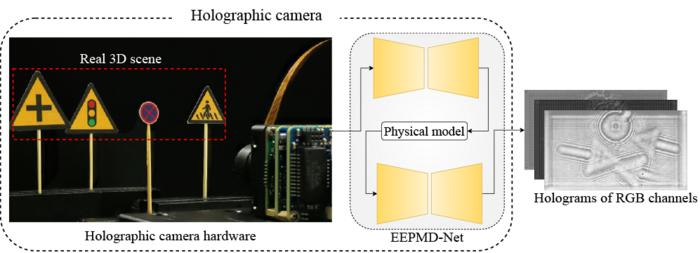
Holography technology can restore the complete light field information of the recorded object, which has important applications in fields like biological microscopic imaging and optical micromanipulation. One important frontier of holography is the reconstruction of realistic 3D scenes. However, the development and application of holographic technology have been hindered by the huge amount of data of the 3D scenes and the laser coherence, which leads to the slow capturing speed of the real 3D scenes and the serious speckle noise of the holographic reproduced image.
In a new paper published in Light: Science & Application, a team of scientists led by Professor Qiong-Hua Wang from Beihang University, China, Professors Song-Lin Zhuang and Da-Wei Zhang from the University of Shanghai for Science and Technology, China, have collaborated on the development of a holographic camera that can be used to acquire holograms of real 3D scenes. The camera can obtain high-quality holograms of real 3D scenes within 150 ms.
The researchers used a liquid camera based on a large-aperture liquid lens and an end-to-end physical model-driven network in the holographic camera. The liquid lens with an aperture of 10 mm has low driving voltage, fast response speed, and a wide range of optical power, which ensures the fast and high-quality capture of real 3D scenes. In addition, the well-trained end-to-end physical model driving network can quickly calculate high-quality holograms of real 3D scenes acquired by the liquid camera. Using the proposed holographic camera, high-fidelity holographic reconstruction of the real 3D scene can be achieved at real depth.
The holographic camera solves the two major bottlenecks of the existing holographic technology, which are the difficulty in acquiring the real 3D scene quickly and the low quality of the holographic reconstructed image, and it is expected to be widely used in many fields, such as 3D display and measurement encryption.
IMAGE CREDIT: Di Wang, Zhao-Song Li, Yi Zheng, You-Ran Zhao, Chao Liu, Jin-Bo Xu, Yi-Wei Zheng, Qian Huang, Chen-Liang Chang, Da-Wei Zhang, Song-Lin Zhuang, and Qiong-Hua Wang

Sign up for the Daily Dose Newsletter and get the morning’s best science news from around the web delivered straight to your inbox? It’s easy like Sunday morning.

Leave a Reply