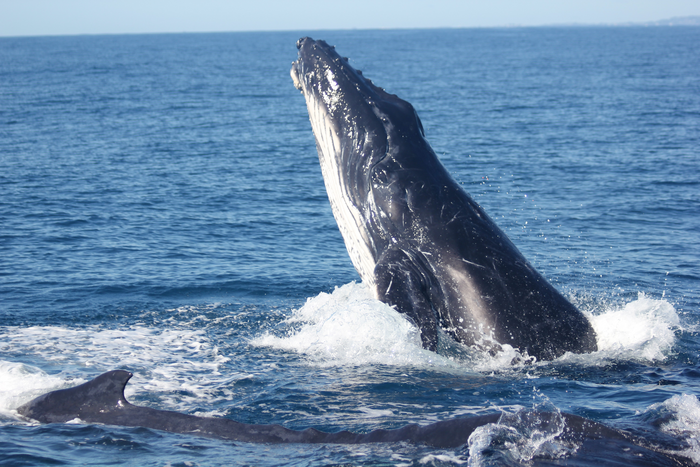
A University of Queensland study has found humpback whales sing louder when the wind is noisy, but don’t have the same reaction to boat engines.
Research lead Dr Elisa Girola from UQ’s Faculty of Science said this quirk of whale evolution could have consequences for breeding and behaviour.
“Humpback whales evolved over millions of years with noise from natural sources but noise from man-made vessels is foreign to their instincts,” Dr Girola said.
If you enjoy the content we create and would like to support us, please consider becoming a patron on Patreon! By joining our community, you’ll gain access to exclusive perks such as early access to our latest content, behind-the-scenes updates, and the ability to submit questions and suggest topics for us to cover. Your support will enable us to continue creating high-quality content and reach a wider audience.
Join us on Patreon today and let’s work together to create more amazing content! https://www.patreon.com/ScientificInquirer
“It’s a surprising finding given engine noise has a similar frequency range to the wind.
“It’s possible the whales are picking out other differences such as wind noise being broadband and the same over large areas, while vessel noise is generated by a single-point source with specific peaks in frequency.
“We don’t know yet if this lack of response to boat noise is making whales communicate less effectively or making breeding practices more difficult.
“Male humpback whale singing is probably used to mediate reproductive interactions, but we can’t say if vessel noise is interfering.”
The audio data for the study was collected in late 2010 off Peregian Beach in Queensland, during the whales’ southward migration from breeding grounds in the lagoon of the Great Barrier Reef to feeding grounds in Antarctica.
Whale songs were recorded using an acoustic array of five hydrophone buoys, which sent signals back to the beach.
A 19-metre fishing boat was introduced to produce vessel noise.
The researchers say it is possible that humpback whales are using other strategies to compensate for vessel noise.
“Even with a 19-metre boat making a racket, the whales just didn’t sing any louder,” Dr Girola said.
“There are a few things going on – they might be using ‘spatial release from masking’, which is the ability to discriminate between audio signals coming from different directions.
“Or there’s ‘comodulation release from masking’ which is the ability to discriminate between signal and noise when the noise has distinctive frequency components and at least some of these components are not overlapping with the signal.
“There’s still so much more research to be done.
“Understanding humpback whales’ response to noise is important for developing mitigation policies for human activities at sea.
“I’m sure these beautiful, mysterious creatures will continue to surprise and amaze us.”
IMAGE CREDIT: The University of Queensland




Leave a Reply