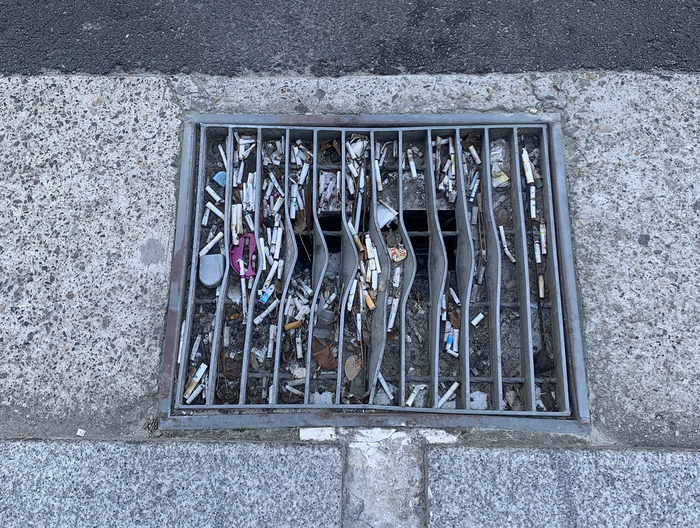
Cigarette filters are the world’s most common form of litter. Researchers from the University of Gothenburg can now show that the filters leak thousands of toxins and plastic fibres that are toxic to aquatic larvae. The researchers are therefore calling for these filters to be completely banned.
On the footpath, at the bus stop, in the park and on the beach. You can hardly avoid seeing cigarette butts in the streetscape. And these butts aren’t just butt-ugly to behold – they’re also really bad for the environment. A research group at the University of Gothenburg has shown in a study that microfibres and the chemicals that leak out of the filters in cigarette butts are toxic to aquatic larvae.
“The filter is full of thousands of toxic chemicals and microplastic fibres, so it’s not just any piece of plastic that’s being discarded into the environment. It’s hazardous waste,” says Bethanie Carney Almroth, Professor of Ecotoxicology at the University of Gothenburg.
If you enjoy the content we create and would like to support us, please consider becoming a patron on Patreon! By joining our community, you’ll gain access to exclusive perks such as early access to our latest content, behind-the-scenes updates, and the ability to submit questions and suggest topics for us to cover. Your support will enable us to continue creating high-quality content and reach a wider audience.
Join us on Patreon today and let’s work together to create more amazing content! https://www.patreon.com/ScientificInquirer
Cigarette filters killed mosquito larvae
In the study which has been published in the journal Microplastics and Nanoplastics, the researchers tested the effects of the toxins that are found in the filter after smoking, as well as the substances that are in the filter from the start, on aquatic mosquito larvae. It turns out that the toxins lead to a 20% higher mortality rate among mosquito larvae. Previous research has shown that the toxins in the filters also have adverse effects on many other aquatic organisms. For example, fish can die if they are exposed to concentrations corresponding to the toxins exuded by barely two cigarette butts in one litre of water for four days.
“Cigarette filters are also a major source of the microplastics that find their way into our environment – something we know has a major negative impact on biological life. The EU has already classified cigarette filters as hazardous waste,” says Professor Carney Almroth.
Cigarette butts are thrown on the ground
From the turn of the year, it will be the tobacco producers who have to pay for cleaning up cigarette butts. But it’s not enough to just put out more ashtrays. The researchers also observed in the study how smokers in Gothenburg behave when it’s time to put out their cigarettes. It turns out that many people throw their cigarette butts on the ground even if there are ashtrays nearby.
“The clean-up costs the municipalities millions of kronor, but there will still be many cigarette butts in the environment. We are now conducting a survey of plastic litter across all of Sweden with the aid of community science in what we’re calling the Plastics experiment. That way, we can work with school children and others to get better figures on where and how many cigarette butts with filters are found in the environment, in addition to other problematic plastic products” says Professor Carney Almroth.
Ban the filters!
She doesn’t think there are any good arguments at all for filters to remain a component of cigarettes. Along with other experts, Professor Carney Almroth has written an opinion piece in the magazine Science of the Total Environment arguing that cigarette butts are not just the most common litter item in the world, they are also just a marketing ploy that do little to protect the smoker, as many people believe they do.
“That’s why they have to be taken off the market entirely,” says Professor Carney Almroth. “It’s not the right approach to focus on making tobacco producers pay for cleaning up the filters. The problem should be prevented in the first place, rather than cleaned up later,” says Professor Carney Almroth.
IMAGE CREDIT: Bethanie Carney Almroth




Leave a Reply