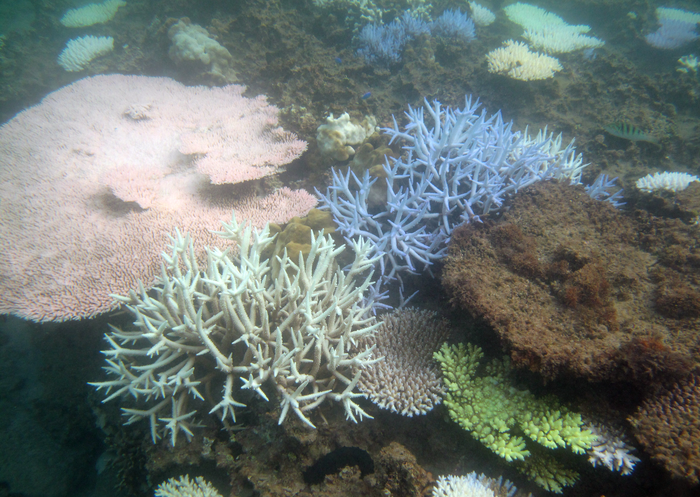
Limiting global warming to 1.5°C above pre-industrial levels will still be catastrophic for coral reefs, new research suggests.

Scientists led by the University of Leeds have discovered that more than 90% of tropical coral reefs will suffer frequent heat stress – their number one threat – even under Paris Agreement climate warming limits.
The 2015 agreement saw 191 countries and the EU sign up to a collective aim of keeping global average temperatures to less than 2°C above pre-industrial levels and pursuing efforts to limit heating to 1.5°C.
The new research suggests that the future of coral under 1.5c heating is even worse than predicted by the Intergovernmental Panel on Climate Change, which reported in 2018 that such a level would cause 70% to 90% of coral reefs to decline. Coral reef survival will require significant and urgent action globally to reduce greenhouse gas emissions.
Lead author Adele Dixon, a PhD researcher in the University of Leeds’ School of Biology, said: “Our finding reinforces the stark reality that there is no safe limit of global warming for coral reefs. Following the COP26 in Glasgow in which some progress was made towards the 1.5°C target, our finding shows that 1.5°C is still a substantial amount of warming for the ecosystems on the frontline of climate change.”
In the past few decades, 84% of the world’s tropical coral reefs have had enough time to recover between heat waves that cause bleaching mortality.
But the research team, which included colleagues from Australia and the United States, has found that even at 1.5°C, only 0.2% of reefs will have sufficient recovery time between heat events and 90.6% of reefs will suffer intolerable thermal stress.
Heat stress causes the decline of all reef species and reduces food and livelihood opportunities for people.
The findings are published today in the journal PLoS Climate.
The researchers set out to discover whether coral thermal refugia would be able to withstand global warming temperatures of 1.5°C and 2°C above pre-industrial levels.
Thermal refugia are areas of coral reef which can maintain suitable temperatures for coral survival even when ocean temperatures in surrounding areas rise. The researchers identified these as areas predicted to suffer severe heat stress less than once per decade, about the time required for reefs to grow back and return to full function after a severe coral bleaching event.
The team used historical data and the latest climate model projections generated by modelling institutions around the world to project future thermal exposure on shallow-water coral reefs globally. From this the researchers identified thermal refugia and predicted whether they would persist into the future.
Currently, refugia are found in all 12 coral reef regions across the globe: Australia, Brazil, the Caribbean, the Coral Triangle in the Western Pacific Ocean; East Asia, the East Pacific, Fiji, Hawaii, the Indian Ocean, the Persian Gulf, Polynesia and the Red Sea.
The findings showed that under global heating of 1.5°C, refugia would be wiped out in every region except for small areas in Polynesia and the Coral Triangle where lower rates of warming and periodic upwelling events, where colder deeper water is brought to the surface, reduce the frequency of severe heat stress events. However, at 2°C of global warming, these thermal refugia no longer exist.
There are ‘hope sites’ that have high variability in temperatures, such as in the Eastern Pacific. These areas may be better able to cope with temperature extremes.
Identifying and protecting thermal refugia is a popular recommendation for coral reef management. Local actions that remove other stressors such as fishing, tourism, and low water quality, promote resistance and recovery, and facilitate migration of coral to more suitable environments, can all aid reef conservation. But the research team concludes that protecting thermal refugia may only be effective in the short term.
Scott Heron, Associate Professor in Physics at the ARC Centre of Excellence for Coral Reef Studies, James Cook University, Townsville, Australia, said: “This analysis confirms that significant action on greenhouse gas emissions is urgent, with significant action needed this decade, but we also need to ramp up local management actions to help reefs survive through predicted impacts.”
Piers Foster, Professor of Climate Physics in the University of Leeds’ School of Earth and Environment and Director of Leeds’ Priestley International Centre for Climate, said: “Our work shows that corals worldwide are even more at risk from climate change than we thought at the time of the IPCC Special Report on 1.5°C. This reinforces the stark reality that there is no safe limit of global warming, and we need to act urgently to save what we can.”
Research supervisor Dr Maria Beger, Associate Professor in Conservation Science in the University of Leeds’ School of Biology, said: “Coral reefs are important for the marine creatures that live on them and for over half a billion people whose livelihoods and food security rely on coral reefs. We need to not only deliver on Paris goals – we need to exceed them, whilst also mitigating additional local stressors, if we want children born today to experience reef habitats.”
Dr Anne Stoner, Research Assistant Professor at Texas Tech University Climate Science Centre, Lubbock, Texas, USA, said: “Climate change is already impacting ecosystems in many areas of the world and will become dangerous even at 1.5°C of global warming. As such, it is crucial that action is taken now to limit global warming.”
IMAGE CREDIT: Beger Lab

Leave a Reply