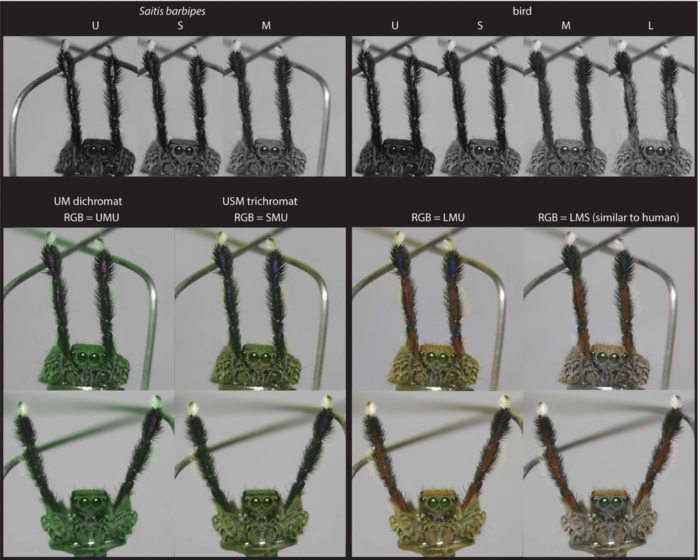
Jumping spiders, the flamboyant dandies of the eight-legged set, have names inspired by peacocks, cardinals and other colorful icons.

But University of Cincinnati associate professor Nathan Morehouse and an international team of researchers led by Cynthia Tedore at the University of Hamburg found that one jumping spider might have little appreciation for its own vivid splendor.
Morehouse examined Saitis barbipes, a common jumping spider found in Europe and North Africa. Males have a furry red crown and legs. Their coloration seems to complement their elaborate courtship dances to woo discerning females.
“We assumed they were using color for communication. But we didn’t know if their visual system even allowed them to see those colors,” said David Outomuro, a UC postdoctoral researcher now at the University of Pittsburgh.
Outomuro was first co-author of the study with Mateusz Glenszczyk, a researcher from the University of Hamburg.
Biologists collected spiders in Slovenia for lab study in Germany and used microspectrophotometry at UC to identify photoreceptors sensitive to various light wavelengths or colors. Unexpectedly, they found no evidence of a red photoreceptor. Likewise, they looked for colored filters within the eye that might shift green sensitivity to red, but found none.
Instead, they identified patches on the spider that strongly absorb ultraviolet wavelengths to appear as bright “spider green” to other jumping spiders. The red colors that are so vivid to us likely appear no different than black markings to jumping spiders.
“It’s a bit of a head-scratcher what’s going on here,” professor Morehouse said. “We haven’t solved the mystery of what the red is doing.”
The study was published in the journal The Science of Nature.
Animals use color in all sorts of ways, including camouflage, warning potential predators of their toxicity, showing off to potential mates or intimidating rivals. But it’s not always apparent what bright colors might signify, Morehouse said.
“We spent a lot of time talking about it as a group. What else could it be? I feel there’s an interesting story behind the mystery,” he said.
The results were surprising, said senior author Tedore, a research associate at the University of Hamburg.
“Males have bold red and black coloration on their forward-facing body surfaces which they display during their courtship dances; whereas, females lack red coloration altogether,” she said. “This initially suggested to us that the red color must play some role in mate attraction.
“Instead, we found that red and black are perceived equivalently, or nearly so, by these spiders and that if red is perceived as different from black, it is perceived as a dark ‘spider green’ rather than red,” Tedore said.
The spider’s red and black colors might improve defensive camouflage, the study suggested.
“For predators with red vision, at natural viewing distances, the spider’s red and black color patches should blur together to become an intermediate orangish-brownish color, which would help the spider blend in with its leaf litter habitat better than all-black coloration would,” Tedore said.
Many colorful jumping spiders see red perfectly well. And paradoxically, some drab-colored spiders also have excellent color vision.
“We thought it would be a tidy project. Colorful spiders can see many colors,” researcher Outomuro said.
But this discovery, Morehouse said, is a reminder of how animals can sometimes perceive the world in ways far different from us. For example, sunscreen absorbs ultraviolet light extremely well, but we never notice because we can’t see that spectrum.
“If aliens were to study us, they might ask, ‘Why did they paint their bodies with strongly UV absorbing colors when they went on the beach?’ We have no perception of ultraviolet light, so we have no idea we’re creating these strong ultraviolet colors when we put sunscreen on,” Morehouse said.
Morehouse is director of UC’s new Institute for Research in Sensing, which examines the way we and other animals perceive the world.
“What does a wind turbine or a car window or a high-rise look like to a bird that might run into it?” he asked.
“We need to consider their perceptual worlds to coexist. But I also think it’s inherently fascinating to imagine our ways into the lives of animals that experience the world in a way that is completely alien to us.”
IMAGE CREDIT: Mateusz Glenszczyk and Cynthia Tedore



Leave a Reply