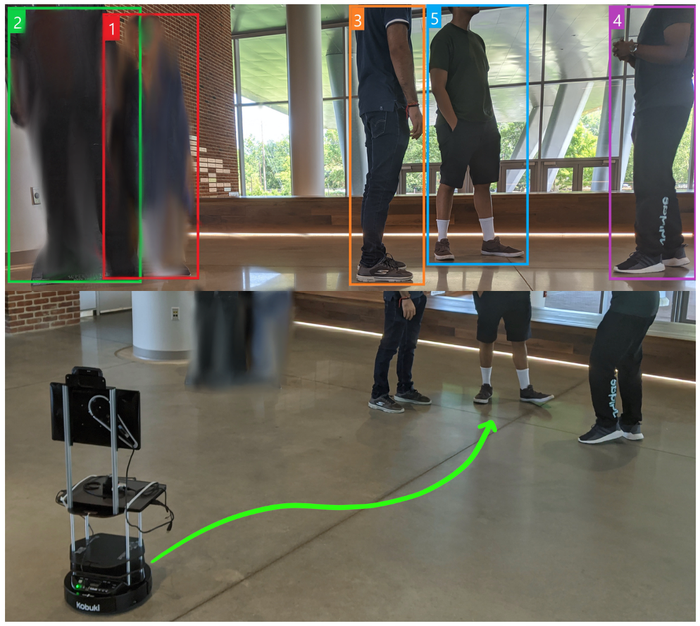
A new strategy to reduce the spread of COVID-19 employs a mobile robot that detects people in crowds who are not observing social-distancing rules, navigates to them, and encourages them to move apart. Adarsh Jagan Sathyamoorthy of the University of Maryland, College Park, and colleagues present these findings in the open-access journal PLOS ONE on December 1, 2021.

Previous research has shown that staying at least two meters apart from others can reduce the spread of COVID-19. Technology-based methods—such as strategies using WiFi and Bluetooth—hold promise to help detect and discourage lapses in social distancing. However, many such approaches require participation from individuals or existing infrastructure, so robots have emerged as a potential tool for addressing social distancing in crowds.
Now, Sathyamoorthy and colleagues have developed a novel way to use an autonomous mobile robot for this purpose. The robot can detect breaches and navigate to them using its own Red Green Blue—Depth (RGB-D) camera and 2-D LiDAR (Light Detection and Ranging) sensor, and can tap into an existing CCTV system, if available. Once it reaches the breach, the robot encourages people to move apart via text that appears on a mounted display.
The robot uses a novel system to sort people who have breached social distancing rules into different groups, prioritize them according to whether they are standing still or moving, and then navigate to them. This system employs a machine-learning method known as Deep Reinforcement Learning and Frozone, an algorithm previously developed by several of the same researchers to help robots navigate crowds.
The researchers tested their method by having volunteers act out social-distancing breach scenarios while standing still, walking, or moving erratically. Their robot was able to detect and address most of the breaches that occurred, and CCTV enhanced its performance.
The robot also uses a thermal camera that can detect people with potential fevers, aiding contact-tracing efforts, while also incorporating measures to ensure privacy protection and de-identification.
Further research is needed to validate and refine this method, such as by exploring how the presence of robots impacts people’s behavior in crowds.
IMAGE CREDIT: Sathyamoorthy et al., 2021, PLOS ONE, CC-BY 4.0 (https://creativecommons.org/licenses/by/4.0/)


Leave a Reply