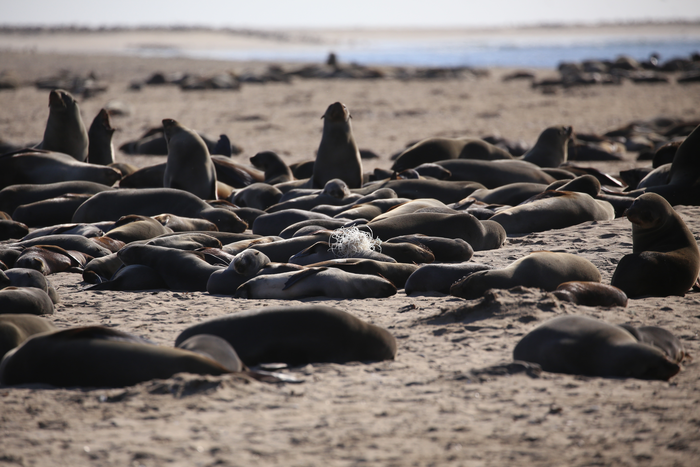
Fishing line and nets are having a major impact on Cape fur seals (Arctocephalus pusillus pusillus), the most common marine mammal observed around the coastline of South Africa and Namibia, where they are endemic.
While their population numbers are considered healthy, plastic pollution, and particularly fishing line and nets, are causing horrific injuries and can result in a slow, painful death.
These are the first results from an ongoing project, initiated in 2018, to investigate the impact of pollution on Cape fur seals in Namibia. The project involves researchers and conservationists from Stellenbosch University, Sea Search-Namibian Dolphin Project and Ocean Conservation Namibia.
The team monitors the entanglement rates of seals and Ocean Conservation Namibia have been disentangling many of the animals affected. The first results from the project were published this week in the scientific journal Marine Pollution Bulletin.
The study demonstrated that a high number of affected animals were pups and juveniles, which were mainly entangled around the neck by fishing line. Rates of entanglement were roughly 1 per 500 animals and was similar between the two colonies investigated at Walvis Bay and Cape Cross. Of the 347 entangled animals documented, the disentanglement team, led by Naudé Dreyer of Ocean Conservation Namibia, were able to successfully disentangled 191 individuals between 2018 and March 2020.
Working in Africa with limited recourses, the team also compared low cost methods of data collection. They found that photographic scans of the colonies were a fast and accurate method to collect data on entangled individuals and the materials they are trapped in.
Dr Tess Gridley, co-director of the Namibia Dolphin Project and an extraordinary senior lecturer in the Department of Botany and Zoology at Stellenbosch University, says plastic pollution and particularly lost and discarded fishing nets are having a big impact to marine life: “Once entangled, these seals face a very painful and uncertain future: finding food becomes harder and wounds can become deep and debilitating, and likely cause death in many cases. Changes to policy could help, such as financial incentives to recover lines, safe disposal of nets and sustainable alternatives to plastics”.
Stephanie Curtis, a research student with the Namibian Dolphin Project and lead author, says the impact of plastic pollution in the oceans is devastating: “Seals should not have to suffer this way because of our carelessness with waste”.
According to Dr Simon Elwen, co-director of the Namibian Dolphin Project and also associated with SU’s Department of Botany and Zoology, fur seals are especially vulnerable to becoming entangled: “They are very curious and playful animals and will investigate objects in the water, but their thick, backwards facing fur which keeps them warm at sea easily snags lines and straps and stops it falling back off.”
Naudé Dreyer from Ocean Conservation Namibia says the project is ongoing: “Since the start of 2021 we have already disentangled over 600 fur seals in only two colonies. This is the tip of the iceberg. It is imperative that studies such as this highlight the consequences of plastic waste on marine animals, and bring around change for the better”.
IMAGE CREDIT: M Laubscher

Leave a Reply