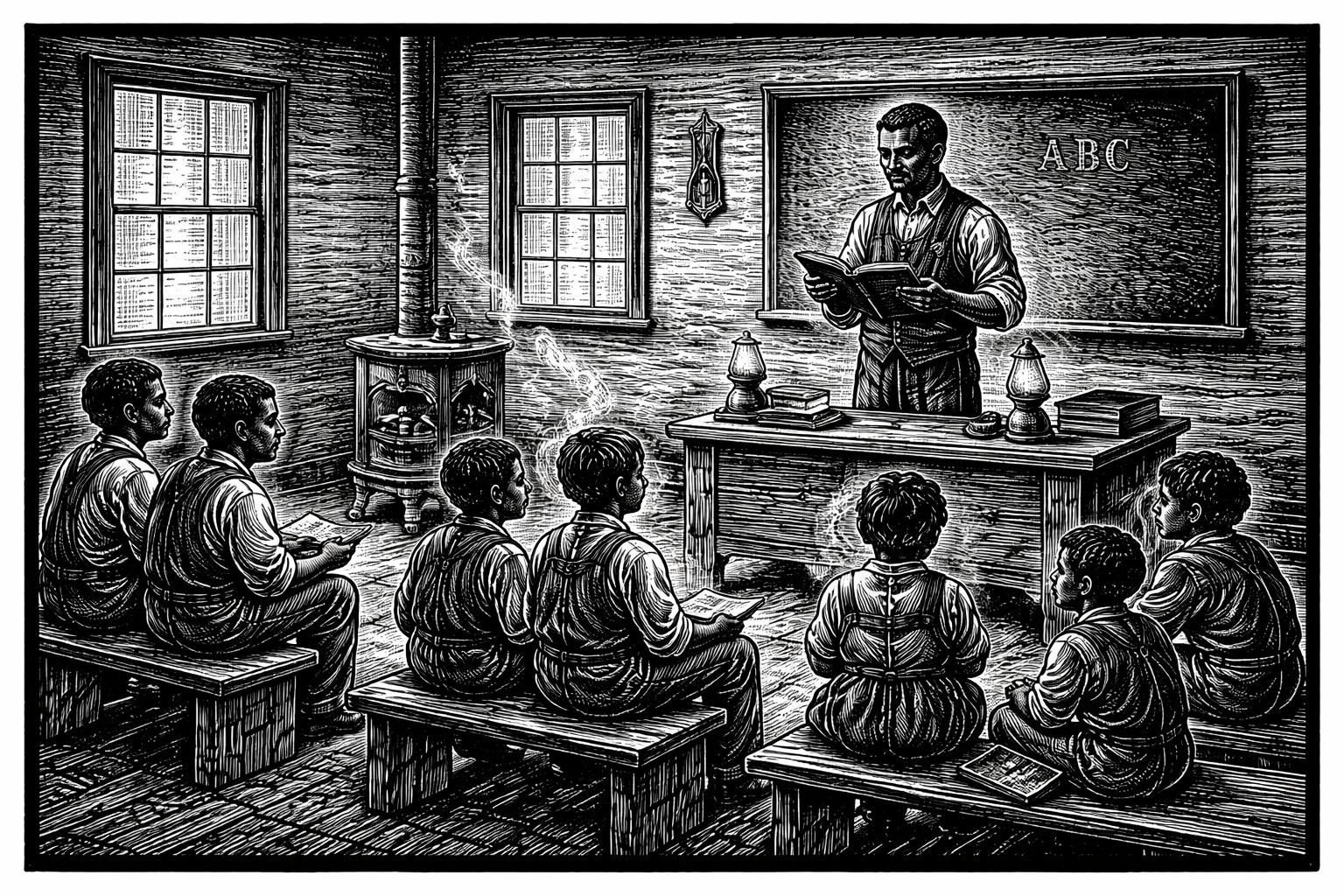
In March 1833, a twenty-five-year-old fugitive named James W.C. Pennington arrived in Newtown, Queens County, to open a one-room school for Black children. The salary was two hundred dollars a year. The building had no books—the local white charity school had already borrowed them. On his first day, nine pupils appeared. Pennington spent his evenings traveling by sleigh through the township, knocking on doors, persuading skeptical parents that years of education—not just months—could transform their children’s prospects. Within weeks, enrollment grew to twelve, then stabilized into a steady class. He re-benched the room to reduce whispering. He insisted on punctuality and home study. He kept a switch he called “Dr. Hickory” in reserve for discipline, though he preferred encouragement. He was building something.
This is what purpose looks like when it operates under constraint. Pennington could have stayed in Brooklyn, where he had connections and relative safety. Instead, he came to Newtown to teach children whose parents worked as gardeners and laborers, whose households appeared in census records as “Free Colored” marks in an enumerator’s ledger. He came because he understood something essential: that freedom required not just legal emancipation but the development of capacity across generations. Education was not supplemental to survival. It was central to it.

Nia: Building for Tomorrow
Nia—purpose—calls a community to make its collective vocation the building and developing of the community in order to restore its people to their traditional greatness. For Newtown’s free Black residents, this principle manifested not as abstract aspiration but as concrete investment: children sent to school despite economic pressure to put them to work, church buildings erected while families struggled to maintain household economies, property acquired not merely for present security but as intergenerational strategy.
The 1850 census reveals a striking pattern: free Black families in Newtown sent their children to school at rates that defied their economic circumstances. In households where parents worked as laborers and gardeners, where property holdings were modest or nonexistent, children ages six to fifteen appeared with marks in the “Attended School Within the Year” column. This was not automatic. Every child in school was a child not working, not contributing immediately to household income, not helping in the garden or running errands for wages.
The Peterson family exemplifies this commitment. In their household of seven members, Nancy Peterson and three children attended school despite the family’s laborer-level income. The literacy split within the family tells its own story: Nancy and the children could read and write; John Peterson Sr. and Soloman could not. The parents invested in capacities they themselves had been denied, understanding that the next generation would need different tools than the ones they possessed.
Across the documented households, children attending school appeared consistently—ten children in one analyzed cluster alone, representing a fifty-five percent attendance rate among school-age youth. These numbers require context. New York’s public school system was segregated. Free Black children could not simply walk to the nearest schoolhouse; they required separate facilities, separate teachers, separate funding streams. Pennington’s Newtown school existed precisely because the alternative was no education at all.

The school Pennington established in 1833 drew on a tradition already being built in Manhattan. The African Free School, founded in 1787 by the New York Manumission Society, had educated thousands of Black children in reading, writing, arithmetic, and geography. Boys learned navigation skills essential for seafaring employment; girls learned sewing and domestic arts. By the 1820s, the system had expanded to seven buildings across the city. Its graduates included some of the most prominent Black leaders of the antebellum era: Alexander Crummell, Ira Aldridge, James McCune Smith, Samuel Ringgold Ward—and Pennington himself would later move in these circles.
What Pennington brought to Newtown was an extension of this urban educational tradition into a rural, agricultural community. The African Free School curriculum was practical—it prepared students for actual economic opportunities while also cultivating capacities that transcended immediate utility. Navigation skills mattered because Black men found employment as sailors. Literacy mattered because it enabled participation in civic life, access to information, defense against exploitation. Pennington understood education not as credentialing but as empowerment.
Building the Church While Maintaining the Home
In 1828—one year after New York’s gradual emancipation law finally freed the last enslaved people—a local landowner named James Hunter deeded two acres to Newtown’s free Black community for a church and parsonage. The resulting institution, initially called the United African Society of Newtown, the Second Colored Presbyterian Church of New York, and later St. Mark’s African Methodist Episcopal Church, became the community’s spiritual and organizational center. It was among the first churches established by people of African descent in Queens County.
Building and maintaining a church required sustained collective investment from families who had little surplus. The land was donated, but construction was not. Maintenance was not. Paying a minister was not. The households documented in the census records—the gardeners with modest property holdings, the laborers with none, the widows maintaining families on diminished resources—these were the people who contributed their labor and their pennies to keep the church standing.
Pennington served this congregation after completing his studies at Yale Divinity School, where he was the first Black student permitted to attend lectures—though not permitted to enroll formally, not permitted to borrow books, not permitted to speak in class or sit anywhere but the back row. He returned to Long Island with credentials no institution would fully recognize but with capacities the community desperately needed. He officiated at the wedding of Frederick Douglass and Anna Murray in 1838. He wrote what may be the first history of African Americans, A Text Book of the Origin and History of the Colored People, published in 1841. He later returned to the Newtown congregation, serving from 1858 to 1863 during some of the most tumultuous years of the antislavery struggle.
The church functioned as far more than a place of worship. It was a meeting hall, a school building, a site for organizing community response to threats. Residents of Newtown helped fugitives reach the North safely. At an 1862 meeting, community members denounced President Lincoln’s proposal for resettling freed slaves in other countries—an early declaration that this community intended to claim its place in America, not be shipped elsewhere. The church made such collective action possible by providing space where people could gather, deliberate, and speak for themselves.

Property as Intergenerational Strategy
The census records document property holdings that might seem modest by absolute standards but represented extraordinary achievement in context. Patience Leverich held $3,000 in real estate. Richard Braddock held $1,600 in real estate and $300 in personal property. The Durland and Peterson households each held approximately $800 in real estate. Smaller holders—George Durling with $550, Francis Rankin with $800—round out the picture of a community where property ownership was possible, if not universal.
These holdings were not accidents of fortune. They represented decades of strategic accumulation, often passed across generations. The Peterson family network—spanning six households and thirty-two individuals by 1850—had roots reaching back to the 1780s, with elders born during the Revolutionary era. When the 1830 census documented Newtown, Petersons already appeared as independent household heads, establishing their presence a full generation before the property accumulations of the 1850s.
Property ownership mattered for reasons beyond economic security. In New York State during the 1850s, Black men could vote only if they owned at least $250 worth of property and had maintained state residency for three years. Neither requirement applied to white men. Property was not merely wealth; it was political standing. The free Black men of Seneca Village—another documented community that was destroyed to build Central Park—constituted a significant fraction of the eligible Black voters in all of New York City precisely because they owned their homes. Similar dynamics applied in Newtown. Property acquisition was a strategy for securing not just economic stability but civic participation.
The concentration of gardeners among property owners was not coincidental. Market gardening—growing vegetables and produce for sale in New York City’s markets—offered a path to property accumulation unavailable through most wage labor. A gardener with access to land could generate surplus, save gradually, and eventually purchase his own plot. The skills were transferable across generations. The proximity of multiple gardening households suggests not isolated entrepreneurs but a networked community sharing knowledge, tools, and market access.
Kuumba: Innovation Within Limits
Kuumba—creativity—calls a people to do always as much as they can, in the way they can, in order to leave their community more beautiful and beneficial than they inherited it. For Newtown’s free Black residents, creativity was not primarily aesthetic expression but adaptive innovation: finding economic niches in a hostile market, maintaining cultural practices under pressure, creating social spaces within geographic constraints. They worked with what they had and made it yield more than seemed possible.
Occupational Creativity
The census occupation columns reveal more than job titles. They reveal strategic positioning within a labor market designed to exclude. “Gardener” appears repeatedly among property-owning households—not generic agricultural labor but specialized cultivation of vegetables, herbs, and market produce for the growing New York City population. “Laborer” appears among those without property, indicating less specialized work, often seasonal, often dependent on white employers.
But the occupational diversity extends further. Queens County’s Black residents during this era worked as sailors and ship pilots, as blacksmiths and carpenters, as domestic servants and washerwomen. Some became captains of their own vessels. The Hofstra University study of Long Island’s antebellum Black population notes that “the men worked the lands, fished and clammed in the bays, or practiced trades as craftsmen and artisans” while “the women engaged primarily in the domestic arts—cooking and cleaning, weaving, needlework and laundry—not only for their own families but also for hire in other households.”
The gardening economy deserves particular attention. Market gardening supplied the enormous and growing food needs of Manhattan, and Queens County’s proximity to the city markets created real opportunity. A successful gardener needed agricultural knowledge adapted to local conditions—frost patterns, soil quality, pest management, crop timing to hit market windows. Multiple gardener households clustered in certain dwelling ranges suggests not merely residential proximity but functional networks: shared knowledge, coordinated planting, collective transport of produce to market. One wagon could carry multiple gardeners’ goods. Harvest labor could be shared across adjacent plots. The fifteen gardeners documented with combined property of $12,000 were not fifteen isolated operations but an agricultural network operating under the guise of individual enterprises.

Cultural Persistence and Adaptation
Naming practices offer a window into cultural creativity under constraint. Historical research on Black naming in America reveals layered traditions: African day-names that persisted through the Middle Passage, classical names imposed by enslavers that were later reclaimed by the enslaved, Biblical names chosen by those who found in Scripture a narrative of bondage and liberation that matched their own experience. Names like Cato, Pompey, and Scipio that might have begun as mockery became markers of identity passed across generations.
The census records of Newtown show predominantly Anglo-American names—Samuel, John, Mary, William—reflecting the acculturation of families several generations removed from direct African influence. Yet naming patterns within families reveal deliberate choices: sons named after fathers, names repeated across generations to establish lineage in a society that had systematically severed family connections during slavery. Herbert Gutman’s analysis of 1880 census data found that nearly a quarter of African American households had a son named for his father—a rate that speaks to intentional preservation of family identity.
The remarkable individual documented as Charity Palmer—aged ninety in 1850—embodies this cultural persistence. Born around 1760 during British colonial rule, she lived through the American Revolution, through New York’s gradual emancipation, through the establishment of the community she inhabited. If born enslaved, she spent approximately thirty-nine years in bondage before freedom. Her presence in the 1850 household was itself a form of cultural continuity—an elder whose memory spanned eras, whose survival testified to resilience, whose very existence connected the community to its own deep past.
Creating Social Space Within Geographic Constraint
The residential clustering patterns visible in census records were not accidental aggregations but creative responses to systematic exclusion. Free Black households concentrated in certain dwelling ranges while vast stretches of the township remained exclusively white. The voids speak as loudly as the presences: two hundred consecutive dwellings without a single Black resident; twenty-three-dwelling gaps dominated by wealthy white farming families with $6,000 to $20,000 estates.
Within the clusters, proximity enabled cooperation. The Peterson network—Samuel at Dwelling 234, David at Dwelling 237, Mary at Dwelling 241, William at Dwelling 246—maintained four technically separate households within a thirteen-dwelling span. For census purposes, for tax purposes, these were independent economic units. In practice, they functioned as an extended family compound. When Samuel’s garden produced surplus, David’s family ate. When David found day labor, he could bring Peterson men with him. Mary’s household provided childcare. William shared specialized tools. The geographic constraint that forced clustering also enabled mutual support.
Similar patterns appear in households that took in non-relatives. Elderly individuals appear in family units where no obvious blood connection exists—suggesting informal elder care arrangements. Young men of different surnames appear in households headed by unrelated families—suggesting labor arrangements, apprenticeships, or assistance to those without family nearby. Dwelling 326 in one analyzed section appears to function as an informal elder care facility, housing multiple elderly Black individuals in what was technically a single household. These arrangements were creative adaptations to circumstances that offered no institutional alternatives.

The Work Ahead
Lighting the candles for Nia and Kuumba during Kwanzaa, we honor ancestors whose purpose and creativity left communities more capable than they found them. The free Black residents of Newtown operated with neither the resources nor the recognition their efforts deserved. They built schools that educated future leaders. They erected churches that organized collective action. They acquired property that secured political standing. They developed economic niches that enabled independence. They maintained cultural practices that preserved identity. They created social spaces where community could flourish despite containment.
James Pennington returned to Newtown repeatedly across his career—as teacher in 1833, as pastor in the late 1830s, again from 1858 to 1863. Despite opportunities in larger cities, despite international recognition as an abolitionist and scholar, he kept coming back to this small community where he had first taught children to read. He understood that purpose is not abstraction. It is commitment to specific people in specific places over sustained time. It is showing up with no books and teaching anyway. It is persuading skeptical parents that education matters. It is building institutions that outlast individual lifetimes.
The census records cannot capture everything. They cannot record the conversations in church basements, the knowledge shared between gardeners, the stories elders told children about the before-time. They cannot document the creativity that operated in spaces invisible to official enumeration. But they can document outcomes: children who attended school, property that accumulated across generations, households that clustered in ways that enabled mutual support. The numbers are residue of purpose and creativity in action.
The community that Pennington served, that the Peterson family anchored, that Charity Palmer witnessed across nine decades—this community was eventually displaced. Modern Elmhurst bears little visible trace of the free Black settlement that preceded it. St. Mark’s A.M.E. Church survived and continues to serve, but the agricultural community, the gardening networks, the residential clusters have long since dispersed. What remains is the record: census marks, church histories, the writings of men like Pennington who documented what they could. And what remains is the principle: that purpose built forward, that creativity adapted to constraint, that communities can leave more than they inherit even when the world conspires to erase them.
[Based on analysis of Federal Census records, 1830-1860, Newtown Township, Queens County, New York, documenting patterns of school attendance, church formation, property accumulation, occupational clustering, and residential concentration across 408 individuals in 134 households, contextualized within the documented histories of the African Free School system, the New York Manumission Society, and the career of James W.C. Pennington.]




Leave a Reply