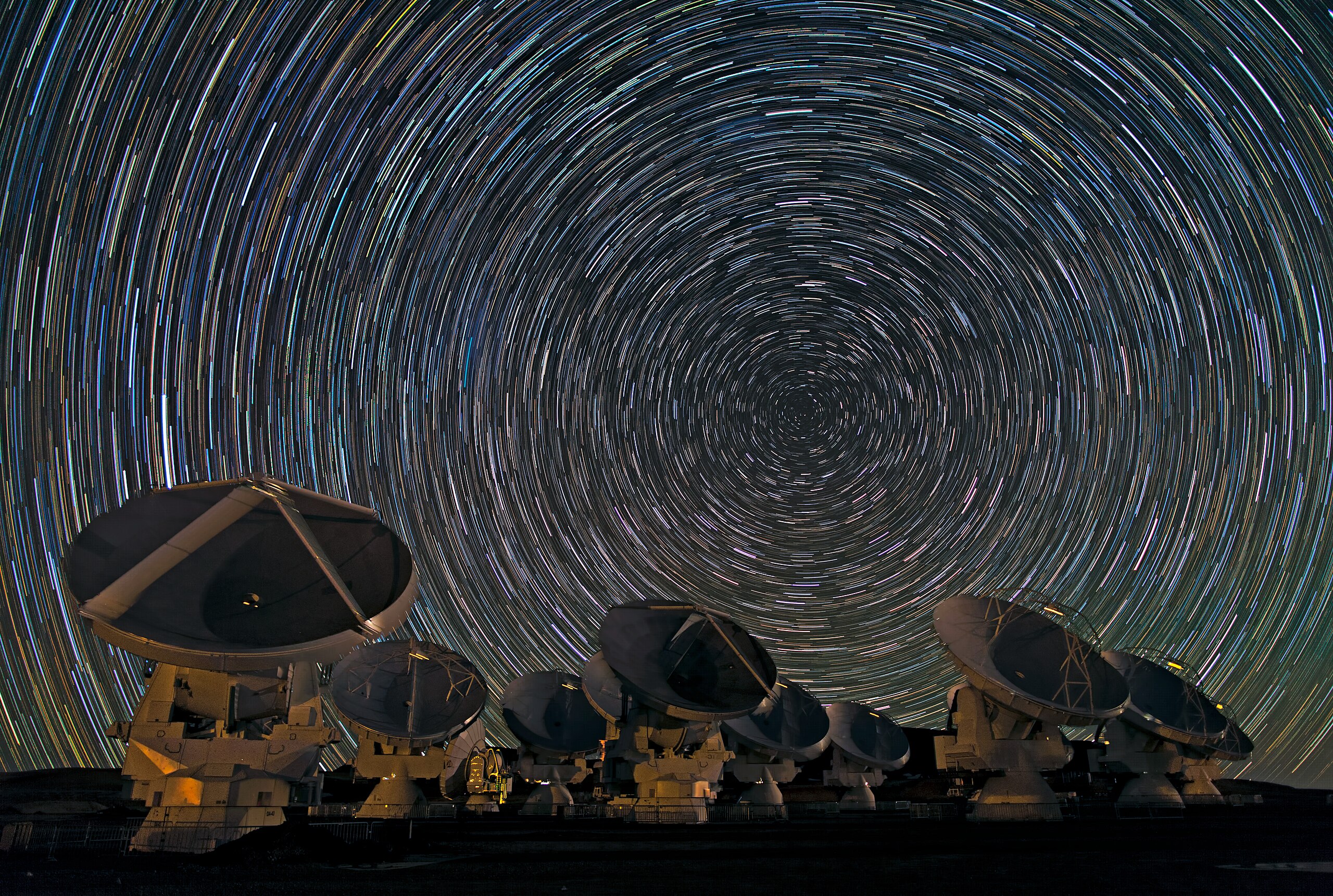

High above Chile’s Atacama Desert, the night sky appears to twist into luminous arcs above one of humanity’s most powerful astronomical instruments: the Atacama Large Millimeter/submillimeter Array, or ALMA. This long-exposure image captures star trails sweeping across the southern sky, a striking visual record of Earth’s constant rotation beneath the cosmos.
The stars themselves are not moving in circles around the observatory. Instead, the curved paths are created by Earth’s spin on its axis. As the planet rotates once roughly every 24 hours, stars appear to drift across the sky. When a camera’s shutter remains open for an extended period, that apparent motion is recorded as continuous arcs of light. The direction and curvature of each trail reflect the observer’s position on Earth and the alignment of the planet’s rotational axis relative to the sky.
Because this photograph was taken in the Southern Hemisphere, the star trails curve around the southern celestial pole — a point in the sky that remains nearly fixed while the stars appear to revolve around it. The farther a star is from this pole, the larger and more dramatic its arc becomes. Near the pole itself, trails tighten into smaller circles, subtly mapping Earth’s geometry onto the night sky.
The observatory below adds a second layer of scientific meaning. ALMA’s array of radio antennas studies some of the coldest and most distant objects in the universe, including star-forming clouds, planetary disks, and early galaxies. Its location in one of the driest places on Earth minimizes atmospheric interference, allowing astronomers to detect faint signals that would otherwise be lost.
Together, the star trails and the silent antennas tell a single story: while Earth spins relentlessly through space, human instruments remain fixed, patiently decoding the light — and time — written across the sky.
IMAGE CREDIT: ESO/B. Tafreshi



Leave a Reply