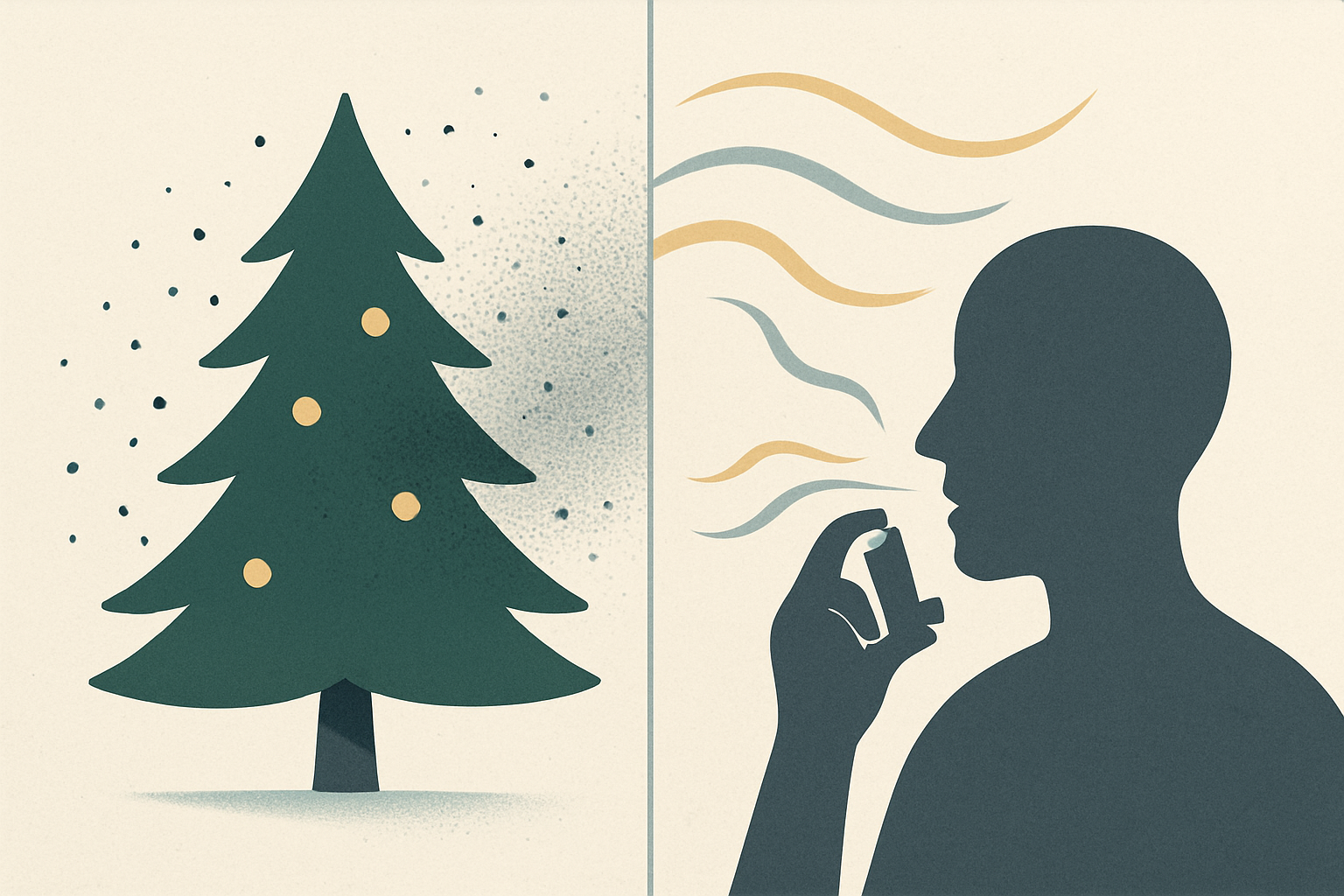
‘Tis the season for holiday parties, twinkling lights, and festive gatherings around the Christmas tree. But for many revelers, that iconic evergreen centerpiece might be doing more than spreading cheer—it could be triggering a surprisingly common respiratory syndrome that sends thousands to emergency rooms each December.
The phenomenon has a name: Christmas Tree Syndrome. And while it might sound like seasonal hype, the science behind it reveals a fascinating collision of biology, chemistry, and microbiology that turns our beloved holiday tradition into an unexpected health hazard for allergy-sensitive individuals.

The Mold Explosion Nobody Sees Coming
The reality of Christmas tree allergies starts with an invisible menace: mold spores. When researchers at SUNY Upstate Medical University analyzed clippings from 28 Christmas trees, they discovered a staggering 53 different species of mold lurking in the needles and bark.[1] Even more concerning, approximately 70 percent of these mold species were identified as potential respiratory allergens, particularly dangerous for infants and young children.
But the real shock came from a 2007 study presented at the American College of Allergy, Asthma & Immunology annual meeting. Researchers tracked a single Christmas tree in a Connecticut home for two weeks and documented a dramatic transformation. During the first three days indoors, mold spore counts registered at a normal 800 spores per cubic meter. By day 14, however, that number had skyrocketed to 5,000 spores per cubic meter—a more than six-fold increase that far exceeded normal indoor air quality standards.[2]
“This mold spore count is five times above normal,” explained study co-author Philip Hemmers, an allergist and immunologist with St. Vincent’s Medical Center in Bridgeport, Connecticut. “These high levels have been correlated with allergic rhinitis and an increased rate of asthma symptoms and asthma-related hospitalization in other studies.”[3]

The Science Behind the Spore Surge
The mechanism driving this mold explosion is deceptively simple. Christmas trees are softwood conifers that naturally retain moisture in their needles, bark, and branches. Mold spores attach themselves to these damp surfaces outdoors, remaining largely dormant in cold temperatures. But when the tree enters a heated home—especially one positioned near heat vents—the warm indoor environment creates what researchers call a “false spring.”[4]
Dr. Lawrence Kurlandsky, lead researcher on the SUNY study, observed this pattern firsthand during his years of clinical practice. “In my many years of private practice, I might see up to 10 kids on Christmas Eve or Christmas Day, who needed to go to the emergency room because they were having an asthma attack,” he noted.[5] His investigation revealed that the four most prevalent molds found on Christmas trees—including Aspergillus, Penicillium, Cladosporium, and Alternaria—are all known allergens capable of triggering respiratory distress.
The central heating and decorative lights compound the problem by providing ideal conditions for mold germination. Within one week of indoor placement, the previously dormant molds begin actively reproducing, releasing airborne spores that circulate throughout the home via heating and air conditioning systems.

The Terpene Factor: When Pleasant Scents Turn Problematic
Beyond mold, Christmas trees present a second respiratory challenge: terpenes. These organic compounds, found abundantly in conifer sap, are responsible for that distinctive pine scent many consider synonymous with the holidays. The primary terpenes in Christmas trees—alpha-pinene and beta-pinene—are volatile organic compounds that evaporate at room temperature, filling your home with their aromatic presence.
For most people, these compounds are pleasant and even potentially beneficial. Research has shown that alpha-pinene can act as a bronchodilator and possesses anti-inflammatory properties.[6] However, for individuals with chemical sensitivities or respiratory conditions, terpenes can irritate airways and trigger asthma symptoms. The compounds can also cause contact dermatitis in people who handle trees directly, leading to red, itchy, or blistered skin.[7]
Douglas Fir and Norway Spruce varieties tend to be particularly problematic due to their high terpene content and dense branch structures that easily trap both mold spores and pollen. Fraser Fir and Balsam Fir contain especially high amounts of resinous sap, making them more likely to cause skin reactions and respiratory irritation.[8]

Separating Myth from Reality
The good news? Not everyone needs to banish evergreens from their celebrations. “If you and your children don’t have any obvious allergies, then it is probably not going to bother you,” Dr. Kurlandsky explained.[9] The estimated 13 percent of Americans affected by mold allergies face the greatest risk, along with individuals with asthma or chronic respiratory conditions.
For those who do experience symptoms—sneezing, wheezing, watery eyes, coughing, or skin rashes—the scientific evidence suggests practical solutions. Hosing down trees before bringing them indoors can remove surface mold and pollen. Running HEPA air purifiers in the same room as the tree can help manage airborne spore levels. And for highly sensitive individuals, limiting tree exposure to four to seven days rather than the traditional multi-week display can significantly reduce symptoms.[10]
The Christmas tree allergy phenomenon isn’t a myth—it’s a well-documented immunological response with clear scientific underpinnings. Understanding the dual threat of mold proliferation and terpene exposure allows holiday celebrants to make informed decisions about balancing tradition with respiratory health, ensuring that the most wonderful time of year doesn’t become the most miserable.
—
Endnotes
1. Kurlandsky, L.E. “Identification of mold on seasonal indoor coniferous trees.” Annals of Allergy, Asthma & Immunology 106 (2011): 543-544.
2. Hemmers, Philip, et al. Presentation at American College of Allergy, Asthma & Immunology Annual Scientific Meeting, Dallas, TX, November 2007.
3. “Live Christmas Trees Can Trigger Mold Allergies.” HealthDay News, November 16, 2007.
4. Gizas, Lisa C., et al. “The Christmas Tree Allergy Phenomenon – Live Christmas Trees Carry Mold That Increase Allergy Symptoms in Susceptible Individuals.” National High School Journal of Science, June 6, 2015.
5. “Christmas Tree Syndrome Might Be The Real Reason For Your December ‘Flu.’” SheKnows, December 13, 2019.
6. Cho, K.S., et al. “Terpenes from Forests and Human Health.” Toxicological Research 33, no. 2 (April 2017): 97-106.
7. “Are Your Seasonal Symptoms a Christmas Tree Allergy?” YorkTest, October 10, 2025.
8. Ibid.
9. “Christmas trees may harbor unwanted presence, study says.” SUNY Upstate Medical University News, December 2011.
10. Hemmers, Philip, quoted in “Live Christmas Trees Can Trigger Mold Allergies.” ABC News, March 24, 2008.



Leave a Reply