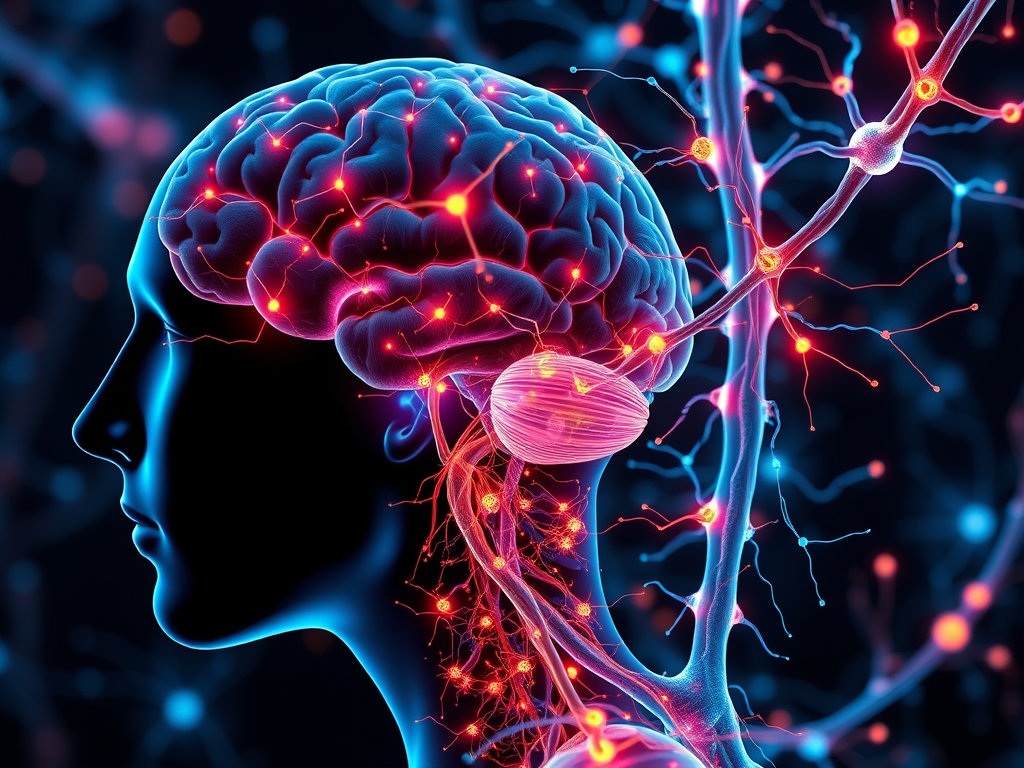
Signals relayed to motor neurons from the brain enable muscle movement, but these signals typically pass through spinal interneurons before they reach their destination. How the brain and this highly diverse group of “switchboard operator” cells are connected is poorly understood.
To address this, scientists at St. Jude Children’s Research Hospital created a whole-brain atlas visualizing regions of the brain that send direct inputs to V1 interneurons, a group of cells necessary for movement. The resulting atlas and accompanying three-dimensional interactive website provide a framework to further understand the anatomical landscape of the nervous system and how the brain communicates with the spinal cord. The findings were published today in Neuron.
“We have known for decades that the motor system is a distributed network, but the ultimate output is through the spinal cord,” said corresponding author Jay Bikoff, PhD, St. Jude Department of Developmental Neurobiology. “There, you have motor neurons which cause muscle contraction, but the motor neurons don’t act in isolation. Their activity is sculpted by networks of molecularly and functionally diverse interneurons.”
While huge leaps have been made in understanding how different regions of the brain relate to different facets of motor control, precisely how these regions connect to specific neurons in the spinal cord has been a blind spot in the field. Interneurons are difficult to study, mainly because they come in hundreds of different, intermingled varieties.
“It’s akin to untangling a ball of Christmas lights, except it’s more challenging given that what we’re trying to unravel is the result of over 3 billion years of evolution”, said co-first author Anand Kulkarni, PhD.
Recent advances have demonstrated the existence of molecularly and developmentally distinct interneuron subclasses, but much is still unknown about their place within neural communication. “Defining the cellular targets of descending motor systems is fundamental to understanding neural control of movement and behavior,” said Bikoff. “We need to know how the brain is communicating these signals.”
Sign up for the Daily Dose Newsletter and get every morning’s best science news from around the web delivered straight to your inbox? It’s easy like Sunday morning.
To dissect the circuits linking the brain to the spinal cord, the researchers used a genetically modified version of the rabies virus that is missing a key protein, the glycoprotein, from its surface. This inhibited the virus’s ability to spread between neurons.
This essentially stranded the virus at its origin. By reintroducing this glycoprotein to a specific population of interneurons, the virus could make a single jump across synapses before becoming stuck again. The researchers used a fluorescent tag to track the virus. By tracking where the virus ends up, the researchers could pinpoint which regions of the brain were connected to these interneurons.
3D map allows researchers to visualize connections
The researchers applied this approach to a class of interneurons called V1 interneurons, which were previously shown to play a vital role in shaping motor output. The work allowed them to accurately trace the origins of multiple signals received by these interneurons back to the brain.
“We’re only targeting the V1 interneurons, but these are actually a highly heterogenous group of neurons, so we thought, ‘Let’s target as many of the V1s as we can and see what’s projecting to them,’” Bikoff said.
The researchers turned to serial two-photon tomography to visualize these neurons and generate a three-dimensional reference atlas. This technique renders the brain as it makes hundreds of micron-thick sections to reveal fluorescently labeled neurons. The atlas allowed the researchers to make accurate predictions about the network that connects different brain structures to the spinal cord and the interneurons with which they interact.
Identifying how these structures link to the spinal cord allows researchers to further investigate the neural circuits controlling movement, and the accompanying web atlas will ensure that the data is freely accessible to all. “We understand what some of the identified brain regions do from a behavioral perspective,” explained Bikoff, “but we can now make hypotheses about how these effects are mediated and what the role of the V1 interneurons might be. It will be very useful for the field as a hypothesis-generating engine.”
Authors and funding
The study’s first authors are Phillip Chapman and Anand Kulkarni, St. Jude. The study’s other authors are Alexandra Trevisan, Katie Han, Jennifer Hinton, Paulina Deltuvaite, Mary Patton, Lindsay Schwarz, and Stanislav Zakharenko, St. Jude; Lief Fenno, University of Texas at Austin; and Charu Ramakrishnan and Karl Deisseroth, Stanford University.



Leave a Reply