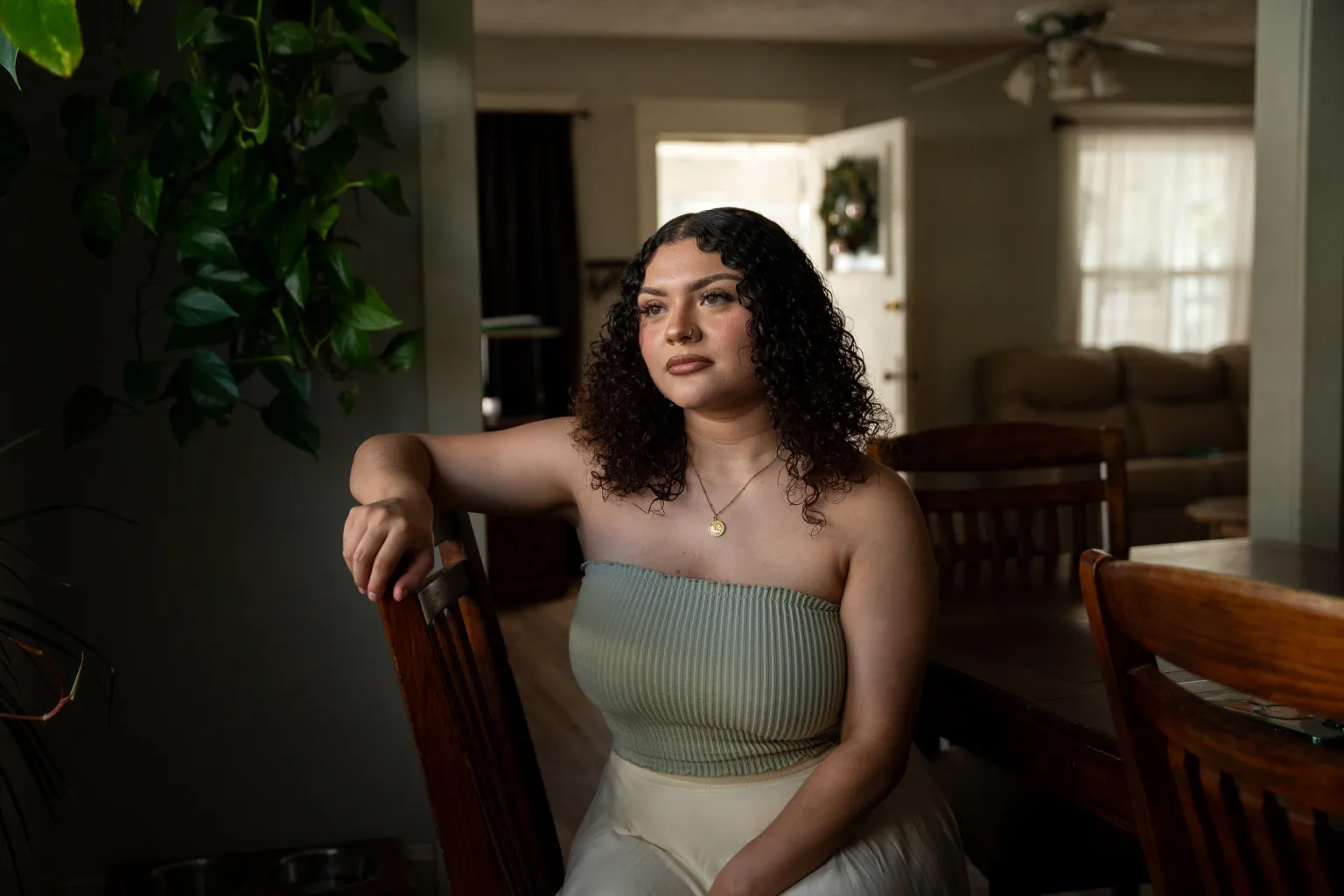
Twenty-four minutes before the mass shooting at the Kansas City Chiefs Super Bowl victory parade in February left one person dead and at least 24 people injured, Jenipher Cabrera felt a bullet pierce the back of her right thigh.
The 20-year-old and her family were just four blocks from Union Station, in a river of red-shirted Chiefs fans walking toward the massive rally after the parade that warm Valentine’s Day. The bullet — fired by teen boys fighting in the street — thrust Cabrera forward.
She grabbed her mom by the shoulder and signaled in panic to her bleeding leg with her large brown eyes, not saying a word. Cabrera was being treated in an ambulance when she heard reports blasting from the police radio.
“My mom was trying to get on the ambulance,” Cabrera said. “I remember them saying, like, ‘You can’t get on. There might be other victims that we need to pick up.’”
Cabrera’s shooting happened before the one that garnered the big headlines that day and is one of hundreds that kill or injure Kansas City-area residents each year. That endless drumbeat of gun violence — from one-off incidents to mass shootings — has shattered the sense of safety for those who survive. As victims and their families try to move forward, reminders of gun violence are inescapable in the media, in their communities, in their daily lives.
“I look at people differently,” said James Lemons, who was shot in the thigh at the rally. Now when he’s around strangers he can’t help but wonder if they have a gun and if his kids are safe.
The new NFL season opened here with a moment of silence for Lisa Lopez-Galvan, the only person killed at the parade. Kansas City has recorded at least 124 homicides this year. Local police say there have been an additional 476 “bullet-to-skin victims” — people who were shot and survived. And there were at least 50 school shootings nationwide by mid-September.
Collectively it is all taking a toll.
Survivors suffer panic attacks and feel a heightened sense of danger in crowds and deep anxieties about the threat of violence anywhere in Kansas City.
Every shooting survivor responds in their own way to gun violence and even the threat of it, according to LJ Punch, a trauma surgeon by training and founder of the Bullet Related Injury Clinic in St. Louis.
For some, getting shot ensures they will always be on guard, perhaps even armed. Others want nothing to do with guns ever again.
“But what’s the common ground? That people desperately want to be safe,” Punch said.
Cabrera’s search to make meaning out of what happened has led her to work with a frustrated local lawmaker seeking new gun laws — something akin to impossible given Missouri state law, which prohibits nearly any local restrictions on firearms.
Sign up for the Daily Dose Newsletter and get every morning’s best science news from around the web delivered straight to your inbox? It’s easy like Sunday morning.
Feb. 14 is a movie in Cabrera’s mind, in slow motion, frame by frame, and the soundtrack is her voice, talking and talking. She sees a group of rowdy teenage boys running around her and her family. Then two pops — fireworks? Another pop. Finally, a fourth.
“I think that’s where the shock kicked in, and I grabbed my mom,” Cabrera remembered. “I didn’t say anything to her. I just, like, looked at her, and I had, like, my eyes were widened, and I kind of signaled with my eyes to look down at my leg.”

Cabrera fell and other fans rushed to her rescue, calling 911, and began cutting off her leggings. Four men instantly pulled off their belts when asked for a tourniquet. She remembers thinking that if she lost consciousness, she could die. So she talked and talked. Or so she thought.
One of her rescuers later said she actually didn’t say a word even when he asked how many fingers he was holding up.
“He told me [that] my eyes were huge, like oranges, and that all I was basically doing was, like, looking up and down four times since he had four fingers up,” Cabrera said.
Cabrera remembers being moved out of the emergency room at University Health to make room for 12 people who came in from the shooting at the rally, including eight with gunshot wounds. She checked social media on her phone — another shooting? Unreal. Finally her parents found her. She spent seven days in the hospital.

Cabrera is grateful to be alive. But she is triggered now when she sees groups of teenage boys cursing and playing, or when she sees red Chiefs shirts. Hearing four pops in a row — a regular occurrence in her northeast Kansas City neighborhood — makes Cabrera’s chest swell and she braces for a panic attack.
“It runs over and over and over and over in my mind,” she said.
‘An Increasing Sense of Threat?’
The U.S. surgeon general declared gun violence a public health crisis in June, but nearly any new regulation on guns is a political nonstarter in Missouri. In fact, a 2021 state law — signed at the Kansas City-area gun store where one of the weapons used in the parade shooting was purchased — would have barred local police from enforcing federal gun laws. The law was struck down by a federal appeals court in August.
Missouri has no age restrictions on gun use and possession, although federal law largely prohibits juveniles from carrying handguns.
Polling of Missouri voters shows support for requiring background checks and instituting age restrictions for gun purchases, but also nearly half were opposed to allowing counties and cities to pass their own gun rules.
Per capita, Kansas City, Missouri, is among the more violent places in the nation. From 2014 to 2023, there were at least 2,175 shootings in this city of 510,000, leaving 1,275 people dead and 1,624 injured. And while murder rates fell in more than 100 cities across the country last year, Kansas City recorded its deadliest year on record.
Punch, of the Bullet Related Injury Clinic, likened the violence to a disease outbreak that goes unaddressed and spreads. The state’s permissive posture toward guns might supercharge the reality in Kansas City, Punch said, but it didn’t start it.
“So is there something going on? Is there an increasing sense of threat?” Punch asked.
Jason Barton was familiar with that violence growing up in Kansas City. Now settled in Osawatomie, Kansas, he thought long and hard about bringing his own gun for protection when he drove his family to the Super Bowl parade.
Ultimately he decided against it, surmising that if something happened and he pulled out a gun, he would be arrested or shot.
Barton responded quickly to the shooting, which happened right in front of him and his family. His wife found a bullet in her backpack. His stepdaughter’s legs were burned by sparks from a bullet ricochet.
Despite his worst fears coming true, Barton said not bringing his gun that day was the right decision.
“Guns don’t need to be brought into places like that,” he said.

‘A 12-Gauge With Teeth’
Mass shootings can derail survivors’ sense of safety, according to Heather Martin, a survivor of the Columbine High School shooting in 1999 and co-founder of The Rebels Project, which provides peer support to survivors of mass trauma.
“Trying to find a way to feel safe again is very common,” Martin said, “in the years following it.”
James Lemons had always felt trepidation about returning to Kansas City, where he grew up. He even brought his gun with him to the parade but left it in the car at the urging of his wife. His 5-year-old daughter was on his shoulders when a bullet entered the back of his thigh. He shielded her from the ground as he fell. What was he realistically going to do with a gun?
And yet he can’t help but wonder “what if.” He can’t shake the feeling that he failed to protect his family. Waking up from dreams about the parade, “I just start crying,” he said. He knows he hasn’t processed it yet but he doesn’t know how to start. He has focused on his family’s safety.
They got two American bulldogs this summer, making three total in the house now — one for each kid. Lemons described them as “like having a gun without having a gun.”
“I’ve got a 12-gauge with teeth,” Lemons joked, “just a big, softy protector.”

Most nights he sleeps only a few hours at a time before waking up to check on the kids. Usually he’s on the couch. It’s more comfortable for his leg that is still healing, and it helps him avoid the restless kicks of his 5-year-old, who has slept with her parents since the parade.
It also ensures he’ll be the one to intercept an intruder who breaks into the house.
Emily Tavis, who was shot through the leg, found solace at her church and from a sister congregation’s in-house therapist.
But then, the Sunday morning after the Donald Trump rally shooting in July, the preacher’s sermon turned to gun violence — triggering panic inside her.
“And it just, like, overwhelmed me so much, where I just went to the bathroom,” Tavis said, “and I just stayed in the bathroom for the rest of the sermon.” Now even attending church gives her pause.
Tavis recently moved into a new house in Leavenworth, Kansas, that she is renting from a friend. The friend’s husband cautioned that if Tavis was going to be alone she needed a gun for protection. She told him she just can’t deal with guns right now.
“And he’s like, ‘OK, well, take this.’ And he pulls out this giant machete,” Tavis recalled, laughing.
“So I have a machete now.”

A Search for Something Good
Cabrera, the young woman who couldn’t speak after being shot, is now trying to use her voice in the fight against gun violence.
Manny Abarca, a Jackson County, Missouri, legislator, lives down the street. One evening, he came to visit. Cabrera’s parents did most of the talking; she’s shy by nature. But then he turned and asked her directly: What did she want?
“I just want, like, some justice for my case,” she said, “or something good to happen.”
Before the parade, Cabrera was offered a factory job where her sister worked, but she hadn’t started because her leg was still healing. So Abarca offered her an internship, helping him establish a Jackson County Office of Gun Violence Prevention, a plan he introduced in July in response to the parade shootings.
Abarca was in the Chiefs victory parade with his 5-year-old daughter, Camila. They were in Union Station when shots were fired — and they huddled in a downstairs bathroom.
“I just said, ‘Hey, you know, just be calm. Just be quiet. Let’s just find out what’s going on. Something’s happened,’” Abarca said. “And then she said, ‘This is a drill.’ And hey, it tore everything out of me, because I was like, she’s referring to her training” at school.
They emerged shaken but safe, only to learn that Lopez-Galvan had died. Abarca knew the 43-year-old mother and popular Tejano DJ through the area’s tight-knit Hispanic community.
Abarca has taken advantage of this heated time after the Super Bowl parade shootings to work on anti-violence measures, despite knowing the severe limitations posed by state law.
In June, the Jackson County Legislature passed a measure that gives local teeth to a federal domestic violence law that allows judges to remove firearms from offenders.
But Abarca hasn’t been able to get the gun violence office approved, and county officials have refused to take up another measure that would establish age limits for purchasing or possessing firearms, fearing a lawsuit from a combative state attorney general. He hired Cabrera, he said, because she is bilingual and he wants her help as a survivor.
In a sense, the work makes Cabrera feel stronger in her fight to move forward from the shooting. Still, her family’s perception of safety has been shattered, and no one will be attending games or a possible Super Bowl victory parade anytime soon.
“We just never expected something like that to happen,” she said. “And so I think we’re gonna be more cautious now and maybe just watch it through TV.”
This article was originally published in KFF Health News and KCUR.
WORDS: Bram Sable-Smith: brams@kff.org, @besables
IMAGE CREDIT: Christopher Smith for KFF Health News
If you enjoy the content we create and would like to support us, please consider becoming a patron on Patreon! By joining our community, you’ll gain access to exclusive perks such as early access to our latest content, behind-the-scenes updates, and the ability to submit questions and suggest topics for us to cover. Your support will enable us to continue creating high-quality content and reach a wider audience.
Join us on Patreon today and let’s work together to create more amazing content! https://www.patreon.com/ScientificInquirer



Leave a Reply