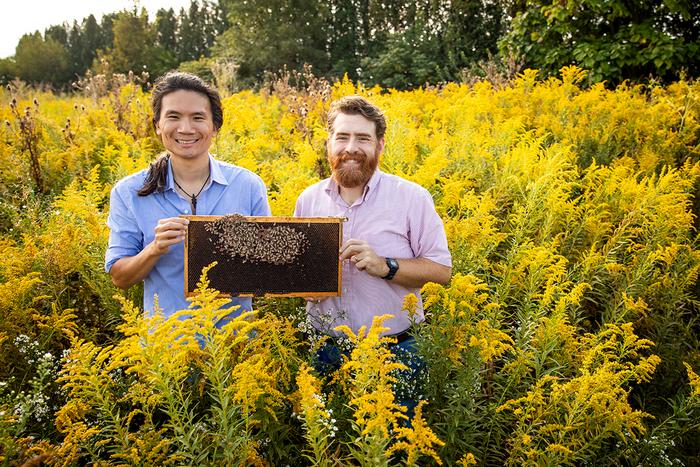
In a new study, researchers at the University of Illinois Urbana-Champaign tackled a thorny problem: How do nutritional stress, viral infections and exposure to pesticides together influence honey bee survival? By looking at all three stressors together, the scientists found that good nutrition enhances honey bee resilience against the other threats.
Their findings are detailed in the journal Science of the Total Environment.
“Multiple stressors are often bad for survival,” said graduate student Edward Hsieh, who led the research with U. of I. entomology professor Adam Dolezal. “However, it is always context-dependent, and you have to be aware of all these factors when you’re trying to make broad statements about how interactive effects affect honey bees.”
Most studies focus on only one or two factors at a time, Hsieh said. They will explore the interplay of poor nutrition and pesticide exposures, for example, or pesticides and viral infections. But no previous studies have looked at how all three factors contribute to honey bee declines — probably because doing so is quite challenging.
Even understanding how bees respond to all the agricultural chemicals they encounter is a complicated task, Dolezal said.
“Some insecticides will work better against some insects than others, but they tend to be more lethal than fungicides or herbicides,” he said. “Some fungicides, however, are known to make insecticides more toxic to insects.”
Sign up for the Daily Dose Newsletter and get every morning’s best science news from around the web delivered straight to your inbox? It’s easy like Sunday morning.
COPYFor the new study, the team looked at pollen collected by honey bees visiting small patches of restored prairie bordering agricultural fields in Iowa. The researchers used the maximum insecticide and fungicide levels detected in bee-collected pollen grains as their guide to likely chemical exposures in the wild.
In a series of experiments, Hsieh exposed groups of caged honey bees to different dietary, viral and/or chemical treatments. The bees were fed either artificial or natural pollen. The agricultural pesticides included chlorpyrifos, an organophosphate; lambda-cyhalothrin, a pyrethroid; or thiamethoxam, a neonicotinoid. Hsieh also infected some of the caged bees with the Israeli Acute Paralysis Virus, one of several viruses known to contribute to the collapse of honey bee colonies around the world.
The experiments yielded some obvious and some unexpected results, Dolezal said.
“What we found was that with the artificial pollen, if bees are exposed to the virus, a lot of them die. And if you expose them to the virus and pesticide at the same time, even more of them die,” he said. “However, if you do the exact same experiment but you give them better nutrition, you get a very different outcome.”
On the natural pollen diet, bees exposed to the virus still experienced higher mortality, the researchers found. But fewer bees died when they were also exposed to a mixture of chlorpyrifos and a fungicide.
“Bees have this inherent ability to deal with stress, and so if you give them a little bit of stress, like a low-level exposure to a pesticide, it may help them deal with a bigger stress from a pathogen like the virus,” Dolezal said. “However, it only works if they have the nutritional resources to do it.”
The researchers warned this doesn’t mean that chemical exposures don’t matter.
“Different pesticides have different molecular targets and do different things,” Dolezal said. “It’s not okay if bees get exposed to a little bit of any pesticide. It depends on the chemical.”
The findings offer some reassurance that providing high-quality prairie habitat near agricultural sites does not create an “ecological trap,” attracting bees to the flowers only to kill them with agricultural chemicals.
“The takeaway from this study is that bees are quite resilient even to the interaction of pesticides and viruses if they have really good nutrition,” Dolezal said. “However, we don’t want people to conclude that pesticides are not a big deal for the bees.”
Pesticides, alone or in combination with viruses, are in most cases detrimental to bees.
“But it is gratifying to know that providing high-quality habitat can at least increase their resilience to these stressors,” Hsieh said.III
IMAGE CREDIT: Michelle Hassel




Leave a Reply