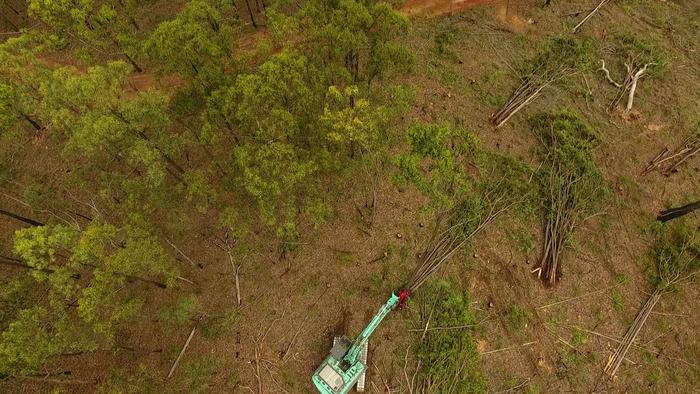
Australia’s environmental laws are failing to stop high rates of tree clearing to make way for agriculture, development and mining, according to University of Queensland research.
PhD candidate Hannah Thomas from UQ’s School of the Environment led a team which used satellite mapping and land clearing data to analyse vegetation loss across northern Australia, including Queensland, the Northern Territory and Western Australia.
“We mapped clearing greater than 20 hectares and then investigated which national or state and territory laws were likely to apply,” Ms Thomas said.

“Of the 1.5 million hectares of land clearing we examined, 65 per cent was potentially non-compliant with at least one law.
“And only 19 per cent of compliant clearing had been formally assessed and approved, with the remainder cleared under specific exemptions.”
The researchers found the clearing deemed potentially non-compliant most likely required assessment under the Commonwealth Environment Protection and Biodiversity Conservation (EPBC) Act 1999, but this did not occur.
Ms Thomas said exemptions, where clearing was allowed to proceed without assessment, were mainly the result of State laws.
“Queensland had by far the highest rates of deforestation with 75 per cent of cases exempt from assessment under the state’s main vegetation management law,” Ms Thomas said.
“In contrast, most clearing in the Northern Territory was assessed, although approval was almost always the outcome.
“In those cases, development of the agricultural and mining sectors across northern Australia was driving the clearing, and particularly linked to pasture development for beef cattle.”
Professor Martine Maron said reducing tree clearing rates was critical considering Australia agreed at the 2021 United Nations Climate Change Conference (COP26) to halt and reverse forest loss by 2030, and prevent further extinctions.
“There is an urgent need to reduce land clearing rates in northern Australia if we are to meet our international commitments,” Professor Maron said.
“The cumulative impacts are severe and worsening, especially combined with the numerous smaller impacts that our study’s conservative 20-hectare threshold didn’t capture.
“Australia must ensure existing laws are applied, and support land managers to keep and care for forest and woodland on their properties.”
The research was supported by WWF-Australia and is published in Conservation Biology.
IMAGE CREDIT: Dr Martin Taylor


Leave a Reply