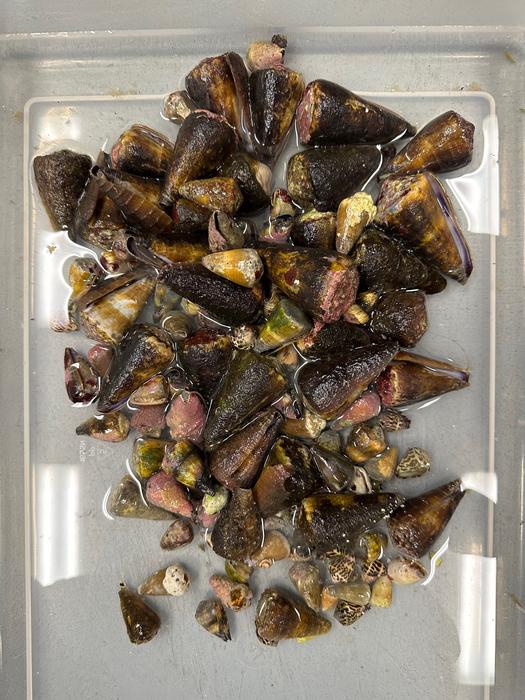
Scientists are finding clues for how to treat diabetes and hormone disorders in an unexpected place: a toxin from one of the most venomous animals on the planet.
A multinational research team led by University of Utah scientists has identified a component within the venom of a deadly marine cone snail, the geography cone, that mimics a human hormone called somatostatin, which regulates the levels of blood sugar and various hormones in the body. The hormone-like toxin’s specific, long-lasting effects, which help the snail hunt its prey, could also help scientists design better drugs for people with diabetes or hormone disorders, conditions that can be serious and sometimes fatal.
The results published in the peer-reviewed journal Nature Communications on August 20, 2024.

The somatostatin-like toxin the researchers characterized could hold the key to improving medications for people with diabetes and hormone disorders.
Somatostatin acts like a brake pedal for many processes in the human body, preventing the levels of blood sugar, various hormones, and many other important molecules from rising dangerously high. The cone snail toxin, called consomatin, works similarly, the researchers found—but consomatin is more stable and specific than the human hormone, which makes it a promising blueprint for drug design.
By measuring how consomatin interacts with somatostatin’s targets in human cells in a dish, the researchers found that consomatin interacts with one of the same proteins that somatostatin does. But while somatostatin directly interacts with several proteins, consomatin only interacts with one. This fine-tuned targeting means that the cone snail toxin affects hormone levels and blood sugar levels but not the levels of many other molecules.
In fact, the cone snail toxin is more precisely targeted than the most specific synthetic drugs designed to regulate hormone levels, such as drugs that regulate growth hormone. Such drugs are an important therapy for people whose bodies overproduce growth hormone. Consomatin’s effects on blood sugar could make it dangerous to use as a therapeutic, but by studying its structure, researchers could start to design drugs for endocrine disorders that have fewer side effects.
Consomatin is more specific than top-of-the-line synthetic drugs—and it also lasts far longer in the body than the human hormone, thanks to the inclusion of an unusual amino acid that makes it difficult to break down. This is a useful feature for pharmaceutical researchers looking for ways to make drugs that will have long-lasting benefits.
Learning from cone snails
Finding better drugs by studying deadly venoms may seem unintuitive, but Helena Safavi, PhD, associate professor of biochemistry in the Spencer Fox Eccles School of Medicine (SFESOM) at the University of Utah and the senior author on the study, explains that the toxins’ lethality is often aided by pinpoint targeting of specific molecules in the victim’s body. That same precision can be extraordinarily useful when treating disease.
“Venomous animals have, through evolution, fine-tuned venom components to hit a particular target in the prey and disrupt it,” Safavi says. “If you take one individual component out of the venom mixture and look at how it disrupts normal physiology, that pathway is often really relevant in disease.” For medicinal chemists, “it’s a bit of a shortcut.”
Consomatin shares an evolutionary lineage with somatostatin, but over millions of years of evolution, the cone snail turned its own hormone into a weapon.
For the cone snail’s fishy prey, consomatin’s deadly effects hinge on its ability to prevent blood sugar levels from rising. And importantly, consomatin doesn’t work alone. Safavi’s team had previously found that cone snail venom includes another toxin which resembles insulin, lowering the level of blood sugar so quickly that the cone snail’s prey becomes nonresponsive. Then, consomatin keeps blood sugar levels from recovering.
“We think the cone snail developed this highly selective toxin to work together with the insulin-like toxin to bring down blood glucose to a really low level,” says Ho Yan Yeung, PhD, a postdoctoral researcher in biochemistry in SFESOM and the first author on the study.
The fact that multiple parts of the cone snail’s venom target blood sugar regulation hints that the venom could include many other molecules that do similar things. “It means that there might not only be insulin and somatostatin-like toxins in the venom,” Yeung says. “There could potentially be other toxins that have glucose-regulating properties too.” Such toxins could be used to design better diabetes medications.
It may seem surprising that a snail is able to outperform the best human chemists at drug design, but Safavi says that the cone snails have evolutionary time on their side. “We’ve been trying to do medicinal chemistry and drug development for a few hundred years, sometimes badly,” she says. “Cone snails have had a lot of time to do it really well.”
Or, as Yeung puts it, “Cone snails are just really good chemists.”
IMAGE CREDIT: Safavi Lab

Leave a Reply