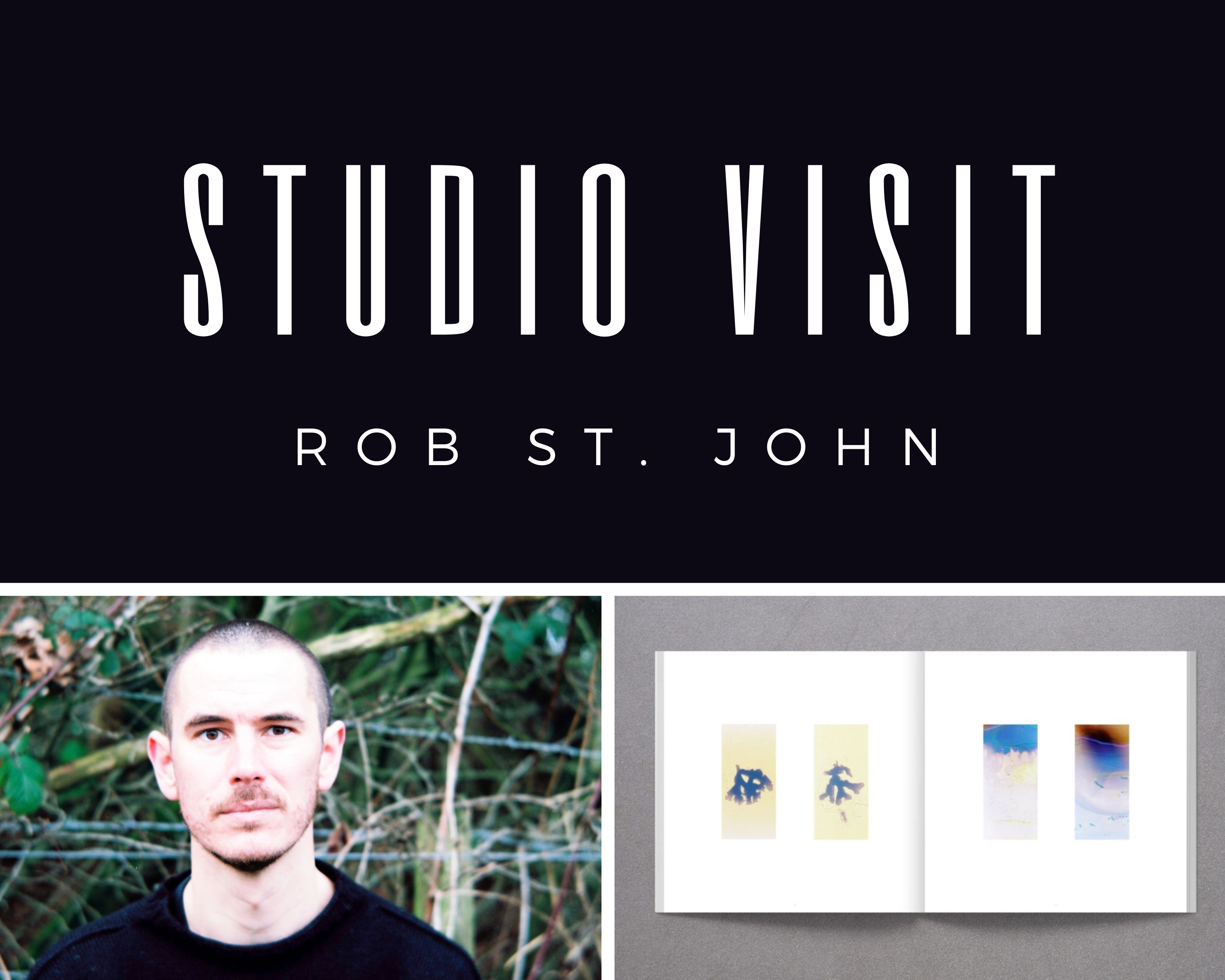
British artist Rob St. John weaves nature and culture into a rich tapestry of sound and image. Through his multifaceted work, St. John explores the landscapes of the UK, blending field recordings, photography, and writing to create a vivid portrayal of the British Isles. His projects often reflect a deep engagement with environmental issues, focusing on how natural and human histories intertwine.
This Studio Visit delves into Rob St. John’s creative process, his inspirations, and the thematic underpinnings of his latest projects. As we explore his unique approach to art and ecology, St. John shares insights into how he captures the subtle dialogues between land and people. Join us as we uncover the layers of meaning behind his evocative works.
Your work spans a vast array of mediums and themes, focusing on the intersections of nature and culture. Sound and soundscapes play a particularly big role in your work. What is it about it that appeals to you?
I think that careful, attentive listening is a vital thing to practice right now, both in noticing the shifts in the natural world, and in cultivating better relationships with each other. Sound recording has given me a way to think about the blurrings of nature and culture in our contemporary landscapes, and helped me find creative ways of noticing and representing them.
More than that, sound recording offers a fun and potentially transformative way of working with communities in different places. The act of close listening – whether through a microphone or just through our own ears – can open up all sorts of spaces for important conversations over experiences of living in a place, and its relationships with big topics like politics, ecology, mental health, history and culture.
This year I’ve been working a lot in Nelson in East Lancashire, on a project called Nelson Overheard, working with community members to record the sounds of the town and surrounding areas, like Pendle Hill. I’m really excited about the ways that sound and listening has created spaces to have valuable discussions over the everyday experiences of life in the area.
Your fieldwork plays a critical role in your creative process. Can you share an experience from your fieldwork that profoundly influenced one of your art pieces or installations?
I like to spend long periods of time in the places that I work. This often helps me to slow and settle into their rhythms, to experiment with creative strategies to somehow frame their patterns, and to do research through archives and interviews.
I spent two month-long residency periods on the island of Örö on the Finnish archipelago in midwinter 2016 and midsummer 2017. This work used sound, film, photography and writing to explore the history of this former-military island, and its potential future trajectories following its re-opening to the public following a century of being off-limits.
This work contributed to the practice component of my PhD across art and geography, so I thought carefully about the ways in which ideas of site, skill and theory bubble up together through extended fieldwork periods like this.
I began to see creative practices not as documentary methods which you ‘ship in’ from the outside, but instead as malleable ways of working which are themselves shaped by the natures of the landscapes in which they are deployed. The work of theorist Elizabeth Grosz was really helpful in shaping this approach, seeing artistic practice as a means of placing temporary frames over the ‘chaos’ of a non-human world that’s continually in flux.
I liked the idea of taking a back-seat in the making process, instead aiming to set the starting points for creative practices – for example sonifications of ecological datasets, or the degradation of camera films buried in the forest floor – and seeing what emerged through their interactions with the natural processes operating on the island. This fieldwork resulted in a film, soundwork and artist book, alongside my PhD.

With a strong background in both the arts and environmental sciences, how do you navigate the interdisciplinary nature of your work, especially when it comes to blending scientific research with artistic expression?
Whilst I’ve always had an art practice, I thought as a teenager that I would eventually work in environmental conversation. Luckily, the Geography undergraduate degree I did at Edinburgh University let me take courses in ecology and climate change alongside environmental art and philosophy, so I’ve always had multiple worlds running alongside each other. I think that this background has given me new ways of approaching art practice – to draw ideas from the natural sciences in how to document and research a landscape, and also a vocabulary for how to describe it, which itself often has an inherent poetics.
It’s also made me think about the commonalities across art and science in how different disciplines know a place through close, attentive practices of fieldworking. It’s also lent a critical eye towards the forms of interdisciplinarity that arise across art and science – I think for all that such collaborations are to be prized, they are rarely designed in ways that are truly transformative.
Instead, from both sides I think they often fall into instrumental pitfalls: whether the science providing the legitimacy for an artist’s role to represent a place or phenomenon; or the artist providing only the outreach and engagement element of a scientific study. I think there are far more interesting ways that these collaborations can take form – where an artist becomes scientist or vice versa, say – but these are often more risky, slow and potentially costly to undertake.
More broadly, I think, for me, working across environmental art and science has lent a subtle but strong politics to everything I do. Like lots of people, I’m dismayed by the lack of convincing political responses to the ecological crisis and climate emergency that we find ourselves in, and the ways in which these planetary breakdowns are having disproportionate effects on the poorest in society. I think art gives us a nuanced vocabulary to be able to speak about such issues with care, and I hope, power.

In addition to your art practice, you’ve written extensively about the environment, art, and sound for publications such as The Guardian and National Geographic Online. How does your writing inform your art, and vice versa?
In lots of my projects, I see writing as another form of expression to try and get under the skin of a place, alongside film, sound, visual work and so on. Often, an exhibition will be accompanied by an artist’s book which offers writing on the context and processes around the work.
Most of the places that I work are quite complex and knotty, and I think that having a range of different modes of creative output gives me a range of tools to try and unpick them in different ways. I also write regularly for EU projects on environmental restoration, which keeps me up-to-date with current issues, and also challenges me to think creatively about shaping stories about the natural world with scientists.
Your project “Soundmarks York” combines archaeological discoveries with modern-day elements to create an immersive experience for the audience. How did you select the six specific locations featured in the trail, and what do you hope visitors will take away from experiencing these “soundmarks” in the context of Roman York’s history and the present-day city?
Soundmarks is a collaboration with the archaeologist and artist Rose Ferraby. We initially worked together in 2019 on a Roman dig at Aldborough in North Yorkshire. We used visual and sound art to try and think with the subsurface histories of a village which are now largely obscured from view. We were then commissioned last year to bring the ways of working we developed to York, again to think about the hidden Roman histories beneath the city’s streets, and how they’ve shaped the characteristics of the modern built environment.
We created an audio trail documenting six important Roman sites – the fort, a graveyard, the river, and so on – which blends sound art and spoken word. I used a range of unusual microphones to record beneath the river and through materials like stone and metal through the city. These included geophones, which are adapted seismic detectors, which pick up bassy vibrations and drones from the rumbles of the city.
This work was then brought together in an exhibition (which is on until autumn 2024) at DIG in York, featuring Rose’s visual collages and a long-form soundscape by me, bringing together the sound works from each site. I hope the work gives people new ways of thinking about the material histories that sit beneath our feet and shape the city we walk through. It’s been a really enjoyable experience working with Rose and other archaeologists to think about stretched scales of time in understanding our contemporary landscapes.
Your sound walk “Bell / Hedge / Scarp / Wall” involves stopping every two hundred steps to record for one minute. How did you come up with this specific structure for the piece, and what do you feel it contributes to the overall experience and narrative of the journey from the Curfew Tower to Lurig Mountain?
This piece was created as part of a month-long residency in the Curfew Tower in Cushendall in Northern Ireland, commissioned by Caught by the River. Artists stay in a strange, old tower in the middle of a rural village.
The tower was originally built to keep the village’s population inside after the nighttime curfew, and its warning bell still hangs on the roof. The view from the top-floor window looks straight up the main street to Lurigethan, a large flat-topped hill which rises steeply from the coastal shoreline.
I became interested in the histories of work on the hill – which includes the remains of a large Bronze Age hillfort, alongside quarries and farmland – and their relationships with contemporary politics of land and access. I began walking and running the short route between the tower and the hilltop regularly: seeing them as two beacons in this landscape. I also bivvyied out on the hilltop and woke up surrounded by skylark song.
The sound recording was made with binaural microphones, which sit in your ears and record a 360 degree field of sound around your head. I wanted to document this route – which I was travelling most days – in sound. I like the way that these sound transects seem to flow along the route, as the soundscape gradually shifts.
Listening along the transect I found that the limestone scarp of the hill acts as a sound mirror for the surrounding landscape, as the sounds from around and below were resonated and amplified. On cresting the scarp onto the flat hilltop, the soundscape falls silent, aside from those larks, and the wind.
The piece’s name comes from the four landscape features that I am currently thinking with as the basis of a written piece, which should hopefully be published later this year in a Caught by the River anthology.
You engage in a lot of collaborations. How do they result in a richer and more expansive end-product?
Collaborations always excite me. There’s always the opportunity to listen to, and observe how other people work, and to learn from that. I’m lucky to have a number of long-term collaborators like Rose and Tommy Perman, as the ebb of our shared and divergent interests seem to coalesce in different ways every time we embark on a new project.
I think it’s good practice to keep challenging yourself, both conceptually and practically, and to stay modest in knowing the limits of your own expertise and skill! Collaboration is also important when thinking about working with people; through workshops, walks and talks I always learn something new, whether about a place or a practice, which helps ground and shape the forms a work takes.
I’m increasingly drawn to these socially-engaged ways of working, particularly in the places around where I live in the North-West of England.
Music seems to be another significant aspect of your career, both as a solo artist and with Modern Studies. How does your musical work relate to your themes of nature and culture?
I’ve played in bands and written songs since I was a teenager. I had a solo career, more than ten years ago, and have subsequently toured in bands all across the UK, Europe and USA. I like the challenge of bringing in elements of my art practice – whether that’s weird sounds or abstracted writing that grasp at an experience or a place – and trying to shape them into song form. Again, it’s a joy working with collaborators you know and love.
Reflecting on your multifaceted career, what advice would you give to emerging artists and writers who are also passionate about environmental issues and wish to make a tangible impact through their work?
I think that meaningful change requires compelling stories, and I think artists have a creative vocabulary that is nuanced and malleable enough to contend with the complex, strange and unsettling natures of the contemporary environmental crisis. However, I think we need to be mindful of seeing artists solely as communicators or activists in trying to make change happen.
That said, there’s huge potential for subtle creative work which extends our understandings of the experiences of these changing environments and non-human worlds. And I think through this sort of work we have so much potential to develop new forms of care, and to find more ethical ways of being and belonging with ecological communities.
This is where I see the exciting work being done across environmental art and science; where artistic practices can help us make sense of the present moment, and the future trajectories of our environments – however subtly, abstracted or poetically – and in so doing help shape new forms of responsibility (or response-ability as Donna Haraway might put it) towards the non-human world. So I’d say we need more people working across these areas, for sure… maybe don’t expect to get rich doing so though!
IMAGE CREDIT: Kate O’Farrell
Sign up for the Daily Dose Newsletter and get the morning’s best science news from around the web delivered straight to your inbox? It’s easy like Sunday morning.

Leave a Reply