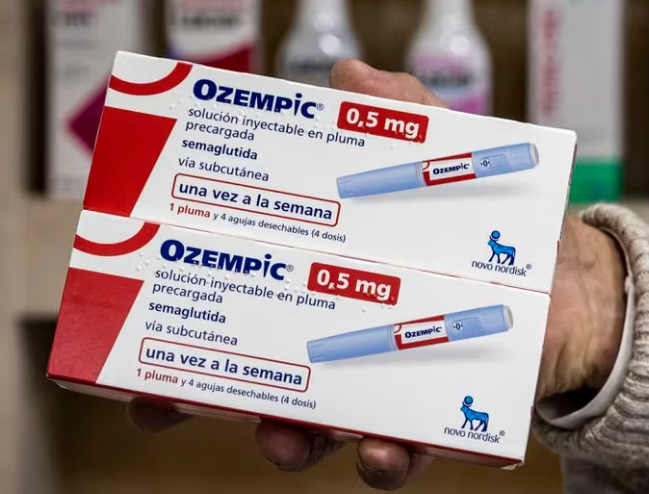
NO SAFETY CONCERNS.
A recent study suggests GLP-1 agonists, used for obesity and diabetes treatment, don’t increase suicidal thoughts, countering previous concerns. The study, analyzing over a million U.S. health records, found no link between these drugs (including Ozempic and Wegovy) and suicidal ideation, possibly indicating a protective effect. However, experts urge caution, noting the study’s limitations and the need for more research. Concerns about these drugs’ side effects, including gastrointestinal issues and rare complications like pancreatitis, persist. Investigations by European and U.S. drug regulators into potential suicidal side effects are ongoing. The study compared patient records on semaglutide (a GLP-1 drug) with other medications, showing lower reported rates of suicidal thoughts among semaglutide users. Nonetheless, factors like underreporting of suicidal thoughts and medication non-adherence could influence these results. Future research, including longer follow-ups and trials including people with depression, is essential for clearer understanding. (Science)
PRIVATE INDUSTRY HEADS TO THE MOON.
Peregrine Mission One, a private moon lander built by Astrobotic, is poised for launch, highlighting a pivotal moment in lunar exploration. This mission, part of NASA’s Commercial Lunar Payload Services (CLPS) initiative, represents Pittsburgh’s rise as a space exploration hub. The lander, carrying various payloads, aims to make history as the first private lunar touchdown in the Sinus Viscositatis region. Astrobotic’s CEO, John Thornton, reflects on the company’s 16-year journey, overcoming challenges and evolving space policies. The mission, launching on United Launch Alliance’s Vulcan Centaur rocket, includes unique payloads like a digital art gallery and a dream capsule with children’s messages. Despite potential risks and launching on Vulcan’s first flight, the mission is seen as a step towards sustainable lunar exploration. Failure is viewed as a learning opportunity, crucial for future CLPS missions. The mission’s success could significantly impact commercial space endeavors and NASA’s Artemis program for human moon exploration. (Space.com)
If you’re enjoying the Daily Dose, sign up for the Daily Dose Newsletter and get the morning’s best science news from around the web delivered straight to your inbox? It’s easy like Sunday morning.
NAVAJO CONCERNS ABOUT LUNAR DESECRATION.
The upcoming launch of United Launch Alliance’s Vulcan Centaur rocket, carrying Astrobotic’s Peregrine lunar lander and memorial payloads by Elysium Space and Celestis, has sparked controversy. These payloads include human remains and DNA, with Celestis’ mission featuring cremains of “Star Trek” icons and others. However, the Navajo Nation President, Buu Nygren, has objected to this practice, citing the moon’s sacred status in many Indigenous cultures. He expressed disappointment in NASA and the U.S. Department of Transportation (USDOT) for not consulting with the Navajo Nation, as promised after a similar incident in the 1990s. Despite these objections, the mission is a private commercial launch under NASA’s Commercial Lunar Payload Services (CLPS) program, with no jurisdiction for NASA over additional payloads. NASA’s representatives acknowledged the controversy but stated that private companies in the CLPS program have autonomy over their payloads. Celestis CEO Charles Chafer defended the mission, stating that religious beliefs should not dictate space missions. The issue highlights the complex intersection of cultural beliefs, commercial space initiatives, and regulatory processes. (Space.com)
FUTURE OF POWERING SPACE STATIONS.
The Indian Space Research Organisation (ISRO) has successfully tested a 100W class Polymer Electrolyte Membrane Fuel Cell based Power System (FCPS) on the PSLV Orbital Experimental Module (POEM), launched on January 1. This fuel cell, an efficient electric generator, operates on electrochemical principles, producing electricity directly from hydrogen and oxygen gases, alongside pure water and heat. During the test, 180W of power was generated, providing valuable data on the performance of the system’s static and dynamic components and the underlying physics. This technology is particularly suitable for space missions involving humans, as it can simultaneously provide electric power, water, and heat from a single system. Furthermore, with water as its only byproduct, the fuel cell is emission-free, making it an ideal power source for space stations. Beyond space applications, these fuel cells have significant societal potential, such as in replacing vehicle engines for emission-free transportation and serving as standby power systems. Their ability to offer range and refueling times comparable to conventional engines gives them an advantage over batteries, positioning them as a promising solution for sustainable energy needs. (Times of India)

CRO INDUSTRY FACES GREAT EXPECTATIONS.
The WCG’s Clinical Research Trends & Insights 2024 report underscores the evolving landscape of clinical research post-COVID-19. The pandemic demonstrated the potential of clinical research, setting high expectations for the future. Key challenges include resource limitations, the integration of diverse technologies, and the complexities of AI and machine learning. Sandra Smith from WCG highlights the current focus on people, timelines, and quality in research. Despite the end of the pandemic, the pressure for rapid vaccine development continues, faced with traditional resource constraints. The report points out an imbalance between the growing number of clinical trials and the available research sites, leading to longer study durations and high pressure on these sites. Solutions proposed include site enablement tools to enhance efficiency and capacity, addressing the administrative burden. Talent retention is a critical issue. Diversity in trials is emphasized, with the FDA requiring diversity action plans. The report also explores the potential of decentralized trials, emerging drug delivery technologies, and the application of AI in managing extensive clinical research data. (Fierce Biotech)
MORE CAREFUL MINING.
Mining is crucial for materials like iron, copper, cobalt, and lithium, but faces challenges due to its environmental impacts and significant data gaps. Key issues include deforestation in Indonesia for coal mining and concerns over lithium mining’s environmental costs. A major problem is the lack of comprehensive global mining data, affecting understanding of its environmental and societal impacts. Many mines, particularly smaller, artisanal, and illegal ones, lack standard reporting, obscuring their true contribution to mineral production. Researchers propose acknowledging data limitations in studies, sharing hard-earned data, and improving data transparency and accessibility. They also suggest using remote sensing and AI to fill data gaps, especially for historic or abandoned mines. Collaborative efforts and substantial research investments are essential for developing comprehensive, global datasets. This is crucial as the demand for minerals, especially for clean technologies, continues to grow, necessitating better understanding and management of the mining sector’s impact. (Nature)
BILLION DOLLAR RECOVERY IN AUSTRALIA.
Queensland faces over $2 billion in recovery costs from recent natural disasters, primarily in the south-east region, according to State Treasurer Cameron Dick. These include damage from Tropical Cyclone Jasper and intense storms described as a tornado, leaving a 4-kilometre wide path of destruction. The Gold Coast, Logan, and Scenic Rim areas were hit hardest, with the Gold Coast experiencing its worst storm in fifty years. The damage includes over 3,200 structures, nearly 1,000 homes and businesses, and significant public infrastructure. The storms led to seven deaths and left 130,000 homes without electricity, with some areas still disconnected after eleven days. Energex reported significant damage to power infrastructure. Over 75,000 people have applied for emergency relief payments, and more than 28,000 insurance claims have been lodged. Insurance Council of Australia expects the average claim cost to be lower than flood damage, as most homes remain habitable. Residents are advised to document expenses and damages for insurance claims. The recovery efforts involve extensive cleanup and rebuilding, with support from the Australian Defence Force and the local community. (ABC)
WASTE NOT, WANT NOT.
In Vancouver, a pioneering project harnesses heat from wastewater to warm homes, particularly in the False Creek neighborhood. Operational since 2010, this renewable energy system utilizes sewage water as a consistent and abundant heat source. Heat pumps in the system achieve over 300% efficiency, significantly reducing greenhouse gas emissions associated with traditional heating methods. This approach exemplifies a global shift towards sustainable energy solutions. The potential of sewage heat is vast; it could provide heating for millions of homes worldwide. Cities like Aarhus, Denmark, have shown that wastewater treatment plants can evolve from energy consumers to producers by adopting this technology. The project underscores the need for urban planners to consider waste heat as a valuable resource. It offers not only environmental benefits but also financial savings, protecting residents from fluctuating fuel prices. The success of similar systems in Stockholm and Aarhus indicates the crucial role of government support and strategic policies in implementing such sustainable energy solutions. (BBC)
SMALL FROG; BIG INFLUENCE.
The western chorus frog, a threatened species in Canada, could impact Premier Doug Ford’s plans for Highway 413 in Ontario. Found along the highway’s proposed route, this small frog breeds in temporary ponds, vital for its survival but often endangered by development. The construction of Highway 413, a key promise in Ford’s re-election campaign, faces potential alterations to protect the frog’s habitat. Ontario’s commitment to the project, highlighted by Transportation Minister Prabmeet Sarkaria, must balance environmental protections. Habitat loss is a major threat to the chorus frog, affecting regional ecosystems. The project’s fate may depend on whether federal or provincial authorities control its environmental assessment. Following a Supreme Court ruling, the federal government plans to continue assessing the highway’s impact, despite Ontario’s opposition. The construction could disrupt not only the chorus frog but also other at-risk species, like the endangered rapids clubtail dragonfly. Environmental concerns include altered water quality and wetland impact, underscoring the need for careful planning and consideration of ecological effects. (CBC)
Thanks for reading. Let’s be careful out there.
WORDS: The Biology Guy.



Leave a Reply