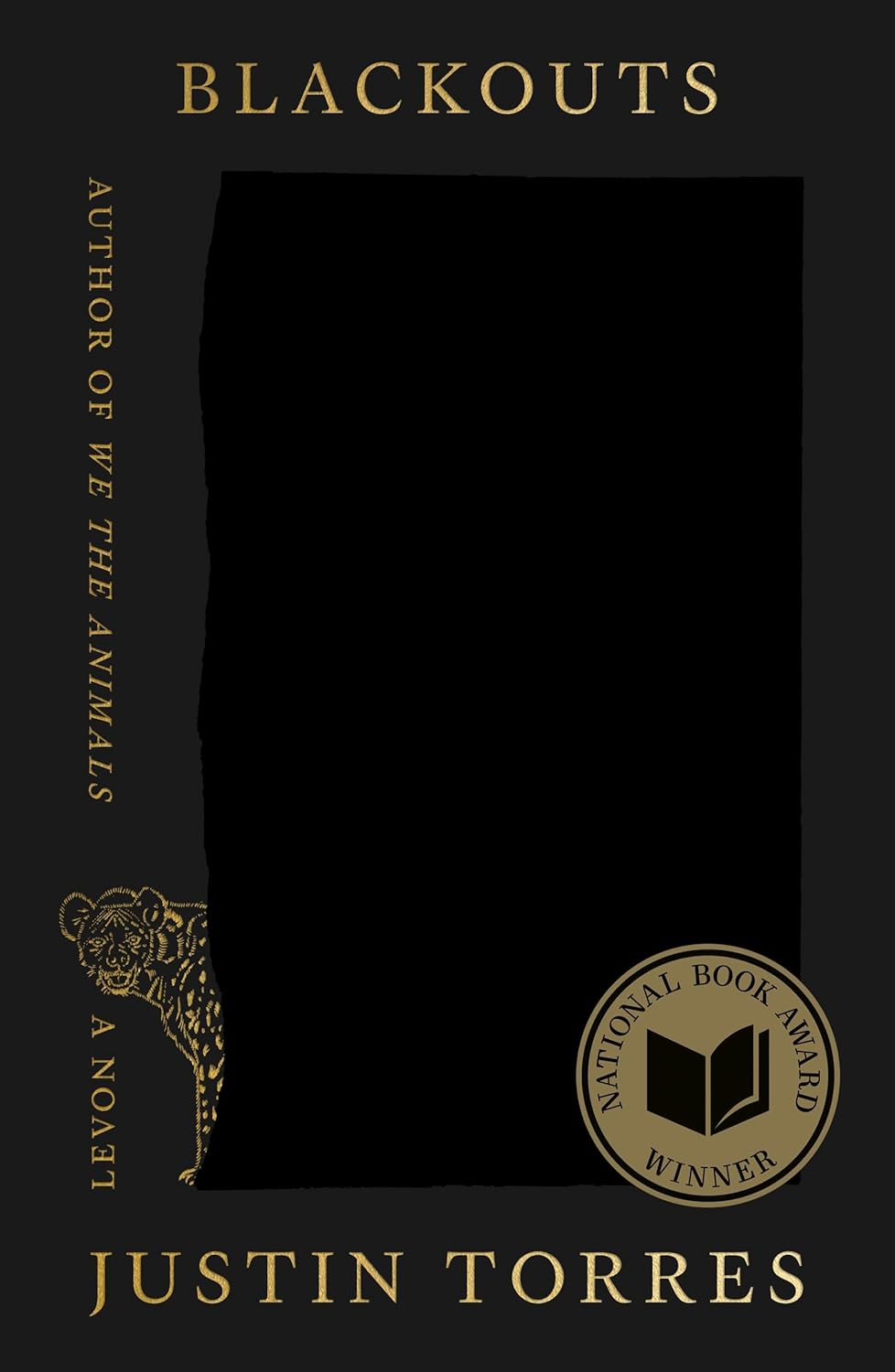
In the labyrinthine folds of Justin Torres’s Blackouts (Farrar, Straus, and Giroux), we find an intricate tapestry interwoven with the variegated threads of queer lineage and historical consciousness, much akin to a spiritual sequel to “We the Animals.” The narrative embarks upon a journey, a kind of odyssey, through the life of a twenty-something writer revisiting the spectral presence of Juan Gay, a figure emblematic of queer Puerto Rican identity. These nocturnal dialogues in “the Palace,” a sort of geriatric oasis in the desert, become a confluence of personal histories and broader cultural narratives, echoing with the voices of figures like Miguel Piñero and Kathleen Collins.
Here, in this novel, one discerns a complex fusion of mental illness, queer intimacy, and the inheritance of culture, encapsulated within the dynamic between two queer souls of disparate generations. It initiates with a Tress image, a vivid tableau of desire’s multifaceted powers. The yarn spun by Torres in Blackouts is a continuation, an extension of sorts, from his earlier work, with the young protagonist becoming the steward of a grand project, a mission steeped in the legacy of Jan Gay and his pioneering studies of homosexual patterns.

Torres, with a deft hand, weaves the motif of erasure poetry into the narrative’s fabric, mirroring the queer historian’s task of excavating buried truths from the sediment of conventional narratives. Our journey follows the younger ‘nene’ and the elder Juan Gay through a surreal landscape punctuated by ‘fugues’ – lapses in consciousness – that serve as metaphorical channels to the past, bridging the lives of Jan and Juan Gay.
In a gothic vein reminiscent of a queer-inflected Shirley Jackson tale, the novel unfurls in the Palace, a setting both haunting and haunted, where the enigmatic Jan Gay’s story is pieced together by Juan and later entrusted to Nene. This act is more than mere transfer; it is an initiation into an expansive, spectral queer narrative, a testament to the undying spirit of queer history.

Torres’s Blackouts further delves into a dreamlike state, where the narrative’s sinews are less concerned with plot than with the ethereal qualities of form and atmosphere. Here, in this dream realm, memory – both personal and collective, particularly in the queer milieu – reigns supreme. The reconnection of the unnamed narrator with Juan at the enigmatic Palace underscores the urgency of intergenerational story transmission. The novel navigates the twilight zones of gay male inheritance and the daunting task of archival recovery, enriched by Torres’s integration of blackout poetry, a symbolic resistance against the erasure of queer narratives.
Blackouts by Justin Torres is not merely a novel; it is a rich, complex foray into the realms of storytelling, historical resonance, and cultural critique. It stands as a vibrant testament to the relentless power of narrative and the indelible imprint of queer heritage. In its refusal to yield to simplistic conclusions, it embraces and celebrates the intricate, often contradictory tapestry of queer history.
WORDS: brice.
Sign up for the Daily Dose Newsletter and get the morning’s best science news from around the web delivered straight to your inbox? It’s easy like Sunday morning.




Leave a Reply