Commercial whaling in the 20th century decimated populations of large whales but also appears to have had a lasting impact on the genetic diversity of today’s surviving whales, new research from Oregon State University shows.
Researchers compared DNA from a collection of whale bones found on beaches near abandoned whaling stations on South Georgia Island in the south Atlantic Ocean to DNA from whales in the present-day population and found strong evidence of loss of maternal DNA lineages among blue and humpback whales.
“A maternal lineage is often associated with an animal’s cultural memories such as feeding and breeding locations that are passed from one generation to the next,” said the study’s lead author, Angela Sremba, who conducted the research as part of her doctoral studies at Oregon State University’s Marine Mammal Institute. “If a maternal lineage is lost, that knowledge is likely also lost.”
The findings were published recently in the Journal of Heredity.

South Georgia is a remote island about 800 miles southeast of the Falkland Islands and home to several whaling stations operating from the turn of the century through the 1960s. In a little over 60 years, more than 2 million whales were killed throughout the Southern Hemisphere, of which 175,000 were killed near South Georgia.
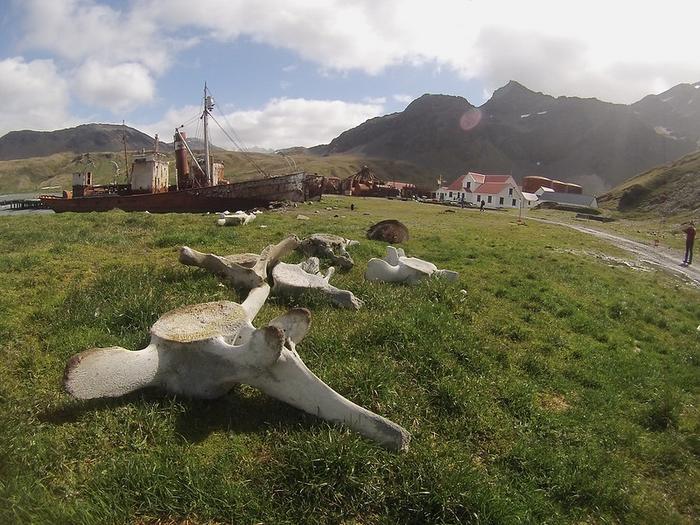
Evidence of that slaughter is still present on the island, which is littered with thousands of whale bones – many 100 years old or more – that were discarded during commercial processing. Cold temperatures in the region aided in their preservation.
South Atlantic whale populations have begun to recover since commercial whaling was halted, but whale sightings around South Georgia remained low. This suggests that local populations may have been extirpated – a term to describe a type of localized extinction, said study co-author Scott Baker, associate director of OSU’s Marine Mammal Institute. Baker last visited South Georgia Island as part of a research voyage in early 2020.
“For 60 years, the whales have been absent from the South Georgia feeding grounds, suggesting that cultural memory was lost,” said Baker, who was Sremba’s Ph.D. advisor. “The numbers of whales returning to this region today are still not large, but there is a sense that they may be rediscovering this habitat.”
To better understand how whaling may have impacted the genetic diversity of today’s population, Sremba analyzed DNA extracted from bones found on South Georgia Island and compared the genetic information with previously published data from living whales in the contemporary post-whaling population.
She and colleagues identified bones of humpback, blue and fin whales, and found that while genetic diversity among the whales remains high, there are indications of a loss of maternal DNA lineages in the blue and humpback populations.
Researchers were not able to detect differences in diversity between pre- and post-whaling DNA samples from Southern Hemisphere fin whales, likely due to the limited availability of post-whaling samples.
Because some whale species can live up to 100 years, there is also a chance that some of today’s whales were alive during the whaling era, said Sremba, who is now a researcher with the Cooperative Institute for Marine Ecosystem and Resources Studies at OSU’s Hatfield Marine Science Center in Newport.
As these whales die, that could result in further loss of additional maternal lineages. This underscores the importance of preserving genetic information from the whales now, she said.
“It’s remarkable these species survived. In another 100 years, we don’t know what might change, and we can’t measure any change now if we don’t have a good understanding of the past,” Sremba said. “This work provides an opportunity to reconstruct the history of these whale populations and help us understand what was truly lost due to whaling activities.”
Rising temperatures due to climate change could also lead to deterioration of the DNA in the bones on South Georgia Island, Baker said.
“This work is a way to preserve this history indefinitely,” he said.
IMAGE CREDIT: Scott Baker, Marine Mammal Institute, Oregon State University.
Sign up for the Daily Dose Newsletter and get the morning’s best science news from around the web delivered straight to your inbox? It’s easy like Sunday morning.
Leave a Reply