A team led by NASA in Utah’s West Desert is in the final stages of preparing for the arrival of the first U.S. asteroid sample – slated to land on Earth in September.
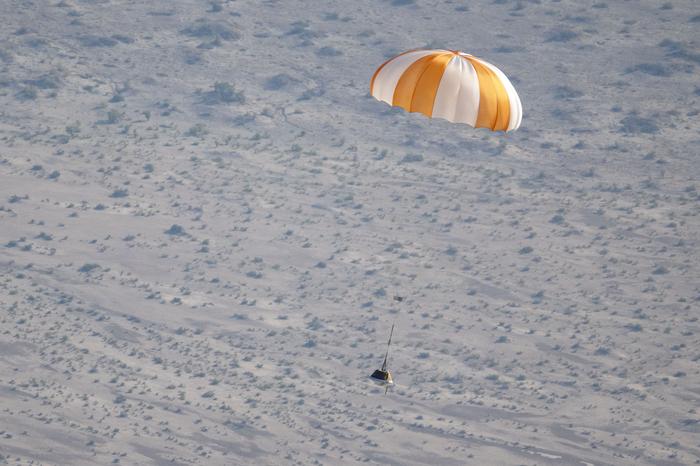
A mockup of NASA’s OSIRIS-REx (Origins, Spectral Interpretation, Resource Identification, and Security–Regolith Explorer) sample capsule was dropped Wednesday from an aircraft and landed at the drop zone at the Department of Defense’s Utah Test and Training Range in the desert outside Salt Lake City. This was part of the mission’s final major test prior to arrival of the actual capsule on Sept. 24 with its sample of asteroid Bennu, collected in space almost three years ago.

“We are now mere weeks away from receiving a piece of solar system history on Earth, and this successful drop test ensures we’re ready,” said Nicola Fox, associate administrator of NASA’s Science Mission Directorate in Washington. “Pristine material from asteroid Bennu will help shed light on the formation of our solar system 4.5 billion years ago, and perhaps even on how life on Earth began.”
This drop test follows a series of earlier rehearsals – capsule recovery, spacecraft engineering operations, and sample curation procedures – conducted earlier this spring and summer.
Sign up for the Daily Dose Newsletter and get every morning’s best science news from around the web delivered straight to your inbox? It’s easy like Sunday morning.
Now, with less than four weeks until the spacecraft’s arrival, the OSIRIS-REx team is nearing the end of rehearsals and ready for the actual delivery.
“I am immensely proud of the efforts our team has poured into this endeavor,” said Dante Lauretta, principal investigator for OSIRIS-REx at the University of Arizona, Tucson. “Just as our meticulous planning and rehearsal prepared us to collect a sample from Bennu, we have honed our skills for sample recovery.”
The capsule is carrying an estimated 8.8 ounces of rocky material collected from the surface of the asteroid Bennu in 2020. Researchers will study the sample in the coming years to learn about how our planet and solar system formed, as well as the origin of organics that may have led to life on Earth.
The capsule will enter Earth’s atmosphere at 10:42 a.m. EDT (8:42 a.m. MDT), traveling about 27,650 mph. NASA’s live coverage of the capsule landing starts at 10 a.m. EDT (8 a.m. MDT), and will air on NASA TV, the NASA app, and the agency’s website.
“We are now in the final leg of this seven-year journey, and it feels very much like the last few miles of a marathon, with a confluence of emotions like pride and joy coexisting with a determined focus to complete the race well,” said Rich Burns, project manager for OSIRIS-REx at NASA’s Goddard Space Flight Center in Greenbelt, Maryland.
Once located and packaged for travel, the capsule will be flown to a temporary clean room on the military range, where it will undergo initial processing and disassembly in preparation for its journey by aircraft to NASA’s Johnson Space Center in Houston, where the sample will be documented, cared for, and distributed for analysis to scientists worldwide.
NASA’s Goddard Space Flight Center in Greenbelt, Maryland, provides overall mission management, systems engineering, and the safety and mission assurance for OSIRIS-REx. Dante Lauretta of the University of Arizona, Tucson, is the principal investigator. The university leads the science team and the mission’s science observation planning and data processing. Lockheed Martin Space in Littleton, Colorado, built the spacecraft and provides flight operations. Goddard and KinetX Aerospace are responsible for navigating the OSIRIS-REx spacecraft. Curation for OSIRIS-REx, including processing the sample when it arrives on Earth, will take place at NASA’s Johnson Space Center in Houston. International partnerships on this mission include the OSIRIS-REx Laser Altimeter instrument from CSA (the Canadian Space Agency) and asteroid sample science collaboration with JAXA’s (the Japan Aerospace Exploration Agency) Hayabusa2 mission. OSIRIS-REx is the third mission in NASA’s New Frontiers Program, managed by NASA’s Marshall Space Flight Center in Huntsville, Alabama, for the agency’s Science Mission Directorate in Washington.
IMAGE CREDIT: NASA/Keegan Barber
If you enjoy the content we create and would like to support us, please consider becoming a patron on Patreon! By joining our community, you’ll gain access to exclusive perks such as early access to our latest content, behind-the-scenes updates, and the ability to submit questions and suggest topics for us to cover. Your support will enable us to continue creating high-quality content and reach a wider audience.
Join us on Patreon today and let’s work together to create more amazing content! https://www.patreon.com/ScientificInquirer




Leave a Reply