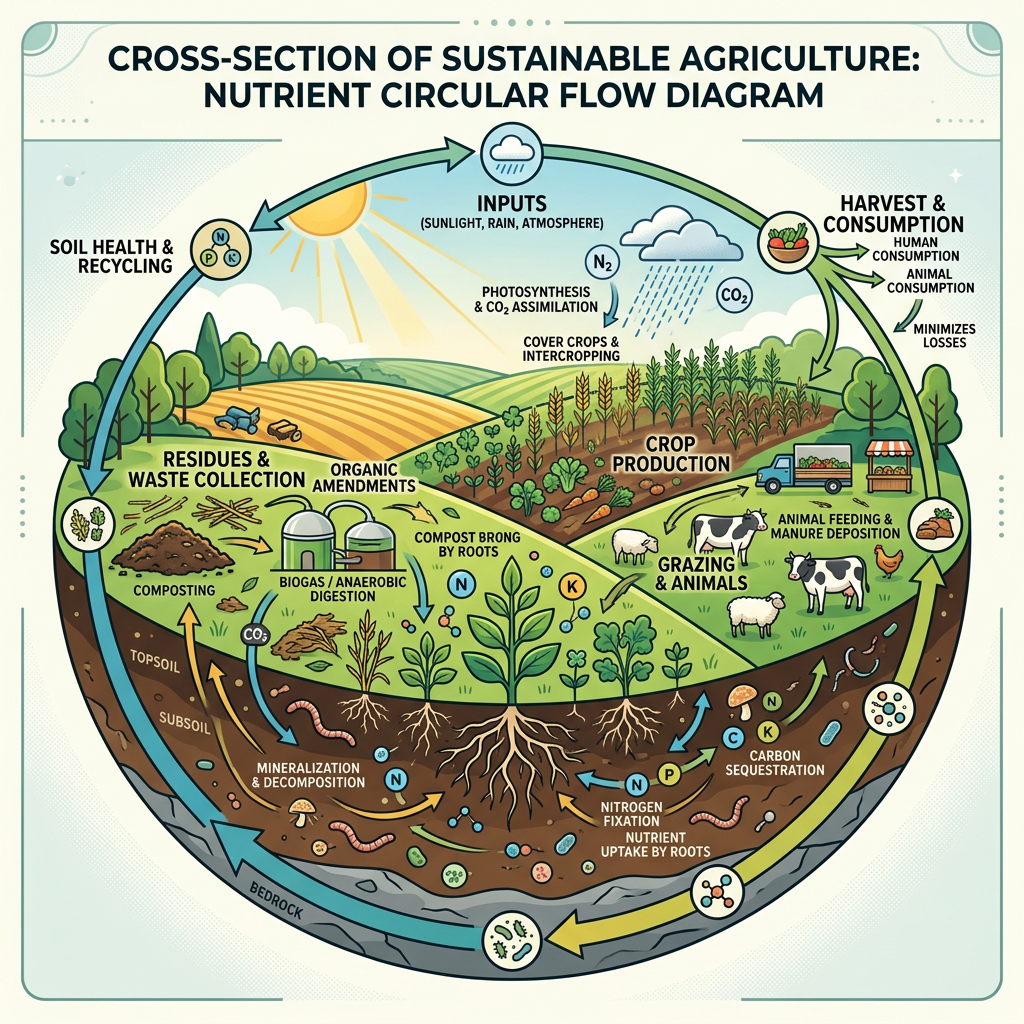
Nutrients recovered from animal and human waste could drastically reduce synthetic fertilizer use in the U.S., according to a new Cornell University study that takes into account real-world implementation challenges like processing and transport.
In the study, under embargo until 5am EST on April 15, 2026 in Nature Sustainability, researchers found that animal and human waste in the U.S. could theoretically meet 102% of nitrogen and 50% of phosphorus needs for the nation’s agriculture, a value of more than $5.7 billion annually. But they also identified a major hurdle: a frequent mismatch between the location of the waste – often in areas densely populated with people or livestock – and agricultural regions with the highest fertilizer needs.
Still, by mapping and analyzing the sources of waste and of agricultural need, the research team found that large percentages of recoverable nutrients – 37% of nitrogen and 46% of phosphorus – can be used locally, and more than half of the surplus nutrients can be redistributed to nearby regions with low economic and environmental costs.

“This is a coordination problem, not a resource problem,” said corresponding author and assistant professor Chuan Liao. “Even considering the real-world constraints, there’s still a substantial amount of nutrients that can be economically redistributed to meet crop needs.”
The research provides a blueprint for harnessing the vast, untapped potential of animal and human waste to reduce the U.S.’s reliance on synthetic fertilizers, which are energy-intensive to produce, harmful to the environment and often made overseas.
“Excessive use of synthetic fertilizers leads to water pollution, and the production itself generates more emissions – it’s a very intensive process,” Liao said. “And you can see with the Iran War, there are supply-chain issues that can lead to great food insecurity as well.”
Using publicly available data, the researchers mapped potential sources of human and animal waste as well as the need for nutrients across 15 major crops, at a resolution of around 10 kilometers. Nutrient surpluses occurred in population-dense areas and livestock-intensive regions, such as the Northeast and parts of the West respectively, while deficits persisted in the Midwest and southern Great Plains. The researchers then analyzed the potential for redistributing nutrients, given the costs of both processing and transportation.
The team found that areas of very high or very low nutrient supply often overlapped with poorer counties, where people are more vulnerable to food insecurity and worse overall health outcomes. Liao said pollution could be a factor: In surplus regions, more waste washes into bodies of water, and in areas of low-nutrient supply, farmers rely more on synthetic fertilizers, which can degrade soil and pollute water as well.
“The nutrient inequality seems to mirror social inequality in a large sense,” Liao said. “So potentially fixing the nutrient flow can promote environmental justice.”
Liao said the best approach to scale the use of waste in U.S. agriculture is to take advantage of opportunities at the local level. He gave the example of a pig farm in the middle of miles of corn fields: With the right infrastructure and incentives, waste from the pig farm could be used to satisfy the nutrient-hungry corn fields right next door.
“We’re advocating for a decentralized system, so that waste can be processed locally,” Liao said. “But in order to do this, we need to coordinate across different sectors such as agriculture, waste and energy. The technology is there, but we need governance and infrastructure to scale up to the entire U.S.”
The study is part of a larger research program exploring the feasibility of using human and animal waste as fertilizer globally, with co-authors Rebecca Nelson, professor in CALS’ School of Integrative Plant Science (SIPS) and Johannes Lehmann, the Liberty Hyde Bailey Professor in SIPS.


Leave a Reply