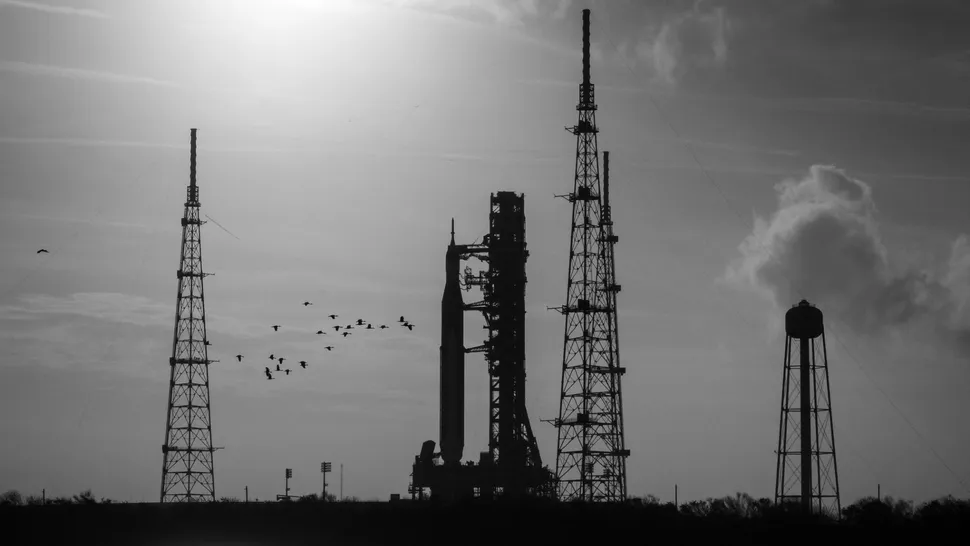
Artemis 2 Set to Carry NASA Back to the Moon With Crew Aboard: NASA is set to launch Artemis 2 today, April 1, at 6:24 p.m. ET, sending four astronauts on the first crewed mission around the moon since Apollo 17 in 1972. The flight is designed as a major test of the Space Launch System rocket, Orion spacecraft, and the systems astronauts will rely on during future lunar missions. Rather than landing, the crew will loop around the moon and return to Earth, proving that NASA can once again send people safely into deep space. The mission is historically significant not only because it ends a 54-year gap in crewed lunar flight, but because it is meant to open the path toward Artemis 3 and a human return to the lunar surface. (Space)
AI Sifts TESS and Finds a Hidden Exoplanet Haul: One of the sharper stories this week is not a single planet but a change in how astronomers find them. A machine-learning system called RAVEN was turned loose on four years of NASA TESS observations and helped validate more than 100 exoplanets, including 31 newly identified worlds, while also surfacing roughly 2,000 additional candidates. That matters because it pushes exoplanet hunting from hand-curated signal checking toward a more scalable, statistics-friendly era. The method is especially useful for short-period worlds and for mapping features like the “Neptunian desert,” where close-in Neptune-size planets are strangely scarce. The broader implication is methodological: astronomy is increasingly becoming a field where discovery depends as much on how you interrogate giant datasets as on what telescope first gathered them. (Space)
Forty-Five Exoplanets Move to the Front of the Life Search: A new habitability-screening effort highlighted 45 rocky exoplanets as especially strong places to look for life, narrowing a field of more than 6,000 known worlds. The researchers focused on planets in a star’s habitable zone and used stellar energy input, orbit shape, and observability to build a practical target list rather than a vague catalog of “maybe habitable” worlds. That makes this more useful than the usual headline about one intriguing planet. Systems like TRAPPIST-1 remain in play, but the study is really about strategy: where to point scarce observing time from JWST and future missions. In astrobiology, target selection is becoming almost as important as instrument capability. This is a good example of the field maturing from speculative possibility toward operational triage — deciding which worlds deserve the next expensive look. (Space)
Webb and Hubble Deliver a Layered Saturn Portrait: NASA’s new Saturn release is less about pretty pictures than multi-wavelength planetary meteorology. By combining Webb’s infrared view with Hubble’s visible and ultraviolet observations, researchers now have a much more complete look at Saturn’s atmospheric structure, ring behavior, seasonal changes, and storm dynamics. The scientific value lies in complementarity: Hubble tracks long-term visible-light weather patterns, while Webb sees deeper thermal and compositional structure that ordinary imaging misses. That kind of pairing is increasingly how outer-planet science advances — not one telescope replacing another, but observatories stacking different slices of the same world into a more complete physical picture. Saturn is also approaching an important seasonal transition near equinox, so these observations become a benchmark for future comparisons. It is a reminder that planetary science often moves forward through repeated, carefully matched views over time, not just one-off discoveries. (NASA Science)
XRISM Measures the Speed of a Galaxy-Scale Hot Wind: A strong astrophysics story this week came from NASA and JAXA’s XRISM telescope, which directly measured the speed of superheated gas blowing out of the starburst galaxy M82. Using broadened iron spectral lines, astronomers clocked the motion of the hot outflow and showed that the wind is moving faster than expected. This matters because galactic winds help regulate star formation, transport metals into intergalactic space, and shape how galaxies evolve over cosmic time. M82 has long been a classic laboratory for violent star formation, but XRISM adds precision spectroscopy that turns a visually dramatic object into a quantitative one. The larger point is technological: high-resolution X-ray spectroscopy is giving astronomers a better grip on feedback, the still-messy process by which galaxies heat, expel, and recycle matter. That is central to nearly every serious model of galaxy evolution. (NASA Science)
The Crab Nebula After Twenty-Five More Years: Hubble’s revisit to the Crab Nebula is the sort of story that shows why long-lived space telescopes matter. The new observations, compared with full-nebula imaging from 1999, reveal how this famous supernova remnant has continued to expand and reorganize over a quarter century. That time baseline lets astronomers watch the aftermath of a stellar explosion as an evolving physical system rather than a static icon. The Crab’s filaments, temperatures, and ionized structures have shifted enough to sharpen models of how supernova debris interacts with surrounding space and with the pulsar-powered engine at the center. In a week full of new objects and fresh claims, this one stands out for another reason: it is a long-duration experiment in patience. Astronomy often depends on waiting long enough for the universe to reveal that it is changing. (NASA Science)
Crab Pulsar ‘Zebra Stripes’ Finally Get a Plausible Explanation: A separate Crab-related story came from new work on the pulsar’s strange radio “zebra stripes,” a long-running puzzle in which bright emission bands are separated by dark gaps. The new explanation ties those patterns to an interaction between plasma effects and gravity, with the pulsar’s environment spreading radio light apart and gravitational lensing-like behavior pulling it back into interference patterns. What makes this interesting is not just that a 20-year mystery may have an answer, but that the answer sits at the boundary between plasma astrophysics, wave propagation, and compact-object gravity. Pulsars are often treated as cosmic clocks, but they are also natural laboratories for extreme physics. If this interpretation holds up, it could change how astronomers read complicated radio structures around neutron stars and help sort out which features come from the source itself versus the medium around it. (ScienceDaily)
A Signal That Might Point to Primordial Black Holes: One of the more speculative but potentially consequential cosmology stories this week concerns primordial black holes — hypothetical objects that may have formed in the early universe rather than from dying stars. A new study argues that an unusual signal could provide a way to test whether such objects exist. This is interesting because primordial black holes sit at the junction of several major mysteries: dark matter, inflation, and the physics of the very early cosmos. They have long been attractive because they would let cosmologists explain some present-day structure using relics from the Big Bang era itself. The catch, of course, is evidence. Most primordial-black-hole discussions remain theory-heavy. So a paper proposing an observational handle is valuable even if it does not settle the matter. In cosmology, new ways to constrain a possibility can matter almost as much as a direct discovery. (Phys.org)
A Distant Galaxy Dims Twentyfold, and Black-Hole Feeding Looks Unstable: Astronomers have reported a galaxy about 10 billion light-years away whose brightness dropped to roughly one-twentieth of its former level over just two decades, apparently because gas accretion onto its central supermassive black hole fell sharply. That is a dramatic change on human-observable timescales for something so distant and massive. The story matters because it pushes back against the idea that active galactic nuclei evolve only over slow, almost geological cosmic intervals. Instead, at least some black-hole feeding episodes may switch states faster and more violently than expected. That has implications for how astronomers interpret quasar populations and black-hole growth histories in survey data, where an object may be caught in only one moment of a much more unstable life cycle. In other words, some galaxies may not simply brighten and fade gradually; they may have lurching metabolic episodes. (Phys.org)
A Giant Radio Relic Appears in an Unusually Low-Mass Cluster: A new MNRAS paper reports the discovery of an arc-like radio relic in Abell 4067, a relatively low-mass merging galaxy cluster. Radio relics trace shock waves in intracluster gas, so finding one in a less massive system helps widen the range of environments where merger-driven shocks can leave observable marks. The relic in this case stretches about 1.48 megaparsecs and appears underluminous relative to relics in heftier clusters, which is consistent with the idea that weaker merger shocks can still generate relics, just less spectacularly. Just as interesting is what was not seen: no detectable central radio halo. That absence reinforces the point that cluster mergers do not produce a uniform set of radio features. Cluster mass, energetics, and merger stage all matter. For large-scale structure work, that is a useful complication rather than a nuisance. (OUP Academic)
Sharper Masses and Radii Clarify What Small Exoplanets Are Made Of: Another MNRAS paper worth attention this week is a careful composition study of six small-planet systems, using CHEOPS transits plus archival photometry and radial-velocity data from multiple instruments. The headline is not a single flashy new planet but better precision: masses typically better than 15% and radii better than 5%, good enough to sort planets into more meaningful composition bins. Some worlds look rocky and sit near the radius valley, others appear to need steam-rich or mixed volatile envelopes, and still others fall into lower-density categories compatible with gas-dwarf or water-world interpretations. That sort of classification work matters enormously for the next decade, because future atmospheric missions need reliable target priors. Before astronomers can ask what an atmosphere contains, they need a better idea of what kind of body they are looking at. This is infrastructure science for exoplanet characterization. (OUP Academic)

COPY II (2-3 PARAGRAPHS)
IMAGE CREDIT: NASA.


Leave a Reply