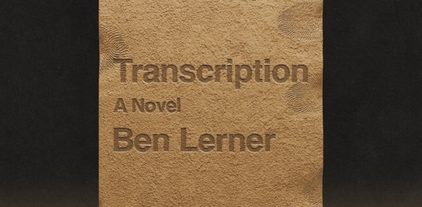
There is a particular species of modern catastrophe — not tragic, not even properly bad, but spiritually annihilating in a way that is funny only after sufficient elapsed time and possibly not even then — that involves dropping your smartphone into water. Ben Lerner’s Transcription begins with one of these. A writer, dispatched to interview an aging intellectual mentor named Thomas, drops his phone into a hotel sink, and here is the thing: the phone contains not just a recording app but the entire operational infrastructure of the contemporary self, which is to say memory, archive, schedule, proof, map, the performed version of one’s own life, the actual version of one’s own life, and several gigabytes of whatever lies between those two things that we mostly prefer not to examine too closely. The device dies. The interview proceeds anyway. The narrator later reconstructs the conversation from memory. Whether “reconstruction” and “fabrication” name the same act or different ones is, it turns out, not a journalistic question. It is an ontological one. It is, Lerner suggests with his characteristic combination of formal precision and genuine emotional urgency, the question.
What is astonishing about Transcription — and “astonishing” is a word one should probably use carefully, or not at all, given that it has been evacuated of meaning by decades of jacket copy, but here it functions as an attempt at accuracy rather than promotion — is how completely Lerner has refracted what could have been a cute parable about technology and memory into something that feels, by the final pages, like an actual reckoning with time, inheritance, and the terrifying biology of influence. The broken phone forces the narrator back onto the unreliable and irreplaceable storage system of the human mind, and in doing so it reveals that the human mind has always been, in some fundamental sense, broken equipment. Memory is not a recording. Love is not a transcript. Grief — and this novel is quietly, fiercely about grief, though it doesn’t announce itself that way, because real grief rarely does — arrives as a cascade of corrupted files that we spend the rest of our lives trying to open.
Lerner’s earlier narrators, the ones who stalked through Leaving the Atocha Station and 10:04 with their hypochondria and their grants and their magnificent cascading anxieties, performed intelligence the way certain very smart people perform intelligence: defensively, preemptively, with enough irony deployed in advance to inoculate against any charge of sincerity. This narrator is different. He listens. He sits with Thomas, who is ninety and dying and difficult and brilliant and in some ways a version of the father and mentor and intellectual precursor that any person who makes art has internalized and can neither fully honor nor fully escape, and he listens. The silence in this novel is — and this may be the highest praise available for a slim literary novel published in the present moment — actually quiet.
The technology question, which the book raises and refuses to answer cheaply, deserves particular attention. It would be easy, and in a certain strain of American literary fiction it has become almost obligatory, to cast the smartphone as villain: the glowing rectangle, the attention-flattener, the device that interposes itself between us and whatever we are supposed to be having instead of the mediated experience we are actually having. Lerner won’t do it. A screen can soothe a child who cannot eat. A FaceTime call can let a son say things to a dying father that proximity made unsayable. Our technologies are terrifying not because they are external to us but because they are no longer external to us at all, and haven’t been for some time. Experience has always been mediated — by language, by memory, by art, by the stories families repeat badly and compulsively for decades until the repetition itself becomes a kind of fate — and to pretend otherwise is to pretend that there was once some pristine unmediated real that the iPhone ruined.
The children in Transcription — Max’s daughter Emmie, who won’t eat; the narrator’s daughter Eva, who won’t stop being afraid — are not symbols in any reductive sense. They are pressure gauges. They measure, in the particular sensitive units that children’s bodies register, the weight of adult histories, unspoken griefs, and the genetic inheritance of anxiety that crosses generations the way certain voices do: recognizably, inescapably, arriving unbidden in your own mouth before you understand what you’re saying.
Transcription is a defense of fiction. Not because fiction gets it right. But because fiction is honest about the distance between getting it right and trying.

COPY II (2-3 PARAGRAPHS)
IMAGE CREDIT: NASA.


Leave a Reply