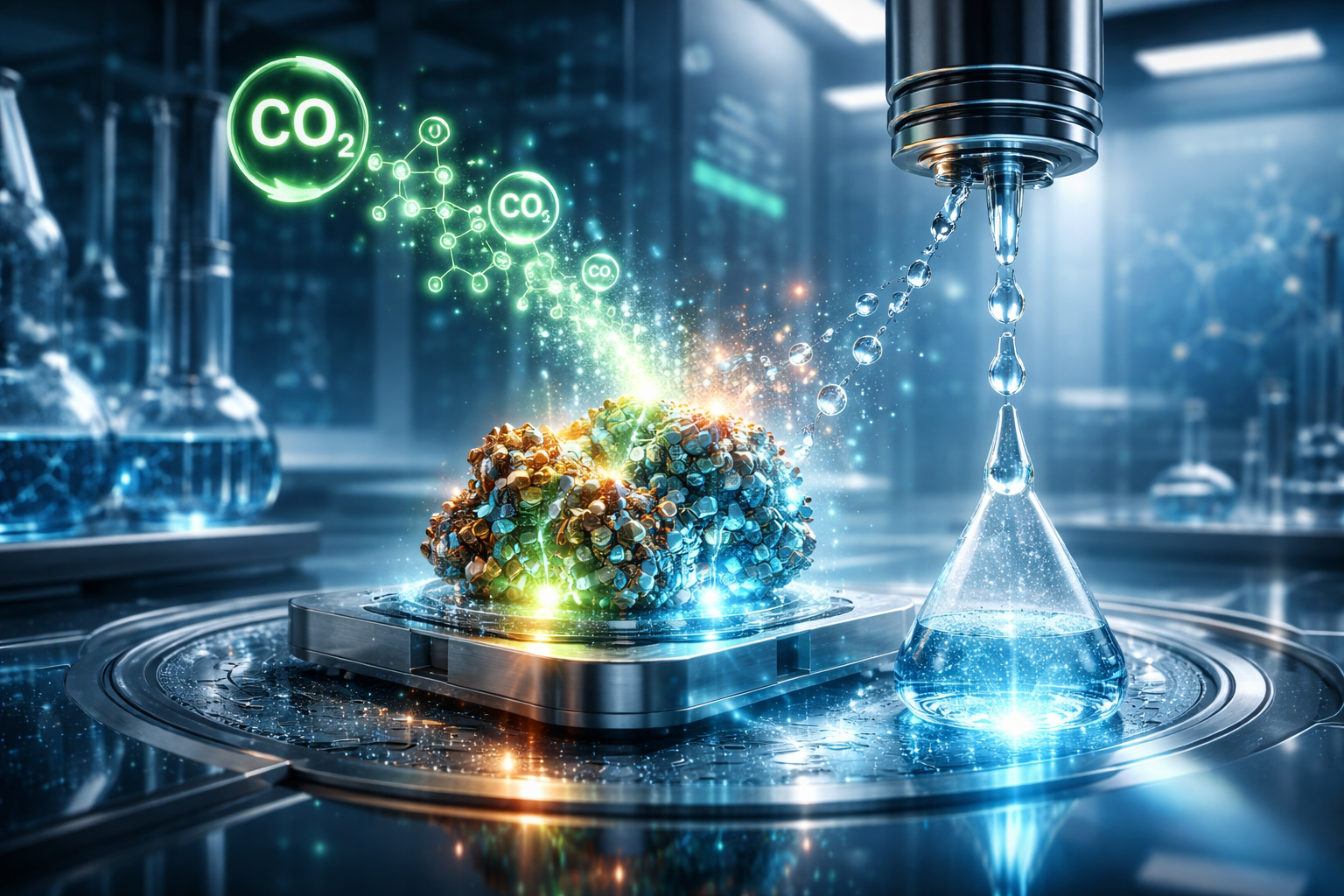
For decades, chemists have chased a tantalizing idea: take carbon dioxide—the same heat-trapping gas driving climate change—and turn it back into something useful. Not just lock it away, but recycle it into fuels or chemicals we already depend on.
A new study suggests that goal may be closer than it looks.
Researchers in China have developed a new catalyst that converts carbon dioxide (CO₂) into methanol, a widely used fuel and industrial chemical, with striking efficiency and stability. The work, published in the Chinese Journal of Catalysis, shows how carefully engineered combinations of common metals can dramatically improve one of the most important reactions in green chemistry.
Why methanol matters
Methanol is one of the chemical industry’s workhorses. It’s used to make plastics, paints, pharmaceuticals, and fuels—and it can itself be burned or blended into cleaner energy systems. Today, however, methanol is mostly made from fossil fuels, which undermines its climate credentials.
If methanol could instead be made from captured CO₂ and hydrogen produced using renewable electricity, it would function like a liquid battery for carbon—storing renewable energy in chemical form while recycling a greenhouse gas.
That’s the promise. The challenge has been making the chemistry efficient enough to matter.
The catalyst problem
Turning CO₂ into methanol is not easy. Carbon dioxide is a remarkably stable molecule, and convincing it to react requires high temperatures, pressure, and a catalyst—a solid material that nudges molecules along the right reaction path.
Traditional catalysts, often based on copper and zinc, tend to produce unwanted by-products like carbon monoxide. They can also degrade over time, limiting their usefulness in real industrial systems.
The new study tackles both problems at once.
Three metals, working together
The research team—based at Fuzhou University and Zhejiang Ocean University—designed a ternary catalyst made from three metals: copper (Cu), zinc (Zn), and cerium (Ce).
The key was not just the ingredients, but how they were combined.
Using a urea-assisted grinding method, the scientists mixed the metals at a very fine scale before heating them. This process created a catalyst full of microscopic “interfaces”—regions where all three elements meet. These interfaces turn out to be chemically powerful.
Each metal plays a different role:
- Copper activates hydrogen, helping split it into reactive pieces.
- A New Way to Turn Carbon Dioxide Into Fuel—More Cleanly Than BeforeA New Way to Turn Carbon Dioxide Into Fuel—More Cleanly Than Before
- Together, they steer the reaction toward methanol rather than waste products.
It’s a bit like a relay race: each metal hands the molecule off to the next, keeping it on the right track.
Impressive lab performance
In laboratory tests, the catalyst converted CO₂ to methanol with about 97 percent selectivity—meaning nearly all of the carbon went into the desired product. Just as important, it stayed stable for at least 100 hours of continuous operation, a key benchmark for industrial relevance.
Using advanced spectroscopic tools, the researchers also tracked how molecules moved across the catalyst’s surface. They confirmed that CO₂ follows a “formate pathway,” passing through a series of short-lived intermediates before becoming methanol. This detailed view helps explain why the catalyst works so well, not just that it does.
How big a deal is this?
This research is experimental, laboratory-scale chemistry, not a commercial technology—yet. The reaction still requires hydrogen, and the climate benefits depend on that hydrogen being produced cleanly. Scaling up from grams of catalyst to industrial reactors is a non-trivial leap.
Still, the advance is meaningful. It shows that relatively inexpensive metals, arranged in the right way, can outperform more conventional designs. That insight could guide the next generation of CO₂-recycling catalysts across the chemical industry.
Sources:
EurekAlert! press release; Chinese Journal of Catalysis (peer-reviewed study by researchers at Fuzhou University and Zhejiang Ocean University).


Leave a Reply