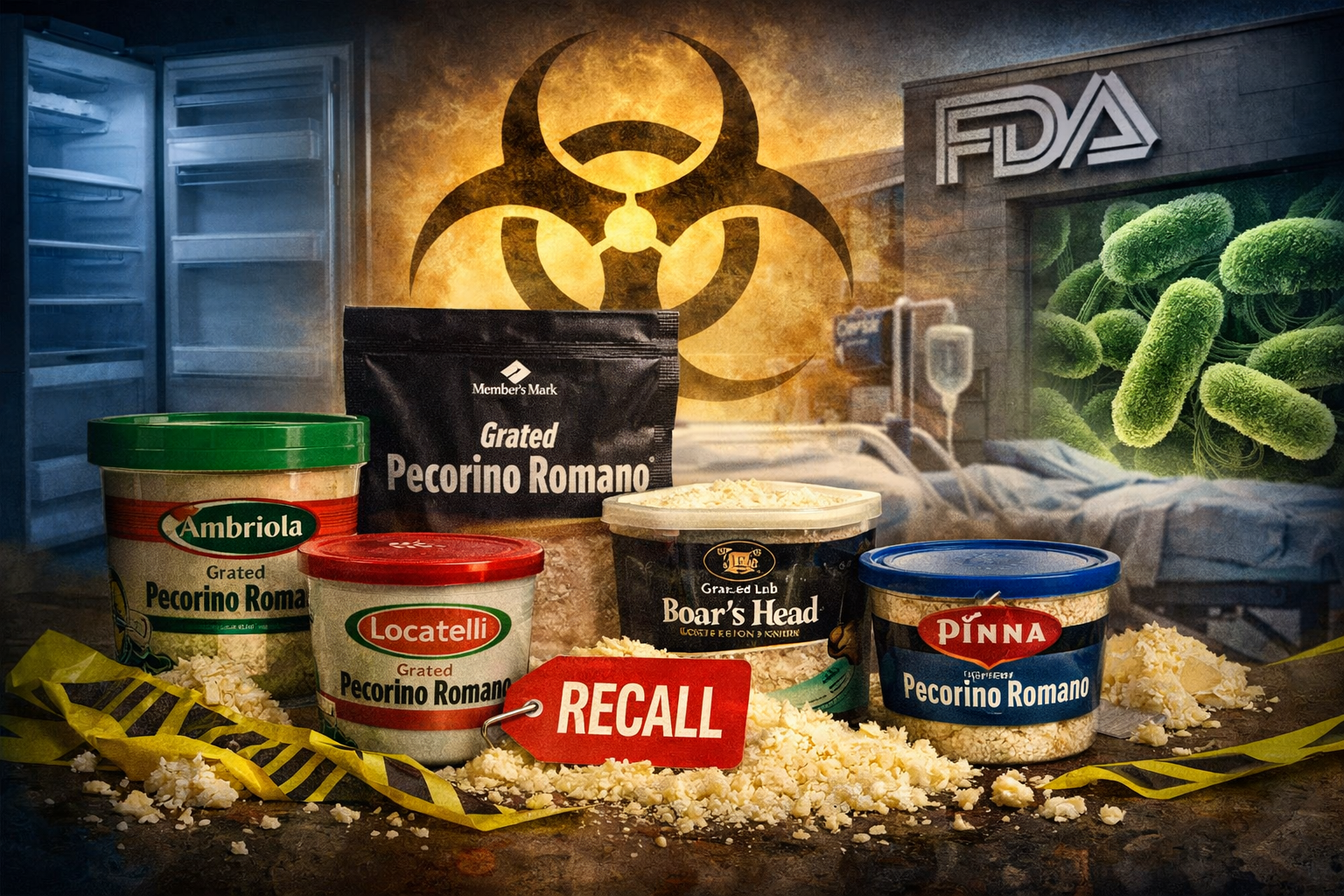
In early January 2026, a recall of grated Pecorino Romano cheese got a sharper warning label: the U.S. Food and Drug Administration (FDA) reclassified it as a Class I recall, the agency’s most serious category. The products trace back to The Ambriola Company in West Caldwell, New Jersey. In a November 25, 2025 company announcement posted by the FDA, Ambriola said routine testing confirmed the presence of Listeria monocytogenes and it was recalling select cheese products because of the health risk.
The recall spans multiple labels—Ambriola, Locatelli, Member’s Mark, Pinna, and Boar’s Head—and includes both retail cups/bags and “sold by the pound” grated product. The FDA notice says affected products were distributed nationwide between November 3 and November 20, 2025, and many carry expiration dates well into 2026, which is why consumer outlets urged people to check refrigerators now. The FDA posting lists the specific products and date codes, including examples like Boar’s Head Grated Pecorino Romano 6-oz cups (03/04/26 and 03/12/26), Locatelli grated 4-oz cups (05/03/26, 05/10/26, 05/17/26), Locatelli grated 8-oz cups (multiple April–May 2026 dates), and Member’s Mark 1.5-lb bags (03/25/26, 03/30/26, 04/05/26).
Ambriola said no illnesses had been reported at the time of its announcement, but advised anyone with symptoms to contact a healthcare provider. The company also said it suspended production and distribution of affected products while reviewing sanitation and food-safety procedures, and its CEO said the company had alerted stores and distributors to remove the products from shelves. For consumers, the action steps are straightforward: don’t eat recalled products, discard or return them for a refund, and clean any containers, utensils, and refrigerator surfaces that may have come into contact with the cheese.
Now for the bigger picture. FDA recall classes are risk signals. A Class I recall means there is a “reasonable probability” that using or being exposed to the product could cause serious adverse health consequences or death. That doesn’t mean harm has already occurred; it means the potential downside is high enough—especially for vulnerable groups—that avoiding exposure is the safest choice.
Listeria is unusual among foodborne pathogens because it can cause severe disease and because it can persist in cold environments. The CDC notes that listeriosis can range from an intestinal illness to invasive infection, with symptoms that may include fever, headache, stiff neck, confusion, and loss of balance. Risk is not evenly distributed: pregnant people, newborns, adults 65+, and people with weakened immune systems are most likely to suffer severe outcomes. In pregnancy, Listeria can spread to the fetus even when the pregnant person feels only mildly ill; CDC notes that about 1 in 4 pregnant people with listeriosis lose the pregnancy or their baby shortly after birth.
Finally, recalls like this are a reminder that food safety is a system, not a guarantee. The CDC estimates 48 million Americans get sick from foodborne illness each year, leading to 128,000 hospitalizations and 3,000 deaths. Most cases come from other germs, but listeria’s stakes are high enough that a quick fridge check—and taking recalls seriously—can genuinely prevent tragedy.




Leave a Reply