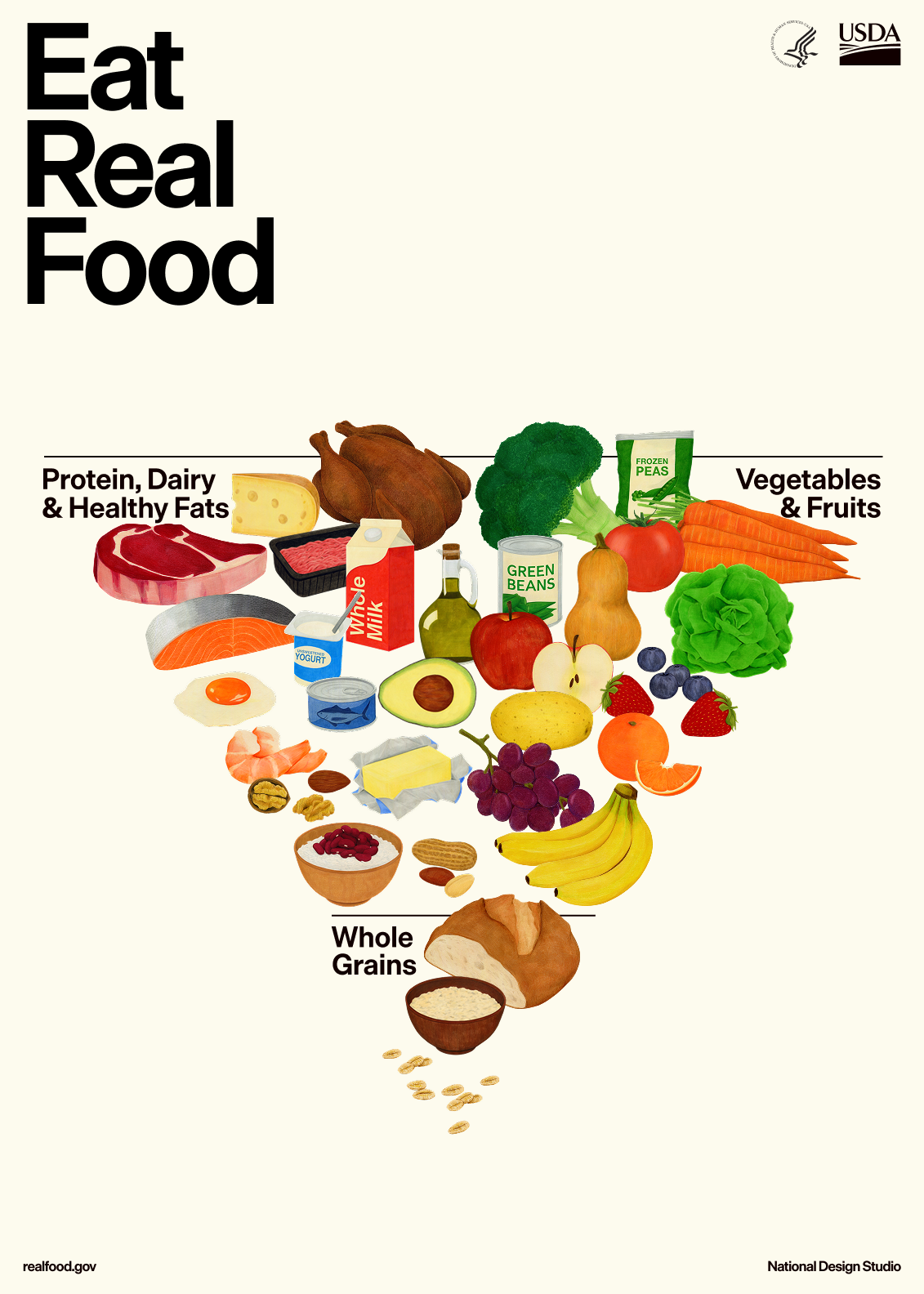
The Trump administration released its 2025–2030 Dietary Guidelines with Health and Human Services Secretary Robert F. Kennedy Jr. framing the update as a reset toward “real food” and away from ultra-processed diets. The guidance is presented as shorter and more message-driven than prior editions, with officials emphasizing whole, minimally processed foods, fewer added sugars, and less reliance on packaged items.
A headline shift is rhetorical: Kennedy and allies say they are ending a decades-long “war” on saturated fat, alongside a broader embrace of full-fat dairy and higher-protein eating patterns. Reported recommendations include increasing protein targets (figures cited around 1.2–1.6 g/kg/day) and endorsing foods such as meat, eggs, and full-fat dairy more prominently than recent guidance, while sharply warning against added sugars and sugar-sweetened beverages. Some coverage also notes a numeric “per-meal” added-sugar cap and language suggesting no amount of added sugar is part of a healthy diet.
Visually, the update is paired with a redesigned (and in some accounts “reversed”) pyramid-style graphic that elevates protein, dairy, “healthy fats,” and produce while deemphasizing grains compared with older pyramid frameworks.
Reaction in early reporting is mixed: many experts applaud the focus on reducing ultra-processed foods and added sugars, but some raise concerns that normalizing butter, red meat, and other saturated-fat-rich choices could undermine cardiovascular risk-reduction messaging—even as the long-standing recommendation to keep saturated fat under 10% of calories is reportedly still present.
Food “pyramids” were invented as a communication tool: a single graphic that converts dense nutrition science into a hierarchy people can remember. One widely cited origin is Sweden in 1974, during an era of price pressure and public-health messaging, with the pyramid format spreading internationally because it visually conveys proportions and priority.
In the U.S., USDA’s most iconic version arrived in 1992 as the Food Guide Pyramid—stacking food groups to suggest “more from the base, less from the tip,” and pairing adequacy (enough vitamins/minerals) with moderation (limits on certain components).
In 2005, USDA replaced that pyramid with MyPyramid, a more abstract, vertical-wedge design meant to reflect personalization, though it was widely criticized as confusing.
In 2011, the U.S. pivoted away from pyramids entirely with MyPlate—a plate-and-glass icon designed to be instantly actionable at mealtime (“build your plate”), and explicitly described by USDA as a replacement for the Food Guide Pyramid (and, by extension, the pyramid era).
The bigger pattern is that each graphic reflects the controversies and priorities of its time: fear of fat in late-20th-century guidance, later emphasis on whole grains and dietary patterns, and today’s renewed fight over processing, sugar, and which fats should be “featured” versus “limited.”




Leave a Reply