Since humanity first set foot on the Moon, the dream of extending civilization beyond Earth has captivated scientists and space agencies worldwide. Mars, with its rocky terrain and seasonal cycles reminiscent of our home planet, has emerged as the leading candidate for future human settlement. But transforming this hostile world into a livable outpost presents challenges that push the boundaries of engineering and biology alike.
Now, an international team of researchers has proposed an innovative solution: harnessing the power of bacteria to turn Martian soil into sturdy building material. Their perspective article, published in Frontiers in Microbiology, outlines how a partnership between two remarkable microorganisms could revolutionize construction on the Red Planet while dramatically reducing energy requirements compared to conventional methods.
“We envision this bacterial co-culture mixed with Martian regolith as feedstock for 3D printing on Mars. At the intersection of astrobiology, geochemistry, material science, construction engineering, and robotics, this synergistic system could revolutionize the potential for construction on the Red Planet.”

The Construction Challenge
Building on Mars presents formidable obstacles. The planet’s thin atmosphere—less than one percent of Earth’s surface pressure—provides virtually no protection from cosmic radiation. Temperatures swing wildly, from a bone-chilling minus 90 degrees Celsius in winter to a comparatively mild 26 degrees Celsius in summer. Perhaps most critically, transporting construction materials from Earth is prohibitively expensive, with launch costs and payload limitations making traditional approaches economically unfeasible.
“Given the high cost and logistical complexity of transporting construction materials to Mars, the development of autonomous in situ resource utilization technologies is imperative,” the researchers write. This strategy, known as ISRU, focuses on using locally available resources rather than shipping everything from Earth.
The cement industry on Earth already faces scrutiny for its environmental impact, accounting for approximately eight percent of global carbon dioxide emissions—more than most countries produce. On Mars, the energy-intensive processes required to produce Portland cement or sinter regolith through heat treatment would strain the limited power systems available to early colonists.

Nature’s Construction Crew
The researchers propose an elegant biological alternative: biocementation, a process in which microorganisms facilitate the precipitation of calcium carbonate to bind soil particles together, creating a concrete-like material at ambient temperatures with minimal energy input.
“Our research pioneers a bold path, drawing inspiration from Mother Nature. In an internationally cross-disciplinary effort, we came together to harness a natural wonder: biomineralization.”
At the heart of their proposal is a partnership between two bacterial species: Sporosarcina pasteurii, a well-studied bacterium known for its exceptional ability to precipitate calcium carbonate, and Chroococcidiopsis, a hardy cyanobacterium that has demonstrated remarkable survival capabilities under simulated Martian conditions.
Sporosarcina pasteurii has emerged as the workhorse organism for biocementation research on Earth. This non-pathogenic bacterium produces high levels of the enzyme urease, which breaks down urea into ammonia and carbonate ions. When calcium is present, this process leads to the formation of calcium carbonate crystite that effectively cements soil particles together. Studies have demonstrated that sand columns treated with this bacterium show significantly increased compressive strength while maintaining structural integrity.
Chroococcidiopsis brings complementary strengths to the partnership. This photosynthetic cyanobacterium, found in Earth’s most extreme deserts from Antarctica’s McMurdo Dry Valleys to the Atacama, has evolved remarkable resistance to desiccation, intense radiation, and temperature extremes. During experiments conducted outside the International Space Station as part of the BIOlogy and Mars EXperiment (BIOMEX) project, dried Chroococcidiopsis cells mixed with Martian soil simulants survived 1.5 years of exposure to space radiation and Mars-like atmospheric conditions.

A Symbiotic Strategy
The proposed co-culture system leverages the strengths of both organisms. Chroococcidiopsis, through photosynthesis, consumes carbon dioxide while releasing oxygen—gradually transforming an initially oxygen-poor environment into one suitable for the aerobic metabolism of Sporosarcina pasteurii. The cyanobacterium also secretes extracellular polymeric substances that provide nucleation sites for calcium carbonate precipitation while offering some protection against harmful ultraviolet radiation.
“Chroococcidiopsis breathes life into its surroundings by releasing oxygen, creating a welcoming microenvironment for Sporosarcina pasteurii. In turn, Sporosarcina secretes natural polymers that nurture mineral growth and strengthen regolith, turning loose soil into solid, concrete-like material.”
The researchers envision this biological construction system operating through cyclic wet-dry phases: moistening facilitates microbial activity and calcium carbonate precipitation, while drying enhances structural consolidation. Astronaut urine could supply key ions including calcium and potassium, creating a closed-loop system that repurposes metabolic waste for construction purposes.

The energy savings could be substantial. According to available data, producing one tonne of calcium carbonate through biocementation on Earth requires approximately 29 megajoules. Conventional thermal sintering, by comparison, demands roughly 1,372 megajoules per tonne—nearly 50 times more energy. Even cold microwave sintering, which uses about six times less energy than thermal methods, still requires approximately 206 megajoules per tonne.
“Unlike thermal or microwave-based sintering of regolith reliant on solar, stored electrical, or nuclear energy, biocementation operates at low temperatures with low energy demands, making it suitable for Mars’ limited power systems,” the authors note.
The proposed system offers benefits extending beyond building materials. The oxygen produced by Chroococcidiopsis could support life-support systems for astronauts. The ammonia generated as a byproduct of Sporosarcina pasteurii’s metabolism might eventually serve as a nitrogen source for Martian agriculture, potentially supporting closed-loop food production systems.
“This microbial partnership offers benefits beyond construction. Chroococcidiopsis, with its ability to produce oxygen, could support not just habitat integrity but also the life-support systems for astronauts. Over longer timescales, the ammonia produced might be used to develop closed-loop agricultural systems.”
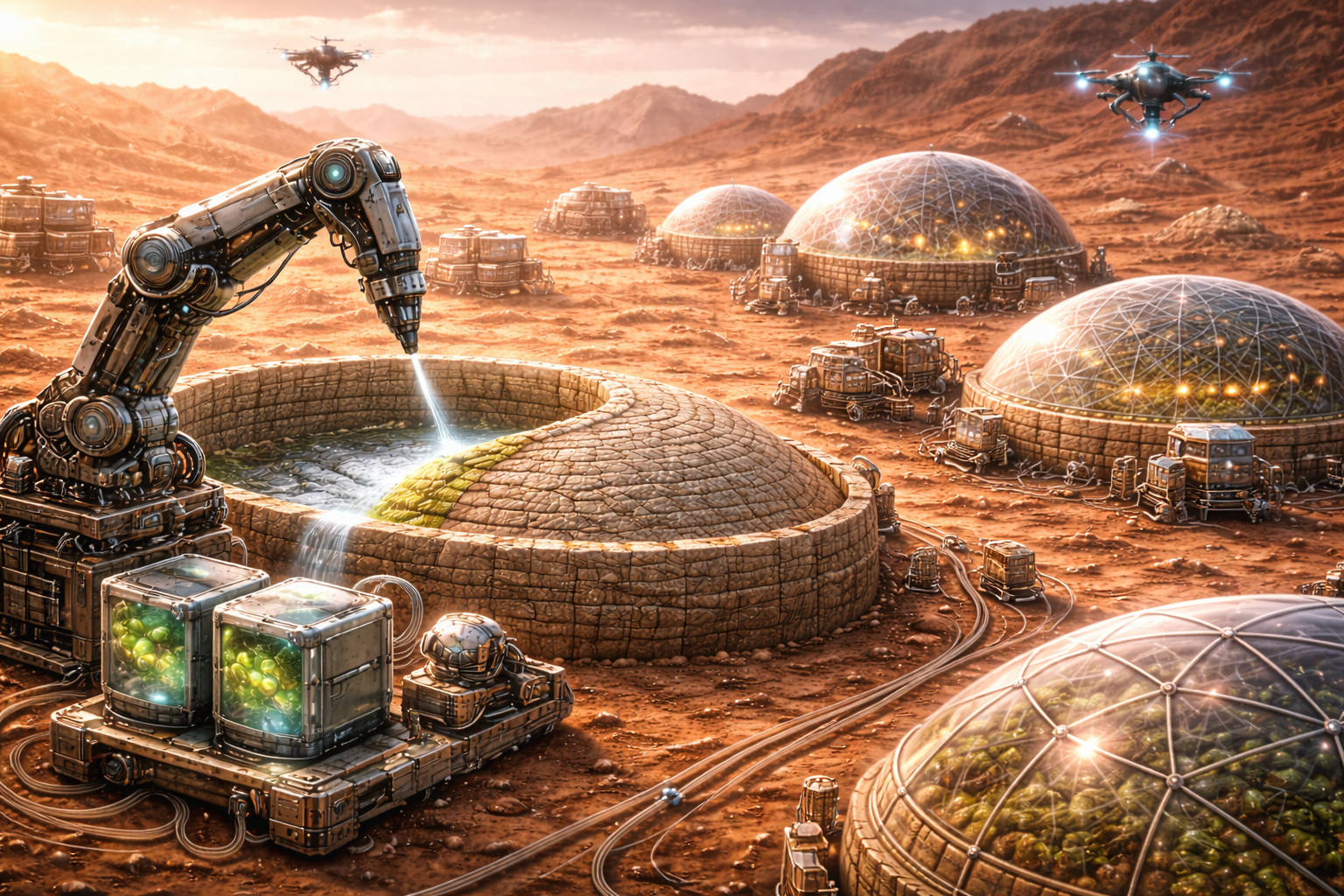
The researchers also envision integrating biocementation with robotic additive manufacturing systems. Advanced 3D printing robots equipped with multi-channel nozzles could deliver bacterial solutions, nutrient media, and regolith slurry through separate feed lines, enabling precise construction of complex structures including arches and domes capable of withstanding pressurization and Martian dust storms.

Challenges Remain
The path from concept to implementation remains steep. Water availability presents perhaps the greatest challenge—while radar observations suggest ice deposits exist beneath the Martian surface, any extracted water may be contaminated with perchlorates, highly oxidizing salts that are toxic to organic life. The Mars Sample Return program, which would provide crucial physical samples for testing, continues to experience delays.
Fundamental biological questions also remain unanswered. While Chroococcidiopsis has demonstrated tolerance to desiccation and radiation in isolation, its behavior when co-cultured with Sporosarcina pasteurii under actual Martian conditions remains speculative. Gene expression under combined stressors is largely uncharacterized, and the effects of Mars’ reduced gravity on microbial growth and biofilm formation are virtually unexplored.
“Given the relatively early stage of research on biocementation for Martian construction, significant gaps remain to be addressed,” the researchers acknowledge. “Biocementation for Martian construction is fundamentally multidisciplinary, requiring integration of microbiology, geochemistry, materials science, robotics, and construction engineering.”
Despite these challenges, the researchers remain optimistic. With international space agencies planning to establish human habitats on Mars in the 2040s, developing biological construction technologies now could prove essential for humanity’s extraterrestrial future.
“The journey is vigorous, but step by step, every discovery, each successful trial and tested protocol, brings us closer to the day when humanity will call Mars our home.”
The study represents a collaboration between researchers from Politecnico di Milano in Italy, the University of Central Florida in the United States, and Jiangsu University in China. The work was supported by NASA through the Space Technology Graduate Research Opportunity Fellowship and the Solar System Exploration Research Virtual Institute’s Center for Lunar and Asteroid Surface Science.
References
- Khoshtinat S, Long-Fox J, and Hosseini SMJ (2025). From Earth to Mars: a perspective on exploiting biomineralization for Martian construction. Frontiers in Microbiology. 16:1645014. doi: 10.3389/fmicb.2025.1645014
- Frontiers Science News (2025). Dynamic duo of bacteria could change Mars dust into versatile building material for first human colonists. EurekAlert. December 2, 2025.
- Billi D, et al. (2019). Dried biofilms of desert strains of Chroococcidiopsis survived prolonged exposure to space and Mars-like conditions in low earth orbit. Astrobiology. 19:1008-1017.
- Billi D, et al. (2019). A desert cyanobacterium under simulated Mars-like conditions in low earth orbit: implications for the habitability of Mars. Astrobiology. 19:158-169.
- World Economic Forum (2024). Sustainable concrete is possible – here are 4 examples. Global cement manufacturing responsible for about 8% of total CO2 emissions.
- Lapierre FM, et al. (2020). Revealing nutritional requirements of MICP-relevant Sporosarcina pasteurii DSM33 for growth improvement in chemically defined and complex media. Scientific Reports. 10:22448.
- Khoshtinat S (2023). Advancements in exploiting Sporosarcina pasteurii as sustainable construction material: a review. Sustainability. 15:13869.
- Castro-Alonso MJ, et al. (2019). Microbially induced calcium carbonate precipitation (MICP) and its potential in bioconcrete. Frontiers in Materials. 6:126.


Leave a Reply