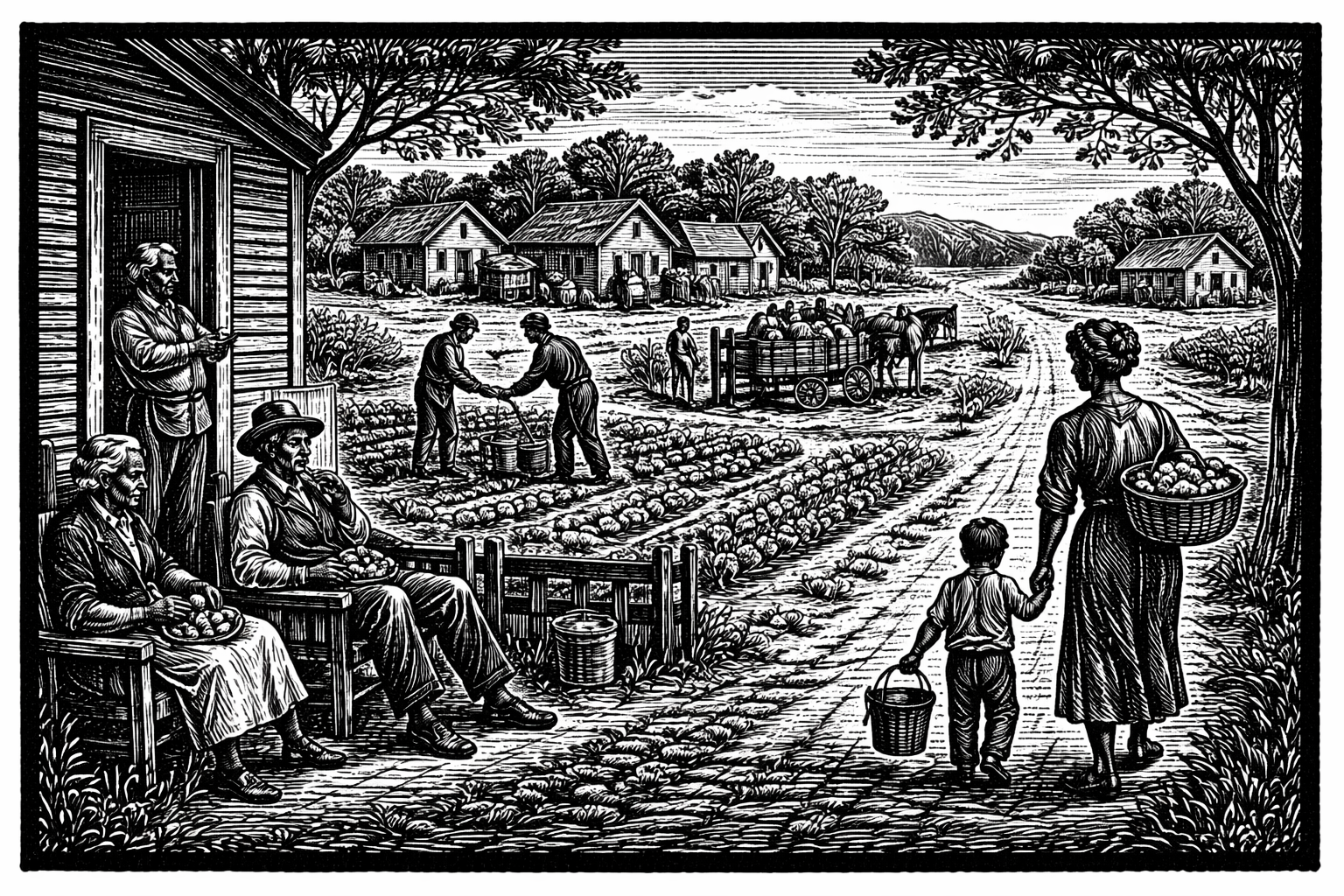
Before there were mutual aid societies with bylaws and membership rolls, before there were church basements with organized benevolent funds, there was the quiet work of neighbors helping neighbors. In early nineteenth-century Newtown—the Queens village now called Elmhurst—free Black families practiced collective responsibility not as abstract principle but as lived necessity. The census records they left behind reveal an elaborate architecture of informal support: elders taken into households not their own, orphaned children raised by extended kin, young men apprenticed in the gardens of older neighbors, families clustering together in ways that suggest strategic coordination rather than coincidence.
Ujima—collective work and responsibility—asks a community to build and maintain itself together, to make each other’s problems into shared problems, and to solve them collectively. For Newtown’s free Black residents, this was not philosophy. It was survival. And the evidence of how they practiced it is written, often inadvertently, in the demographic records of the federal census.

The Household as Safety Net
The census enumerator walking through Newtown’s dirt roads in 1850 or 1860 recorded what he saw: names, ages, occupations, birthplaces. What he could not record—what the columns of his ledger had no space for—were the stories behind the household compositions he documented. Yet those compositions speak volumes.
Consider the Durland household in the 1860 census. Peter Durland, 28, heads a family of five. His wife Liddy is 24. Their son Samuel is 10. But then the record shows Am Durland, 60, and Elizabeth Durland, 50—elderly relatives absorbed into the younger family’s home. This is not unusual in the census; multi-generational households appear throughout. What makes it significant is the pattern. Across Newtown’s free Black community, household after household shows the same arrangement: working-age adults maintaining homes that include elders who could no longer live independently.
The Peteron household tells a similar story. John Peteron, 57, lives with his wife Charity, 50, along with George Seymore, 25, and William Seymore, 18—young men with a different surname sharing the household. Were they nephews? Boarders? Former apprentices who stayed? The census does not say. But their presence suggests a household economy that extended beyond the nuclear family, a home that absorbed young men who needed a place while contributing their labor to the household’s survival.
Perhaps the most striking example appears in Dwelling 326 of an earlier census batch: a household containing only elderly men, ages 53 to 93, and one younger woman, Henrietta Francis, age 30. No children. No nuclear family structure. This appears to be an informal care arrangement—something like a proto-nursing home organized within the community itself. Henrietta Francis may have been a caretaker, compensated in ways the census could not capture. The elderly men were not abandoned to the poorhouse or left to fend for themselves. They were gathered, housed, and maintained by community members who recognized their responsibility to those who could no longer provide for themselves.
This was Ujima before the word existed—collective work operating through the most basic unit of social organization, the household itself.

The Gardener’s Network
Gardening was the dominant occupation among Newtown’s free Black property owners. The census records multiple gardeners concentrated in adjacent or nearby dwellings, their combined property values often exceeding $12,000—substantial wealth for any community in antebellum America, remarkable for a community systematically excluded from most economic opportunities.
The clustering was not coincidental. Adjacent gardens allowed crop diversification while maintaining specialization. A gardener focusing on root vegetables could trade with a neighbor growing leafy greens. Knowledge of soil conditions, frost patterns, and pest management could be shared over fences and across property lines. When harvest time came, one wagon could carry multiple gardeners’ produce to the markets of growing New York City. Seasonal labor—the intense work of planting and harvesting—could be shared, with families helping each other through the peaks of the agricultural calendar.
The census lists these men as independent gardeners, each with his own recorded property value. But the geographic evidence suggests something more complex: an agricultural network masquerading as individual enterprises for the census taker’s benefit. What appeared to the state as fifteen separate gardening operations was, in practice, a cooperative economic system—shared tools, shared knowledge, shared labor, shared transport, shared risk.
Young men in these households—sons, nephews, boarders with different surnames—worked alongside the older gardeners. The census records them as laborers, but their proximity to established gardeners suggests something more: apprenticeship, skill transfer, the transmission of agricultural knowledge from one generation to the next. A 20-year-old laborer living in a gardener’s household was not just earning wages; he was learning a trade that could eventually provide him with independence and property of his own.

The Peterson Network
No family better illustrates the power of collective work than the Petersons. Across the 1850 census, the Peterson surname appears in six separate households, encompassing at least 32 individuals. By the 1850s and 1860s, this extended family network had accumulated over $20,000 in combined property—extraordinary wealth that placed them among the most economically successful free Black families in the region.
The households were separate for census and tax purposes, but they functioned as an interdependent system. In Dwelling 736, John Peterson, 50, maintained a household of seven. Three dwellings away, Jacob Peterson, 29, headed a household of five. Further along, Peter Peterson, 62, anchored another household of six. John Peterson Sr., 65, presided over a twelve-member household that included his wife Nancy, ten children ranging in age from 11 to 29, and adult sons working as laborers alongside their father.
This was strategic family deployment. Separate economic units meant separate tax assessments and separate vulnerability to creditors. But the physical proximity—households within a few dwellings of each other—enabled continuous mutual support. When one Peterson garden produced excess, another Peterson family ate. When day labor opportunities arose, multiple Peterson men could respond together. The elder households provided childcare for the younger families. The younger families provided care for the elders.
The literacy patterns within the Peterson network reveal another dimension of collective investment. John Peterson Sr. could not read or write. Neither could his son Soloman. But Nancy Peterson had attended school, as had several of the children. The family was not uniformly literate, but it was not uniformly illiterate either. It had invested selectively in education, ensuring that some members could navigate the documentary requirements of property ownership, contracts, and legal protection while others focused on physical labor. Literacy was a family resource, distributed strategically across the network.
Before the Institutions
The New York African Society for Mutual Relief was formally organized in 1808 in Manhattan, with a mission to assist widows and orphans, pay burial expenses, and help members acquire real estate. The Free African Society of Philadelphia had been founded even earlier, in 1787. These institutions—with their bylaws, membership dues, meeting halls, and formal records—are what historians typically mean when they speak of mutual aid in free Black communities.
But institutions emerge from practices that precede them. Before Black New Yorkers could organize formal societies, they had to develop the habits of mutual support, the trust networks, and the practical systems that formal organizations would later codify. What the census records of Newtown reveal is this earlier layer: the informal mutual aid that made institutional mutual aid possible.
In 1828, a year after slavery was finally abolished in New York under the 1799 gradual emancipation law, landowner James Hunter deeded two acres to Newtown’s free Black community for a church and parsonage. The resulting United African Society of Newtown—later St. Mark’s A.M.E. Church—became the institutional center of the community. But the people who founded that church had already been practicing collective work for years. They had already been taking in elders, raising orphans, sharing labor, and pooling resources. The church formalized what the community had already been doing.
The African Methodist Episcopal Church itself emerged from this dynamic. Richard Allen founded the AME denomination in 1816 because Black Methodists needed an institution they controlled. But Allen did not create the impulse toward collective religious life from nothing; he organized and formalized practices that Black Christians had already developed in less visible ways. The same pattern holds for mutual aid societies, benevolent organizations, and burial societies. The institutions captured and amplified energies that were already flowing through the community.

Property and Collective Advancement
How did free Black families in Newtown acquire property in a society structured to deny them economic opportunity? The census records property values but not acquisition histories. Yet the clustering patterns suggest one mechanism: established property owners helping newcomers gain footholds.
Property ownership was not evenly distributed across the community. Some households held substantial real estate—$1,600 for the Braddock family, $800 each for the Durlands and Peterons. Others owned nothing. But the property owners and the propertyless lived in proximity, often in adjacent dwellings. This proximity created opportunities. A young man without capital could work for a property-owning neighbor, learning the trade while accumulating savings. A family renting from a Black landlord paid into the community rather than into white hands. Information about available land, fair prices, and trustworthy sellers could flow through neighborhood networks rather than depending on white intermediaries who might exploit or exclude Black buyers.
The Braddock household illustrates what collective advancement could achieve. Richard Braddock, 43, was listed as a farmer—not a gardener or laborer but a farmer, suggesting he worked land substantial enough to merit the distinction. His property was valued at $1,600 in real estate and $300 in personal estate, the most substantial holdings in his census section. He had a wife, Ann, and three young daughters. He was building something he could pass down.
Braddock did not achieve this in isolation. He lived among other free Black households, participated in the same community networks, probably worked alongside the same gardeners and laborers who appear in adjacent census entries. His success was individual in the sense that the census recorded it under his name. But it was collective in the sense that it depended on—and contributed to—a community infrastructure of mutual support.
Ujima and the Work Ahead
Remembering Newtown’s free Black community during Kwanzaa means seeing Ujima not as an ideal to be achieved but as a practice that was already being lived. The households that took in elders, the gardens that shared labor, the family networks that pooled resources—these were not steps toward collective work. They were collective work, happening in real time, documented inadvertently in records created by a state that had no interest in celebrating what these communities had built.
The formal mutual aid societies that emerged in the antebellum era—the ones historians write about, the ones that left minutes and membership rolls and organizational records—were not the beginning of collective work in Black communities. They were the institutionalization of practices that stretched back to the earliest moments of freedom, and before freedom, to the survival strategies of enslaved people who had nothing but each other.
In lighting the candle for Ujima, we honor those who understood that building and maintaining community was work—real work, as demanding as any trade and more essential than most. They did not wait for institutions to tell them how to help each other. They figured it out in kitchens and gardens, in households stretched to accommodate one more elder or one more child, in labor shared across property lines that the census treated as absolute divisions. Their collective work was the foundation on which everything else was built.
[Based on analysis of Federal Census records, 1830-1860, Newtown Township, Queens County, New York, documenting 408 individuals across 134 households in the Free Black community.]




Leave a Reply