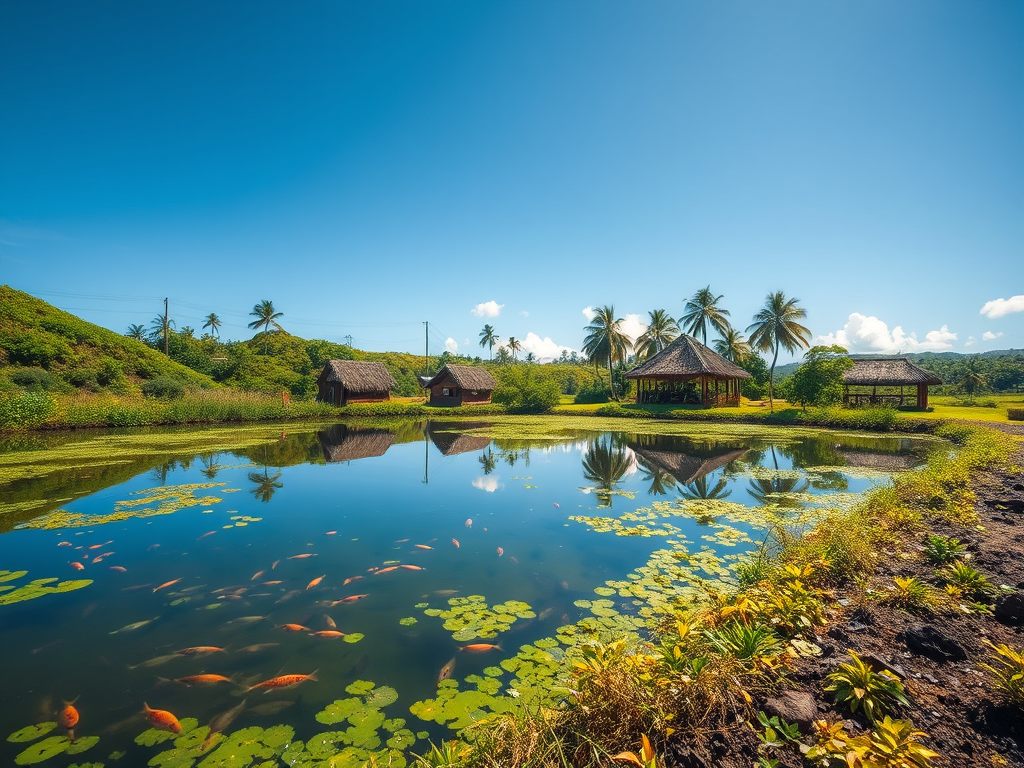
Traditional Hawaiian fishponds (loko iʻa) are emerging as a model for climate resilience, according to a study from the University of Hawaiʻi at Mānoa’s Hawaiʻi Institute of Marine Biology (HIMB). The research, published in npj Ocean Sustainability, revealed Indigenous aquaculture systems effectively shield fish populations from the negative impacts of climate change, demonstrating resilience and bolstering local food security.
“Our study is one of the first in academic literature to compare the temperatures between loko iʻa and the surrounding bay and how these temperature differences may be reflected in potential fish productivity,” said lead author Annie Innes-Gold, a recent PhD graduate from UH. “We found that although rising water temperature may lead to declines in fish populations, loko iʻa fish populations were more resilient (fish populations did not decline as much as fish populations in the surrounding estuary) to rising water temperatures than those in the surrounding estuary. This result is likely due to the temperature regulation that the loko iʻa receives from freshwater input, both at the surface and below the ground.”
The authors found that the combined benefits of fisheries regulations, nutrient flow restoration, and restocking were found to offset some of the potentially negative effects of warming on fish populations and substantially increase short- and long-term estuarine and loko iʻa fish density.
Innes-Gold worked with an interdisciplinary team that included university researchers, resource managers and loko iʻa practitioners.
“These findings highlight how important freshwater inputs are as a source of temperature regulation,” said Innes-Gold. “They also support the importance of biocultural restoration in terms of enhancing fish populations and increasing social-ecological resilience in a changing climate.”
For Hawaiʻi, the findings demonstrate the value that Indigenous knowledge and systems have on guiding modern science.
“Loko iʻa are a system unique to Hawaiʻi, and their restoration can have wide-reaching benefits including cultural preservation, education, healthy ecosystems, food security, and now—from what we found in our study—also climate resilience,” said Innes-Gold.

The team used mathematical modeling to simulate various management and climate change scenarios.
“What’s powerful about this modeling approach is that it allows us to test management scenarios we couldn’t easily experiment with in real life,” said senior author Lisa McManus, who leads the Marine Ecological Theory Lab at HIMB. “Our projections show these combined restoration strategies can substantially increase fish populations even under warming, quantifying how Indigenous systems offer viable climate solutions.”
“Loko iʻa are designed to take advantage of natural ecological processes—their design increases the residence time of nutrient-rich waters, so it makes sense that it would also increase the residence time of cooler freshwater and result in lower temperatures,” said Innes-Gold.
More research is being done to further understand how the loko iʻa functions and how it could promote resilience to climate change at sites such as the Heʻeia National Estuarine Research Reserve. The work was funded by Hawaiʻi Sea Grant, the NMFS-Sea Grant Fellowship in Population and Ecosystem Dynamics, and the Heʻeia National Estuarine Research Reserve.

Leave a Reply