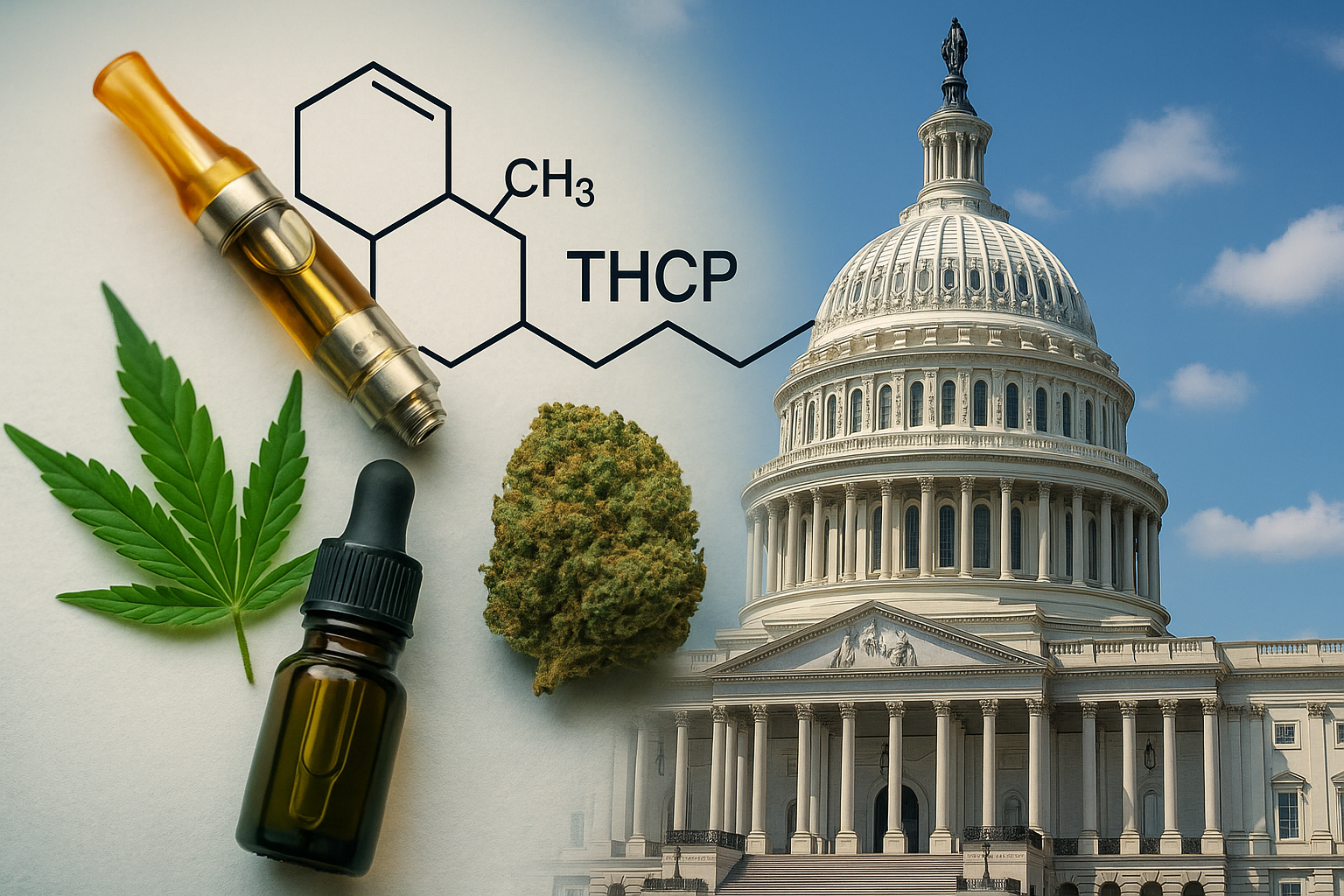
If Congress rewrites hemp rules to cover “THC-like” cannabinoids, the science gets messy fast. A handful of rare or newly marketed THC variants pack far more punch per milligram than standard Δ9-THC—and many slip past routine “total THC” tests. That makes any blanket milligram cap hard to enforce and even harder to explain.
The potency problem
Take Δ9-tetrahydrocannabiphorol (Δ9-THCP), identified in 2019. THCP is essentially THC with a longer seven-carbon tail that wedges deeper into the CB1 receptor’s hydrophobic pocket, dramatically boosting binding. In human CB1 assays, THCP’s affinity clocked in around 33 times tighter than Δ9-THC; mouse behavioral tests confirmed the stronger effect. Translation: milligram for milligram, THCP grabs hold of the brain’s primary cannabis receptor far more aggressively than regular THC.
Medicinal chemists saw this coming. Classic structure-activity studies show that CB1 potency climbs as THC’s side chain lengthens from five carbons toward seven or eight, with receptor affinity driving the trend. THCP’s seven-carbon tail hits that pharmacological sweet spot—which is why “milligrams per container” rules calibrated for Δ9-THC can badly underestimate psychoactive kick when a producer swaps in a higher-affinity homolog.
What else counts as “THC-like”?
Beyond Δ8-THC (already on regulators’ radar), the roster includes homologs like THCB (four-carbon), THCH (six-carbon), and THCP (seven-carbon), plus hydrogenated or semi-synthetic variants such as HHCP. All bind the same receptors but with different strengths and behaviors—meaning identical milligram labels can deliver wildly different experiences. A recent analytical-toxicology method for blood and urine screening explicitly added these compounds to its detection panel, underscoring that standard assays won’t catch them unless labs upgrade methods and stock new reference standards.
Critically, not all “THC-likes” act alike. THCV (with a shorter three-carbon tail) behaves as a CB1 antagonist at low doses—pharmacologically opposite to THC—then may flip toward agonism at higher levels. That’s a red flag for policy drafters: lumping everything “THC-like” risks conflating compounds with opposite dose-response curves.
Sourcing and quality-control gaps
How much THCP occurs naturally? Trace amounts show up in plant material relative to Δ9-THC and CBD. Forensic work suggests most retail THCP involves semi-synthetic conversion from CBD. Independent labs routinely find unidentified byproducts in THCP-labeled vapes—consistent with synthesis side-reactions—raising quality-control questions beyond raw potency. (The same impurity story has dogged Δ8 conversions.)
An LC-HRMS study that measured Δ9-THCP in retail flower, gummies, and vapes found discrepancies between lab results and producer claims—a reminder that without harmonized methods and certified standards, enforcement by “milligrams per package” can be gamed or misapplied.

Why this matters for a federal cap
Potency equivalence vs. simple milligrams. If a rule caps “total THC per container” but a product substitutes a higher-affinity homolog, consumers may experience stronger effects at the same listed dose. A science-based approach would weight “THC-like” molecules by relative potency—analogous to morphine-milligram equivalents in pain medicine—and express a single “THC-equivalent” figure. (That weighting would require consensus values from receptor assays, animal models, and eventually human pharmacokinetic studies.)
Analytical readiness. Many routine “total THC” tests compute Δ9-THC plus a conversion factor for THCA. They don’t quantify THCP, THCH, or THCB unless labs have validated LC-MS methods and reference materials in hand. Federal language about “THC-like” effects only works if lab panels can operationalize it.
Risk communication. Packaging that advertises “low mg” but uses a higher-affinity homolog invites accidental overconsumption. Standardized equivalence labeling would help consumers—and poison-control surveillance—track exposure across a shifting cannabinoid landscape.
So what does all this mean?
The scientific challenge isn’t just whether hemp-derived intoxicants remain legal—it’s that receptor pharmacology is outpacing milligram-based rules. THCP demonstrates how a small structural tweak can supercharge CB1 engagement. Unless assays and labels catch up, any federal “THC-like” cap risks being simultaneously under-protective (for high-affinity homologs) and over-broad (for compounds like low-dose THCV that don’t behave like THC at all). That’s the policy bind lurking inside the Senate’s funding package.

Leave a Reply