Britt Rusert is a scholar of African American literature and history whose research illuminates the often-overlooked intellectual and cultural contributions of 19th-century Black Americans. As the author of Fugitive Science: Empiricism and Freedom in Early African American Culture, which examines African American engagement with natural science in the 1800s, Rusert has established herself as a leading voice in recovering lost narratives from this pivotal period. Her latest book, currently in production, focuses on the life and world of William J. Wilson, a relatively obscure but fascinating figure whose work she first encountered while researching the Anglo-African Magazine—a groundbreaking Black periodical published in Lower Manhattan during the mid-19th century. Rusert’s meticulous archival work, drawing from obituaries, census records, church documents, and periodical sources, has helped piece together the fragmented story of a man whose common name made historical research particularly challenging.
William J. Wilson, born around 1818 in New Jersey and writing under the pen name “Ethiop,” was a Black educator, writer, and cultural critic whose life embodied both the possibilities and precarious nature of free Black existence in antebellum America. The son of a man likely born into slavery in Virginia, Wilson moved to New York City, where he married Mary Wilson and eventually settled in Brooklyn, becoming a prominent educator and serving on the city’s Board of Education.
Before setting down roots in Kings County, Wilson and his family spent time as part of the free Black community in Newtown, likely taking over teaching duties from James W. C. Pennington at the African Free School around 1840. Like Pennington and Samuel Ringgold Ward before him, Wilson served as more than just a schoolmaster. He became an active member of the community, particularly in matters pertaining to African American enfranchisement, organizing local meetings and representing Newtown in conferences beyond the town’s borders. By the time Wilson moved on to Brooklyn, he had honed the teaching, administrative, and organizational skills that would make him an indispensable member of Brooklyn’s ascendant free Black community.
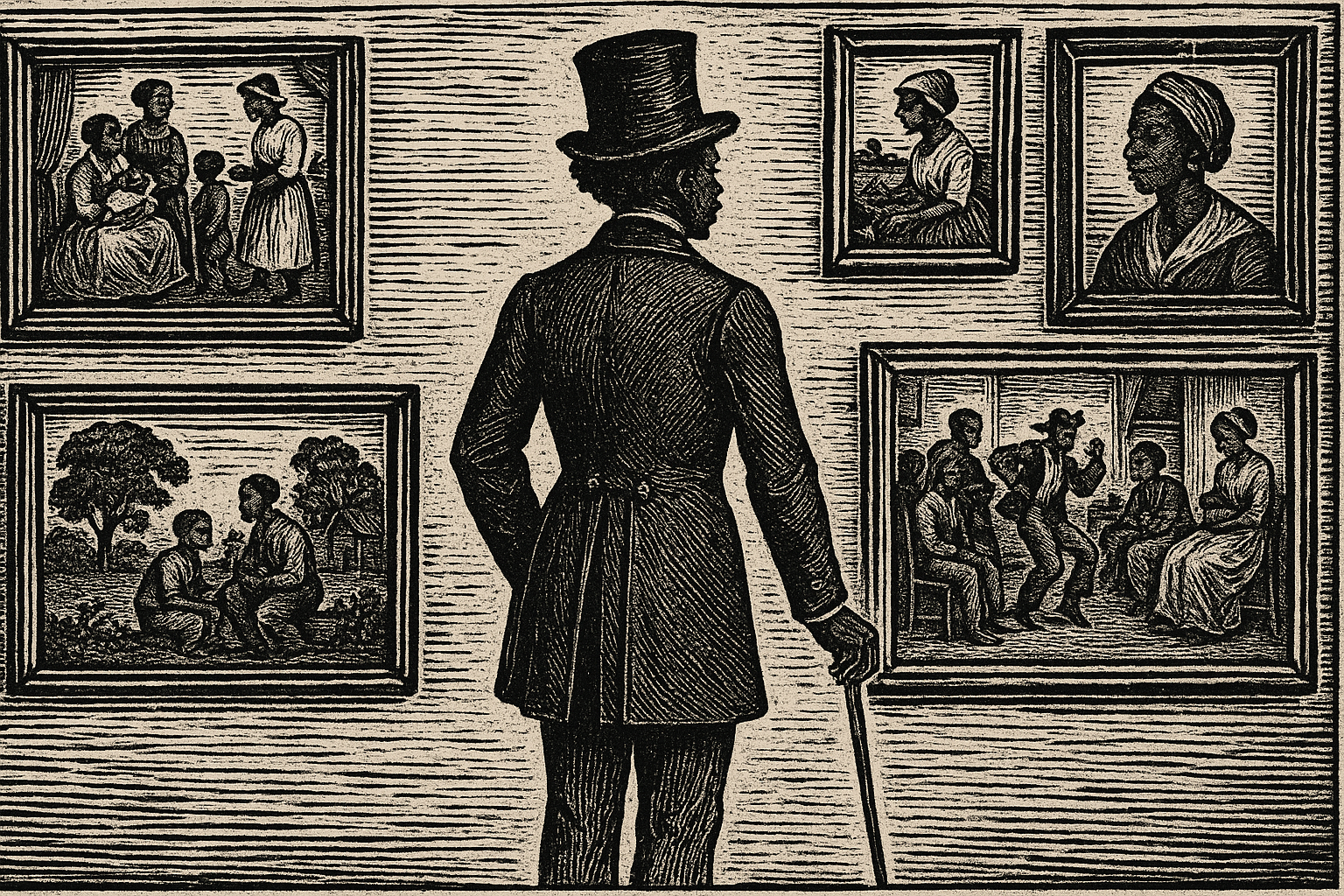
As an educator in Brooklyn, Wilson and his schools faced constant harassment and violence. Undeterred, he maintained a remarkable intellectual life, contributing prolifically to Black periodicals and creating his most celebrated work, the Afric-American Picture Gallery—an imaginative literary series that envisioned a Black-curated museum space at a time when African Americans faced severe restrictions on their mobility and access to cultural institutions. His life reveals a network of Black intellectuals, educators, and activists who understood education as central to freedom and used literature, art, and community building as forms of resistance against the oppressive surveillance and violence that defined their era.

Marc Landas: What initially drew you to William J. Wilson, his life, and his work?
Britt Rusert: I first discovered William J. Wilson while doing research for my first book, Fugitive Science. That book traces all the ways African Americans engaged with natural science in the 19th century, and I relied heavily on this amazing Black magazine—I think of it as the Black New Yorker of the mid-19th century—called the Anglo-African Magazine. It was published out of Lower Manhattan by a Black editor and bookseller. Then I came across the Afric-American Picture Gallery by Wilson, and I had never heard of it. It just really blew me away. My interest in Wilson started with that text, and I just finished a book that’s entering production about Wilson’s life and world.
ML: What do we know about William J. Wilson’s early life?
BR: William Wilson is a pretty common name, so even using census records can be tricky. I actually found an obituary in a Black newspaper out of Washington, D.C., that ended up being really helpful. His obituary, written by someone who knew him, says he was born in New Jersey around 1818. He attended common school in northern New Jersey—possibly Shrewsbury—with white and Black students and apparently experienced a lot of racism. We know his father lived in Virginia and was likely born in slavery. There’s probably a story to be told about his family’s journey north and how they became free. My guess is he’s from somewhere along the coast, given all the nautical themes in his writing and the fact that he ended up in Brooklyn.
ML: When he first came to the New York City region, where did he go?
BR: He moved to Manhattan first and quickly—probably through church connections—made connections with prominent Black activists and community members. He married Mary Wilson, who was born in New York City. My guess is his initial social connections actually came through her and her family. After they married, they moved to Brooklyn, where they started their family and built a life.
ML: What was it like piecing together his life from all these disparate sources?
BR: It’s difficult. He was well-known at the local level but didn’t have a national presence, so it’s much harder to track his life than someone like Martin Delany or Frederick Douglass. He didn’t leave us any monographs. As a literary studies scholar, it’s challenging when you have a writer who was prolific in the periodical sphere but never wrote a book. So his writing has been harder to piece together, both his literary biography and his actual biography. But tracing things through networks—networks of people and communities—has been really helpful. You can learn a lot by starting with churches, because they were hubs of educational, social, political, and religious life.
ML: How does placing Wilson in that community help us understand him and that community?
BR: It helps us see how focused African Americans in New York and across the North in this period were on understanding education as central to uplift and progress. Wilson is involved in things that look like civil rights struggles around education in the 20th century. He helps us illuminate the side of civil rights in the 19th century that’s about education.
In the book Brooklynites, Prithi Kanakamedala does work to recover Mary Wilson’s life. She taught a lot—she was also an educator and taught alongside him. Kanakamedala argues that it was probably Mary’s family connections and her own entrepreneurship that contributed to their family’s upward mobility. She opened a crockery store—a cookware store—in Brooklyn, and appears to have done very well. Women were the fundraisers for the abolitionist movement—running antislavery bazaars and producing capital for the movement and for these spaces in ways that are often neglected.
But you have to see Wilson in a community context. He’s different from someone like Frederick Douglass, who was very intent on crafting his own persona. Wilson is more of a community figure. You have to see him in relation to a collective, and even at a neighborhood level, that’s really crucial.
ML: The whole notion of him circulating into art galleries and calling himself a flâneur runs contrary to what you would naturally think people who’ve just been emancipated would be like. Can you discuss the “Black elite” and their relationship with the arts?
BR: The shadow of slavery looms large, but part of the point for figures like James McCune Smith and Wilson is that they weren’t born enslaved, right? Wilson’s father was probably enslaved, but Wilson himself was born free. And there were pockets of free people in New York, even in the late 1700s. So part of his interest in stylizing himself as a cosmopolitan figure and as a flâneur is about articulating the fact that free Black people do and have existed, even before 1827.
I also talk about him as being a dandy figure. Monica Miller has a great book called Slaves to Fashion about the figure of the Black dandy in the 19th century, and she argues that figure actually comes from slavery—that it’s occupied by both free people and enslaved people. So there was a culture around the flâneur and the dandy that was both about articulating freedom and was also connected to slavery.
ML: Would you say that framing himself in that way, and the act of actually doing it, were acts of rebellion?
BR: Oh, absolutely. And remember, this is a period of deep surveillance of African Americans in New York, which intensified after the passage of the Fugitive Slave Act in 1850. He’s writing in a post-Fugitive Slave Act, post-Dred Scott moment, where African Americans are being disenfranchised, with increased surveillance and limits on mobility. People are literally being kidnapped off the street. This is like ICE circa 1857, 1858. People like Solomon Northup, who was born free in New York, are kidnapped and sold into slavery, emboldened by the Fugitive Slave Act. So in the face of all of that, Wilson’s interest in strolling and movement and viewing art and wandering—I think it’s rebellious, and it’s also an articulation of freedom.
ML: His life as an educator was marked by harassment—vandalism and violence against his schools. How did these daily struggles shape his worldview and his writing?
BR: I think it made him a realist. You get the sense across his writing that he understands the prevalence of racism and prejudice, and that just because people have been legally emancipated doesn’t mean those structures of oppression and violence are ending.
There’s also something about the targeting of children and youth. That’s one thing I really take away from his writing—he circulated in a world of children and youth because of being an educator. Black youth in this period were even more disenfranchised because of their vulnerability as children, being targeted, infantilized, and treated as if they didn’t have access to a childhood. Since he was a teacher, he also circulated in circles with women, white women and Black women. I think this is part of his stylization of himself as a dandy. You can tell he’s in some ways in a world of women, even though he is part of the coterie of Black male intellectuals. He’s more proximate to these feminine cultures and circles, more so than people like Frederick Douglass and Ward.
ML: Where did his nom de plume “Ethiop” come from?
BR: We don’t really know. The scholar Derrick Spires suggests he could have taken it from Phillis Wheatley. In Wheatley’s poems, she refers to herself as an Ethiope, and we know Wilson had read her because he talks about her poetry in the picture gallery and installs a portrait of her in his text.
This is also a kind of early Afrocentric moment when Black intellectuals and educators are turning to Egypt and Ethiopia to talk about how the origins of arts and science and civilization are actually in Africa, not in ancient Greece or Europe. Ethiopia was looked to as a site of real pride for African Americans. So it’s sort of what we would now call Black nationalist, or an early Black Power gesture.
And it’s hard to talk about without James McCune Smith, because Wilson first starts using Ethiop in correspondence with him. McCune Smith’s pen name is Communipaw, which refers to that mixed-race settlement in what is now Hoboken. McCune Smith was really proud of his mixed ancestry. Wilson—more similar to Martin Delany in this respect—was very proud of his, quote-unquote, pure African ancestry. So that might also be a reason he uses Ethiop. But it’s also playful. For both McCune Smith and Wilson, there’s a kind of playfulness to those monikers.
ML: Where did the Afric-American Picture Gallery come from?
BR: He wrote the picture gallery after doing a multi-year correspondence with James McCune Smith in Frederick Douglass’s paper, where they were both writing columns addressing Douglass but also responding to each other. Wilson starts writing as Ethiop at that point, establishing this pen name and developing himself as a kind of persona or character through those columns.
So he takes his nom de plume from this correspondence and turns Ethiop into a full literary character. He abstracts him and makes him the protagonist of this deeply imaginative text. It’s a further expansion—he fleshes out this character he had started to develop through his periodical correspondence.
In the correspondence with McCune Smith, he often talks about visual art. He’s really interested in how racial representation can be mobilized within this movement for freedom and citizenship. He believes that producing portraits and representations of dignified African Americans will be significant in the struggle. There’s one column where he talks about visiting a portrait gallery in Manhattan on Broadway—Plumbe’s Gallery. In this period, if you went to have a daguerreotype or early photograph taken, you would often go into these photographic studios, and there would basically be a picture gallery around you—portraits, paintings, photographs. My guess is that a model for the picture gallery may have been one of those photographic galleries.
ML: Did he actually walk into these galleries?
BR: I think he did. This is before Jim Crow segregation—an age of de facto segregation instead of de jure. His access would have been based on the whim of the proprietors. You could be let in one day and denied the next. But Broadway was a real mix of high culture and low culture, a really raucous, rowdy space. There were also underground subterranean spaces with sex, gambling, drinking, and eating. My guess is that environment created possibilities for people to gain access to the businesses on Broadway. When he talks about going into Plumbe’s Gallery, it’s such a vivid account that my guess is it really happened.
And it’s significant that he’s imagining this Black space in the picture gallery itself. Ethiop is both the docent and the curator, possibly the owner—he occupies multiple roles. He constructs it as being a space apart from the world outside, kind of shut off, sort of like a retreat. There are comments about how when patrons visit, Ethiop is annoyed because it’s his space for contemplation, and he sees the public as intrusive.
ML: What stands out to you about the African American Picture Gallery?
BR: One thing is the fact that it’s a textual gallery—a speculative museum, something he’s creating. That’s significant since African Americans’ access to these spaces of art making and exhibition were very limited. The fact that he uses the page as a space to imagine a gallery is really significant.
I also think the picture gallery itself is a kind of enclave, a Black enclave. It’s very enclosed, a Black-run space, but it’s in the heart of the city with white space immediately around it. There’s a way to think about the picture gallery as adjacent to Weeksville or Newtown or one of these other African American enclaves in the city.
ML: What did he and his wife do after the Civil War?
BR: He’s basically pushed out of his position on the Board of Education in Brooklyn, where he was a long-standing principal of Colored School Number 1. What I’ve gleaned from periodical sources is that he gave a talk supporting abolition and the Union that was deemed too radical. Jonathan Wells, who wrote The Kidnapping Club, says New York is the largest pro-slavery city north of the Mason-Dixon line. There were tons of slavery apologists and slaveholders hiding out all over the place.
So Wilson is pushed out, and he and his family pack up and move to D.C. He begins teaching in a freedmen’s school, part of that exodus of African Americans from the North who move south to help recently emancipated people. It’s a testament both to the precariousness of African Americans, even supposedly well-off Black New Yorkers in this period, but also to his family’s commitment to Black education. Douglass is an important figure in his life, and he ends up in D.C. with some of these other figures. D.C. is increasingly the heart of federal power, and these well-known African American intellectuals and activists knew it was important for Black representation to be happening there.
ML: Wilson strikes me as someone ahead of his time. Can you discuss how he was of his time, but also ahead of it?
BR: The fact that he’s imagining a future for Black art is one way he’s very forward-looking. At the beginning of the picture gallery, he says there are empty spaces on the wall, and he invites readers to contribute to the picture gallery. That’s such a cool speculative moment. In some ways I think he’s anticipating Black speculative fiction of the 20th and 21st century. When he talks about those blank spaces on the wall, he’s both encouraging Black readers to try their hand at visual art, but it’s also a sly nod to the fact that this is a text, a periodical. I think he’s actually suggesting readers should become writers and submit their own publications to the Anglo-African Magazine.
But the language of “ahead of their time” is tricky. The more research I do in this era, every figure I write about is ahead of their time in some way, and that’s part of the reason we’re interested in them. We’re drawn to figures who got us here. In historical research, we often end up focusing on figures who were ahead of their time because they helped construct the modernity we live in now. So in that way, he’s not ahead of his time, but very similar to this whole milieu of African Americans we’ve been talking about.
INTERVIEWER: Marc Landas




Leave a Reply