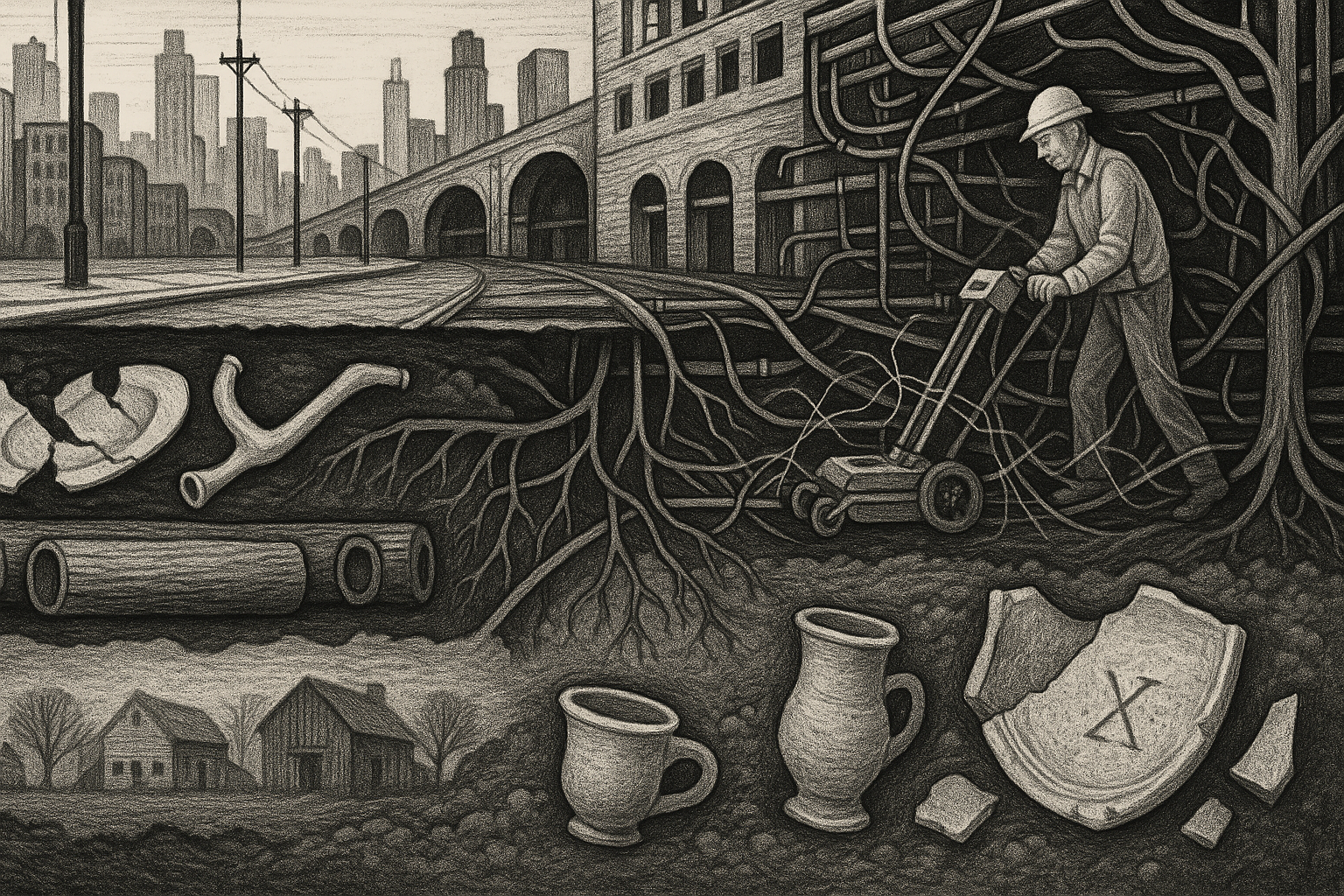
In this conversation, urban archaeologist Christopher Ricciardi unpacks the realities of doing archaeology in New York City—where concrete, utilities, and centuries of rebuilding complicate the search for the past. He explains why “disturbed” sites can still yield evidence, where geophysics like GPR fall short in dense urban contexts, and how regulations—not curiosity—often determine when digs happen. With Newtown’s free Black community as the focus, Ricciardi outlines what material culture might (and might not) reveal, why agrarian landscapes are especially challenging, and how even fragmentary finds—paired with documentary records—can help reconstruct an erased history.

To start, what are some of the unique challenges you face when conducting archaeological work in a place as dense as New York City?
There are many. First and foremost is concrete—that’s the big one. And that’s only after you’ve gotten all the permissions, approvals, and sign-offs to do the work. New York City is incredibly dense. It’s been built on and rebuilt many times, which means there are lots of layers below ground. That doesn’t mean significant deposits don’t exist; they do, and they can inform us about what’s transpired.
People sometimes don’t realize that even disturbances—trenches, construction, earlier digs—can help inform us. Those, too, are part of the city’s history and development. You can have an undisturbed site just inches away from where a sewer line was installed. It’s a hard concept for non-archaeologists to understand, but a disturbed site isn’t automatically devoid of significance.
Do those disturbances complicate dating?
Yes and no. The “no” first: disturbances can actually help. If we know an electrical line was installed by Con Ed in 1956, anything below that line predates 1956. Similarly, wooden water mains in Lower Manhattan were installed in 1804, so items associated with those installations are from 1804 or later. In that way, disturbances can help us date sites.
But they can also complicate things—especially when infrastructure like a sewer, electrical line, or subway tunnel cuts through a site. That can make it hard to draw conclusions because the context is disrupted. You’re left with a smaller sample, and it’s difficult to date a site reliably using just a few artifacts. Statistics can mislead. If you find one piece of redware that might date to 1600, that doesn’t mean the whole site is from 1600.

When you compare Manhattan to modern-day Elmhurst—which is developed but not as built-up as Manhattan—how much does that difference affect the likelihood of finding things?
Not as much as you might think. Development isn’t a one-to-one indicator. Just because a building has been on a site since 1950 doesn’t mean there’s nothing underneath it. Modern construction often builds on top of previous layers rather than excavating down to bedrock and starting clean.
So for archaeologists, “disturbed” doesn’t mean worthless. A developer might think, “It’s disturbed; there’s no point digging,” but that’s not how we see it. We approach heavily disturbed sites with more modest expectations, but we rarely write them off. There’s often something that can add to the historical record. Then it becomes a question for the regulatory agency: What’s the risk? What’s the value of doing the work?
What are your biggest concerns when doing archaeology in the city?
Soil conditions are a big one. In the outer boroughs, there’s more clay and poor drainage. Water can be both a curse and a blessing—on the shoreline, it can preserve things like bulkheads or ship remains. But for most organic artifacts like bone or wood, water causes deterioration.
Then there are legal constraints. You can’t just dig anywhere. Most archaeological work in NYC happens because of cultural resource management (CRM) requirements tied to construction funded by city, state, or federal money. These regulations dictate what kind of archaeology is needed for each project.
There’s very little academic archaeology in NYC. You can’t just say, “I know there was a Native American village here; I want to dig.” You need permission, and most land is either private or already developed. So archaeology here is highly regulated and driven by law, not academic curiosity.
The odds of finding something are lower than not finding anything. But that doesn’t mean we shouldn’t try.
So would you say most discoveries are contingent on some kind of construction project?
I wouldn’t say “discoveries,” but yes—most archaeological work in NYC is triggered by regulatory requirements. It’s not always new construction. Renovations, upgrades, or utility installations can also prompt it. If any project uses municipal funding or happens in a historic district, CRM protocols apply.
For example, there’s a relatively new burial ground law—2022 or 2023, I believe—that requires even private developers to follow certain steps if they might uncover human remains. So it’s not just public construction anymore.
Let’s say you wanted to investigate a site but there’s already a building or a sidewalk over it. Are there any technologies that help?
This is a big debate. You’re probably thinking of ground-penetrating radar (GPR). In my experience—over 35 years as an archaeologist in this city—GPR works well in very specific areas, but not in urban settings like NYC.
GPR detects differences in soil composition, but it can’t tell you what’s there. In NYC, the ground is crisscrossed with utility trenches, subways, basements, tree roots—you name it. GPR can light up like a Christmas tree, and you don’t know if it’s detecting a boulder, a root, or something significant. You can spend thousands opening concrete only to find an old water pipe. Others may disagree, but in my opinion, GPR doesn’t deliver what people hope for in this environment.

Are there other options?
Magnetometers and resistivity surveys, among others, but they face the same problem: they detect anomalies without identifying them. Radar is radar—it bounces signals off objects, and you get a contrast in material, not a clear picture. Whether it’s GPR, drone-mounted sensors, or satellites, they all face that limitation in an urban setting.
Turning to the free Black community that once lived in Newtown—if you were trying to find evidence of them, what would you look for?
First, consider the timeframe—late 17th to early 19th century. People in the Northeast then had a fairly uniform material culture: earthenware and refined ceramic plates, smoking pipes—typical household items. But a plate can’t tell you the race or status of the person who used it.
You need the totality of the material—artifacts, stratigraphy, remnants of structures—matched with documentary evidence like tax records. For example, at the Hendrick I. Lott House in Brooklyn, we found a redware plate with an X inscribed on the back. Some scholars theorize that enslaved African Americans marked their belongings this way. That kind of contextual clue—supported by evidence from other regions—can help, but it’s rare to make a direct attribution without documentation.
If you found artifacts on a site known to be occupied by free African Americans, could you reasonably associate them?
Yes. If the artifacts match the timeframe and the documentary record shows African Americans lived there, you can make a reasonable association. It’s about layering the evidence—archaeological, historical, structural—to tell a fuller story.
Newtown was mostly agrarian before late-19th-century development. Given how spread out those communities were, does that make discoveries harder?
It does. Agrarian communities had homes and barns surrounded by acres of farmland. Today, unless you dig exactly where a house or outbuilding once stood, you’re likely hitting old plowed fields, which aren’t as archaeologically rich.
You can look at street layouts—historic roads often had homes along them—but those are now major modern roads, often heavily developed. Ironically, the best archaeological opportunities are often in the most developed spots, which are also the hardest to access.

Based on everything you’ve said, what are the prospects of uncovering traces of the free Black community in Newtown today?
On the face of it, the chances are slim. The odds of finding something are lower than not finding anything. But that doesn’t mean we shouldn’t try.
Even fragmented finds add to the historical record. Thanks to regulations—especially those tied to public funding or burial grounds—there are still chances to conduct archaeology. Agencies like the Landmarks Preservation Commission (LPC) do a great job enforcing these rules when projects cross their desk.
Unfortunately, private development isn’t subject to the same rigor. I’d love to see more responsibility and interest there. Every time a new basement is dug or a sidewalk is opened, there’s a chance we lose more. It’s important to recover even the little things and piece them together to tell the bigger story.
INTERVIEWER: Marc Landas


Leave a Reply