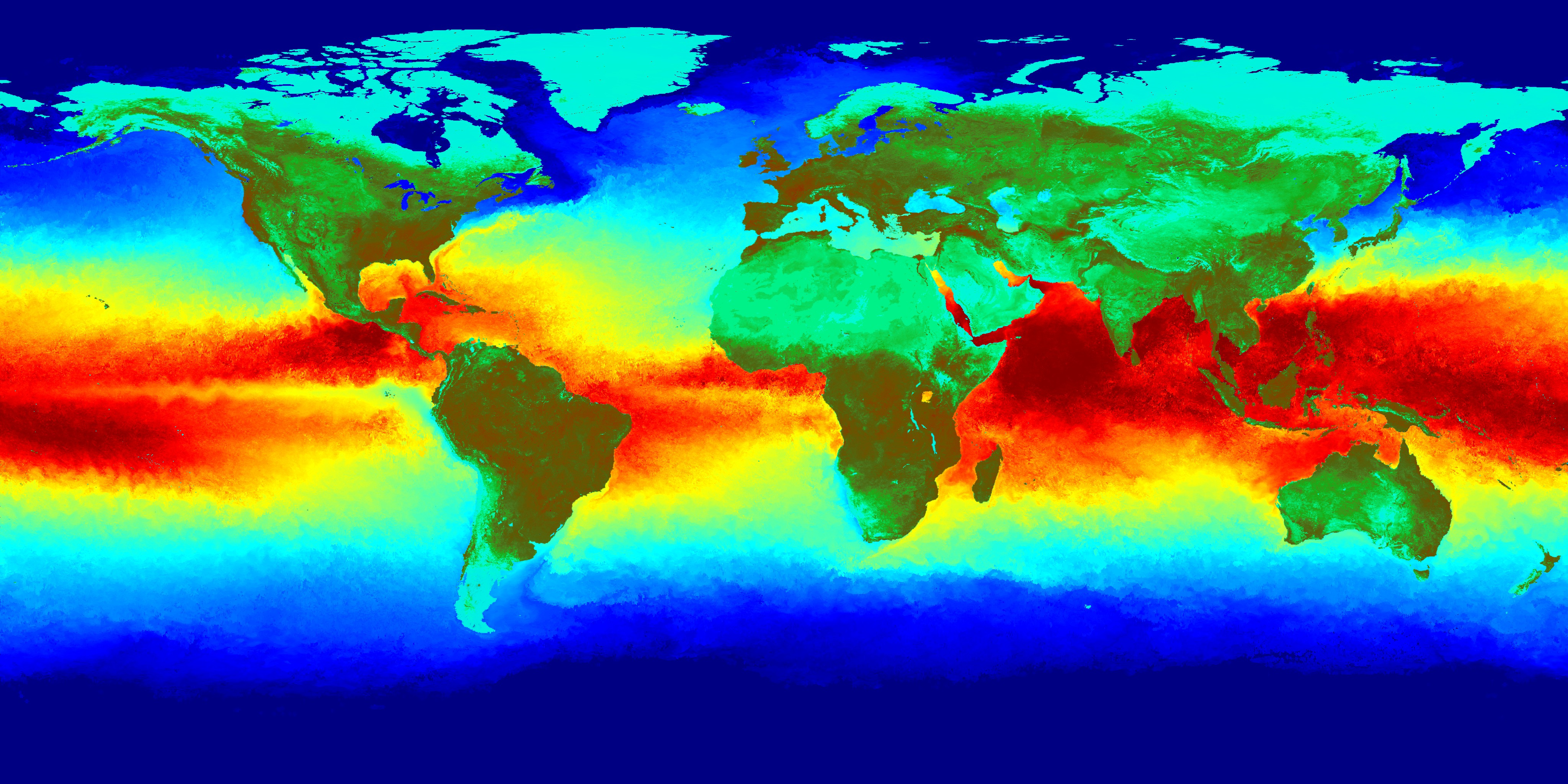

This vivid global map depicts sea surface temperature (SST) aboard Earth’s oceans, using satellite data to translate thermal variations into visible color cues. Produced by NASA’s Scientific Visualization Studio, the map integrates ocean temperature with land vegetation to deliver a full picture of planetary surface heat distribution.
Here, warm reds and oranges signal tropical seas—home to powerful currents like the Gulf Stream—which moderate climate and power global energy transport. Green to yellow tones depict mid-latitude waters, while blue hues represent cold polar or upwelling zones along coasts. Sea surface temperature is vital as it influences weather patterns, evaporation rates, and marine biodiversity. Warmer SST leads to increased evaporation and atmospheric moisture, fueling storms; cooler waters support nutrient-rich upwelling zones essential for ecosystems.
Data for this visualization comes from instruments such as AVHRR aboard NOAA satellites and MODIS aboard NASA’s Terra/Aqua platforms, providing ~1 km resolution and global coverage twice daily.
Scientists use SST maps to detect climate trends, monitoring long-term warming, marine heatwaves, and El Niño/La Niña cycles. For example, anomalous warm zones in recent years have been tied to coral bleaching events, shifts in fish migrations, and intensified tropical storms. Such patterns are tracked through sensors on NOAA and NASA satellites, feeding into models and real-time monitoring.
Ocean warming also contributes to thermal expansion, one of the drivers of sea-level rise. Rising mean SST over decades affects global climate through feedback loops—warmer oceans absorb less atmospheric CO₂ and hold more energy, amplifying warming.
By translating raw thermal data into color gradients, this image makes complex ocean dynamics intuitive: from blazing equatorial zones to fractured polar edges, it frames how heat moves, affects weather, and signals changes in Earth’s climate system. It’s a snapshot and a baseline—both beautiful and scientifically indispensable.

Leave a Reply